Lecturer discusses role of mixed methods
The 26th Annual Edgar W. Couper Lecture
The surname “Couper” rings familiar at Binghamton University.
A local community leader and pioneer of New York public higher education, the late Edgar W. Couper chaired the “Committee of 100,” the body responsible for the University’s founding in 1950.
For more than a quarter century, the Edgar W. Couper Endowment Fund for Educational Excellence, created by friends and family, has provided Couper Fellowships annually to one or more students in Binghamton University’s doctoral program in Educational Theory and Practice. It also supports the Annual Edgar W. Couper Lecture.
Speakers for the lecture are selected by a vote of faculty and students in the Department of Teaching, Learning and Educational Leadership.
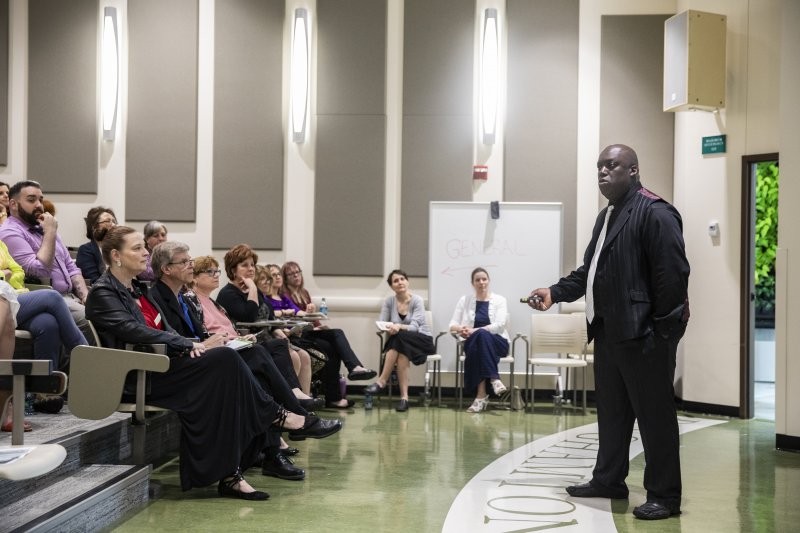
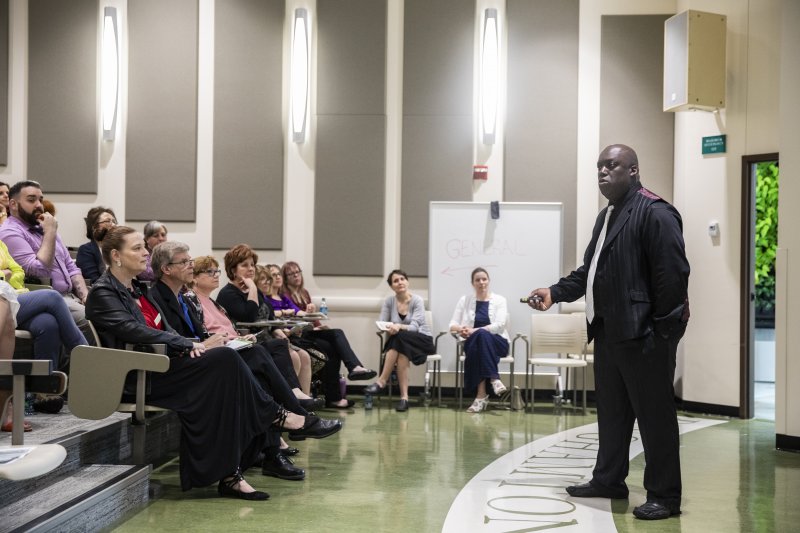
This year’s choice was Anthony Onwuegbuzie, a professor in the Department of Educational Leadership and Counseling at Sam Houston State University in Huntsville, Texas, and distinguished visiting professor at the University of Johannesburg.
Onwuegbuzie teaches doctoral-level courses in qualitative research, quantitative research and mixed research, as well as teacher education courses and educational psychology courses. He is also immediate past president of the Mixed Methods International Research Association.
Onwuegbuzie’s enthusiasm for mixed methods was obvious throughout his presentation, “The Role of Mixed Methods in Advancing Educational Research and Practice.”
Quantitative and qualitative learning, teaching and research, he said, have historically been separate and distinct. Often, that is still the case. Onwuegbuzie is looking to change that. “Mixed methods research,” he said, “incorporates both qualitative and quantitative data. The two, together, provide the how and the why, offering a more complete picture.”
Onwuegbuzie said mixed methods is not limited to use in academics or research. In fact, he said, the mixed methods approach is often included as part of everyday decision-making, it just isn’t identified by that name.
For example, not many people would purchase a car without looking at gas mileage and price, quantitative considerations. Qualitatively, however, for many people, color and appearance are key contributors to the same decision.
A mixed methods approach, according to Onwuegbuzie, ultimately provides more comprehensive information for decision-makers in any role.
Edgar Couper’s granddaughter, the Rev. Janet Couper Watrous, attended this year’s lecture with her husband, Robert C. Kochersberger, a professor at North Carolina State University.
Esther W. Couper, wife to Edgar and grandmother to Watrous, was a strong contributor to the local community in her own right as founder of the Family and Children’s Society.
Patty Gazda-Grace, adjunct professor and community liaison at the College of Community and Public Affairs, is a longtime friend of Watrous, as well as the Couper and Watrous families.
“Janet Watrous and I have been friends since elementary school,” Gazda-Grace said. “Both the Couper and Watrous families are deeply connected to this area, and their quietly generous dedication to giving and to serving others has benefited our community in countless ways.”
Jose Morales and Nicole LaBarre, the two 2017–18 Couper fellows, attended this year’s lecture. Both expressed their appreciation to the Couper family for the fellowship experience and the opportunities it provided.
LaBarre noted that the fellowship helped her move more quickly toward her goal of completing an EdD degree in Educational Theory, Research and Practice. “The qualitative study that I chose to conduct could not have been possible without the support of the Couper Fellowship. The fellowship allowed the time necessary for conducting observations and interviews during the school day, when I would have been teaching.”
Laura Bronstein, dean of the College of Community and Public Affairs at Binghamton University, and Candace Mulcahy, chair of the Department of Teaching, Learning and Educational Leadership, hosted the event.