Life as a biomedical engineering graduate student
Three biomedical engineering graduate students share their day-to-day experiences in the Binghamton University PhD program.
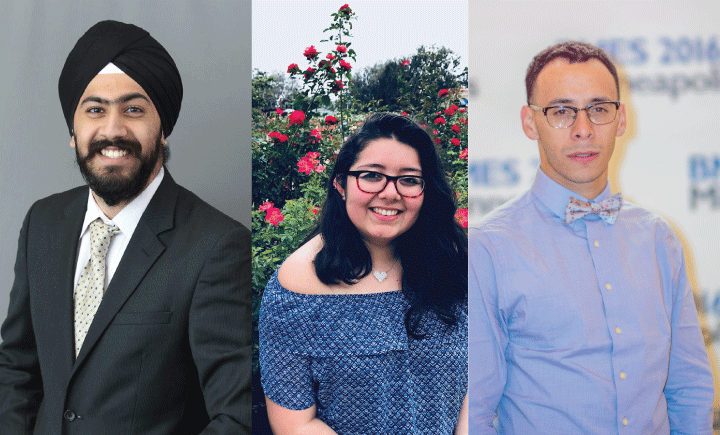
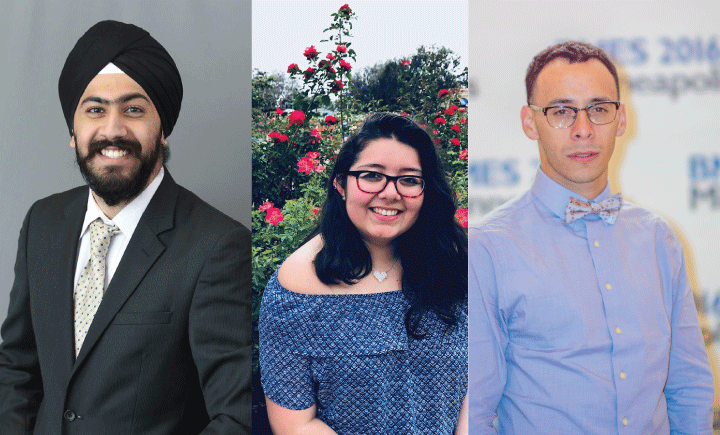
Being a biomedical engineering student isn’t easy. Three Binghamton University graduate students each describe their programs differently, based on where they are in their studies.
Melissa Mendoza, who is finishing her first year of graduate school, received her bachelor’s degree from the Rochester Institute of Technology last spring. She said her program at Binghamton involves many different tasks, one of which is being a teaching assistant (TA) for an 8:30 a.m. class. Besides attending class, she holds office hours and grades myriad assignments. At the time of this interview, she was in the middle of grading 65 exams.
Mendoza also works on a microfluidic model of calcific aortic valve disease, thereby modeling factors that lead to disease of a valve within the heart.
“Ideally, you have to make a physiologically relevant model,” she said, and she’s excited to begin doing research full time this summer.
“It’s why you come to grad school,” Mendoza said, “To work on something novel; something innovative.”
She hopes to receive her PhD in 2022, if not before. She would like to work in research and development after she graduates.
Mendoza is a first-generation college student and said it can be very difficult to explain to her parents what she does at graduate school.
“Sometimes I really have to talk to them like they’re first-graders, for them to appreciate it,” Mendoza said.
Jonathan Bramsen, who earned his bachelor’s degree in electrical engineering from Clarkson University, says he enjoys the spontaneity of his schedule and always has work to do.
“No two weeks are really ever the same for me,” he said.
A week typically involves a meeting with his advisor, his office hours and classes as a TA, and a group lab meeting. He also has tutored high school students.
Another important part of graduate school is publishing.
“You’re there to contribute to the current pool of knowledge,” Bramsen said, “which can be manifested through scientific publications.”
“In addition to all that, you’re going to have an existential crisis or two,” Bramsen said. “Like, why am I doing all this?”
He said graduate school is much more independent than undergraduate. At any given time, he has a mountain of things to do, but not hard deadlines. What to do and when is up to him. And while there is little time outside of graduate school for his personal life, he’s learned to organize time effectively.
“I always make time for fun,” said Bramsen, who is in his fifth year of graduate school and plans to earn his PhD in another one to two years.
Jaspreet Singh, MS ‘17, often wakes up before 4:30 a.m. in order to catch the 5:30 a.m. bus to Binghamton’s main campus before walking to his office in the Innovative Technologies Complex (ITC). He is a TA for lab classes three days a week, has weekly meetings to discuss lab results and keeps up on current research in his field.
Singh, who came to Binghamton from India with a bachelor’s degree, is pursuing his PhD. He says he primarily immerses himself in his own research, which focuses on photodynamic cancer therapy. That research keeps him constantly busy, he says, adding that the only slow times are when he is waiting for his research materials to arrive from the lab.
“At times, the weeks are so busy that I spend 70 or 80 hours working,” Singh said. “Sometimes I don’t even get time on weekends.”
Singh agreed that graduate school is very different from undergraduate studies. He has a primary advisor with whom he discusses his plans, but does his own studies and plans his own experiments.
“You learn everything by yourself,” Singh said.
That includes calling companies to order the materials he needs, helping his lab mates when necessary and training undergraduate students.
Singh said he is going back home briefly this summer, in order to take some much-needed time off. He plans to graduate in no more than three years and to work in the United States.
Working with his advisor, Assistant Professor Amber Doiron, is a “dream come true,” he says, and is happy to begin seeing the results of his hard work in the lab.
“I ultimately don’t want to sit in front of a computer in an office,” Singh said. “I would love to work in a lab.”