Faculty in Harpur College earn national honors
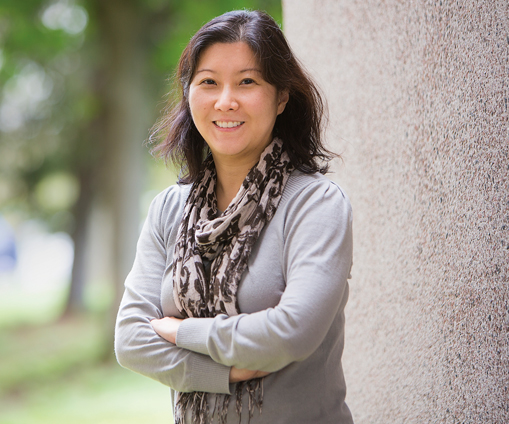
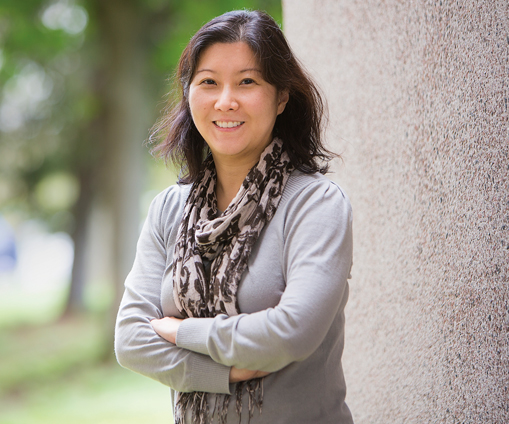
Harpur College faculty members continue to receive awards ranging from National Endowment for the Humanities and National Science Foundation grants to Fulbright fellowships. These honors allow faculty to enhance their scholarship while conducting research around the world. Here are four award-winning faculty members and their stories.
Sonja Kim, Asian and Asian American Studies
Sonja Kim is going back to 1940s South Korea to ask big questions in a local context. Kim, an associate professor of Asian and Asian American Studies who specializes in Korean history, was awarded a Fulbright to spend 10 months in South Korea, where she will be affiliated with Seoul National University. Her research project centers around the T’omangmin people, a social classification for rural migrants in urban areas under the Japanese colonial era.
Kim’s interest in this social category of persons emerged as a product of chance. “It was kind of serendipity,” Kim says. “I found this 1940s publication of a medical student report. It was pretty thick. And I just thought: Why are they spending their time every weekend going to urban squatters, knocking on doors, asking them: Can we measure you? Can we ask you how much money you make? Can we ask you why you’re here?” For Kim, the study sparked larger questions about the role of government and medicine in the classification of people.
“It was just interesting to see where this project emerged, why it emerged, why were medical students involved in this,” Kim says. “But that is part of a much larger picture of 1) medical research, and 2) where medicine, science and technology are in colonial governance.” The term T’omangmin came into use in the 1920s and vanished after World War II.
Kim sees this as an example of the way demographics rapidly change in times of economic dislocation, which is still relevant today. “When we look at the way medical and government practices are and the way South Koreans also think about nation and race and self…there are going to be intersections and connections with the past that inform the present and then what happened in between,” Kim says.
“The U.S. is still heavily involved on the peninsula. We see South Korea as a site of a lot of global migration, and so in that sense I feel it is an important piece to look at.”
While in South Korea, Kim plans to delve into colonial archival sources, medical students’ journals and U.S. military government records to find context for the T’omangmin term. “The bigger picture is: How do you manage populations? How do you govern population and where does medicine and science fit into that? And then in turn, what are the implications for individuals who live there?” Kim says. “I think this is a general question for all of society that we even have today. It’s a big question in general.”
Kim also received a Fulbright as a graduate student, which allowed her to travel to South Korea to write her dissertation. She says she tries to go back every couple of years to use the archives and stay in contact with other researchers, but she wouldn’t consider a permanent relocation. “My home is here now. Students always ask me, ‘are you going home over break?’ I tell them, ‘My home is here.’ This is my home,” Kim says. “I told my students I’m coming back. I’m packing a few suitcases, but that’s about it.”
Wendy L. Wall, History
The Immigration and Nationality Act of 1965, like the Civil Rights Act and the War on Poverty, was part of Lyndon Johnson’s Great Society. Its origins are often elided or it’s simply considered an inevitable byproduct of his sweeping programs. But radical overhaul of the United States’ immigration policies — arguably the central debate in 2016’s presidential race — was neither inevitable nor an afterthought.
Wendy L. Wall says the 20-year push to reform the policy was the most important social movement in U.S. history you’ve never heard of. Wall, a historian who joined Binghamton’s faculty in 2010, received a highly competitive fellowship from the National Endowment for the Humanities to research how Cold War politics and efforts by ethnic, religious, civic, patriotic and labor groups to spur, shape or halt immigration reform transformed vast swaths of American life.
“When President Lyndon Johnson signed the act into law under the shadow of the Statue of Liberty, he downplayed its importance,” she writes in her proposal to the NEH. “‘[This] is not a revolutionary bill,’ he declared. ‘It does not affect the lives of millions. It will not reshape the structure of our daily lives, or really add importantly to either our wealth or our power.’ Few predictions have proven faultier.” The act did away with a system of national origin quotas in place since the 1920s that heavily favored immigrants from Northern and Western Europe. It replaced this with a system that favored the reunification of families and, to a lesser extent, skills.
This opened the door not only to Southern and Eastern Europeans, but also to millions of newcomers from Africa, Asia and the Middle East. It also put a ceiling for the first time on immigration from the Western Hemisphere, greatly contributing to illegal immigration from Latin America. “Neither popular writers nor historians of postwar America pay much attention to how we got the Immigration Act of 1965,” she says.
“It’s often portrayed simply as the product of a great liberal moment — we got the civil rights and the voting rights, and the Immigration Act got thrown in there too…I’m interested in both how we got the act, and why it took the shape it did.”
Immigration reform then was just as contentious an issue as it is today, she says. The Cold War was raging, and proponents of reform argued that failure to make changes in the policy was offending the newly decolonized people of Asia and Africa that the United States wanted to keep out of the Soviet Union’s orbit. Ethnic groups such as Greeks and Italians used Cold War rhetoric too, arguing that population pressure in their home countries encouraged social unrest and provided a fertile ground for communism. “There were also people on the other side of the equation, people who didn’t want to open the borders. They said, ‘Ah, well, if we open the borders, then we’ll have all these spies coming in,’” Wall says. It’s a familiar argument in 2016, with some politicians seeking to limit or ban immigration from Muslim countries because of the fear of terrorism.
Jeffrey Mativetsky, Physics
Research that may lead to inexpensive clean energy has won a Binghamton University physicist support from the National Science Foundation’s prestigious Faculty Early Career Development (CAREER) Program.
Jeffrey Mativetsky, assistant professor of physics, will receive more than $525,000 over five years for the work, which began in July 2016. His research centers on the relationships between nanoscale structure and electrical function in organic materials for solar cells and electronics. “One of the main things holding back the use of solar cells is the cost associated with them,” he says. “Organic solar cells provide a pathway toward low-cost, clean energy.
Organic materials open new possibilities because they are lightweight and mechanically flexible, making it possible, for example, to integrate them into curved surfaces.” Organic materials can also be processed near room temperature, Mativetsky notes, which is another factor that makes them attractive for flexible electronics. Mativetsky, who blends principles of physics, chemistry and engineering in his research, says he’s motivated by a desire to work on systems that are relevant to society. He’d like to see solar cells integrated into disaster relief tents, for instance.
In his laboratory, students work at a 16-footlong, nitrogen-filled glovebox as vacuum pumps vibrate and several solutions swirl in vials on a countertop stir plate. The glovebox maintains an environment a bit above atmospheric pressure, with less than 1 part per million of oxygen and humidity. Mativetsky has two atomic force microscopes, and his team uses additional equipment at Binghamton’s Analytical and Diagnostics Laboratory.
Mativetsky received seed funding through Binghamton’s Transdisciplinary Areas of Excellence program, which encourages work across multiple fields of inquiry and counts smart energy as a special area of interest. The preliminary results obtained by Mativetsky with fellow Binghamton physicist Joon Jang and chemist Alistair Lees provided a foundation for the NSF proposal. “We made it to the start line,” Mativetsky says. “Now we can do the research we set out to do.”
The core of that research will focus on moleculebased nanowires, filaments that are far, far thinner than a human hair and which often have special properties not found in materials at larger scales. Mativetsky is especially interested in how electric charge moves through these nanomaterials. “We’re investigating the fundamentals of how nanoscale structuring affects charge photogeneration and charge transport,” he says.
Mativetsky believes these nanowires could improve organic solar cell performance and enable the manufacture of flexible solar cells that are thinner than a sheet of paper. Such solar cells might be less efficient than traditional ones made with silicon, he says, but they could produce more energy per gram of material. Mativetsky, a native of Montreal who earned a doctorate in physics from McGill University in 2006, held post-doctoral fellowships at the Supramolecular Science and Engineering Institute in France and at Princeton University before joining Binghamton’s faculty in 2012.
He is already the recipient of another $300,000 NSF grant, which supports research into graphene oxide with potential applications in flexible electronics, energy storage, sensors, composite materials and biomedical engineering.
Tina Chronopoulos, Classics and Medieval Studies
Tina Chronopoulos is taking medieval literature beyond translation and into the world of interpretation. “Scholars in medieval English and medieval French tend to be a lot more on top of questions like sex, gender and oppression — things that really drive a lot of modern research,” says Chronopoulos, an assistant professor of classics and medieval studies.
“But the field of medieval Latin tends to be conservative, not necessarily because the people are conservative but because of the work that we do. The work is very different. It’s often concerned with actually trying to find the text. It’s a lot more philological.”
This year Chronopoulos is one of five winners of the Solmsen Fellowship, awarded by the Institute for Research in the Humanities at the University of Wisconsin-Madison. The fellowship provides a stipend of $55,000 and will allow her a year’s break from teaching to continue researching and writing a book about the unexplored aspects of sexuality in medieval Latin. “My hope with this book is to bring some of the concerns that people have in medieval English or medieval French, and bring them to these kinds of texts,” Chronopoulos says.
The book will be titled Voices of Ganymede: Latin Homoerotics from Medieval Europe. “Ganymede is this figure from classical Greek mythology. He was abducted by Jupiter because he was incredibly beautiful and he was made Jupiter’s cupbearer…and then at night he was…Jupiter’s boy toy, I guess you could say,” Chronopoulos says.
“In the medieval period if you call someone a Ganymede, you’re saying that this person, a man, is probably sleeping with other men.” Chronopoulos says her interest in the subject was sparked by the author John Boswell when she read his 1980 book, Christianity, Social Tolerance and Homosexuality. “He was the first person to really examine sex and sexuality in the medieval period,” Chronopoulos says. “He published these texts but no one’s looked at them.”
Chronopoulos decided to read Boswell’s texts with her graduate class and was encouraged by her students’ interest in the topic. Boswell’s book debunks the conception that homosexuality was either nonexistent or condemned in premodern Europe. “We tend to think of the medieval period as this time when the official rule is: You should only be having sex if you’re a man and a woman, if you’re married and if you’re going to have children,” Chronopoulos says. “And you should only be having sex on certain days of the month, right? Because if it’s a holiday, or a saints day, if it’s this day, or that day, you shouldn’t be having sex.
Which means that basically there are not that many days left for having sex.” Chronopoulos laughs and adds, “That was the official view, and then there’s what’s really going on. Men are having sex with men, and women are having sex with women, and I’m interested to find out how that is portrayed and why people might be portraying it.”