Binghamton hosts athletics summit
Panels examine issues such as mental health, coaching communication
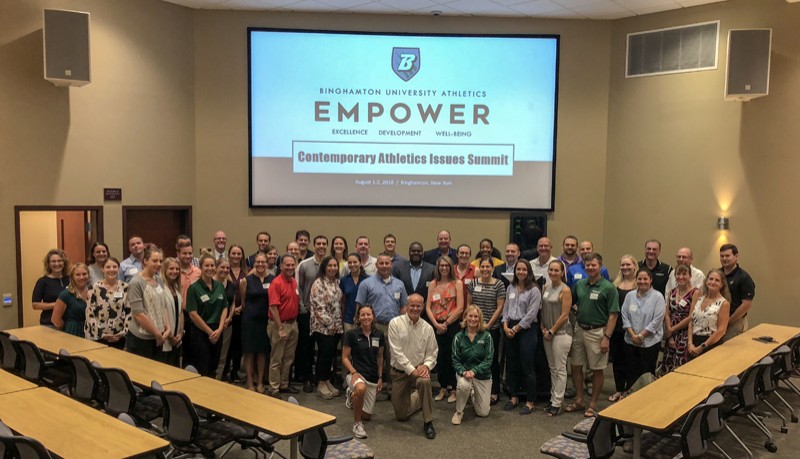
As its fall sports teams start arriving back on campus for preseason this week, Binghamton has already begun the academic year on a strong note.
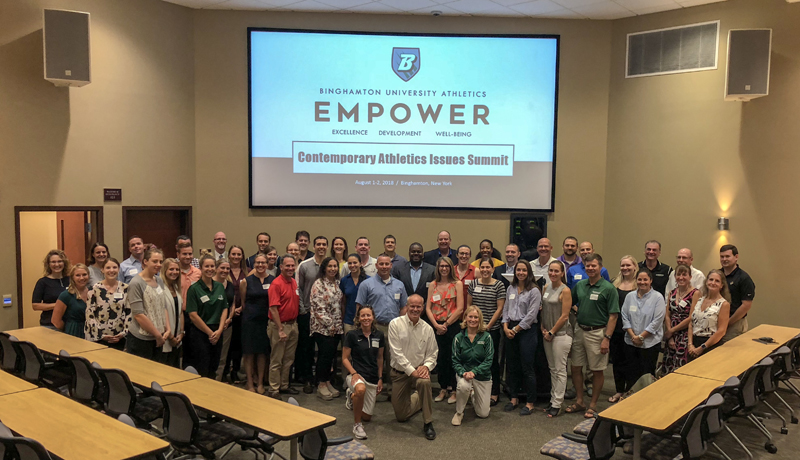
The athletic department hosted a two-day Contemporary Athletics Issues Summit at the University’s Center of Excellence in the Innovative Technology Complex on Aug. 1-2. The aim of the summit was to enhance communication and collaboration within and across athletic departments. The main components addressed were mental health, substance use, evolution of coach communication, and understanding emerging adult needs.
Student-athletes and staff from 10 other intercollegiate programs joined Binghamton for the inaugural event. Senior women’s basketball player Kennedi Thompson and redshirt senior wrestling Joe Russ represented Binghamton’s student-athletes on one of the panels. Head men’s soccer coach Paul Marco was one of the speakers as were several other Binghamton athletic administrators.
Other speakers at the summit included Binghamton University President Harvey Stenger, who delivered the keynote address, and America East Commissioner Amy Huchthausen. Administrators from other schools such as Penn State, Vermont, Albany and Hamilton also were among the speakers and panelists.
“As a university president, you learn that the good athletics brings to a university is far better than the bad it could bring,” Stenger said. “Coaches have the ability to help guide our students down a positive emotional intelligence response path by how you react to their mistakes.”
“I was honored to participate in the inaugural Empower Summit exploring student-athlete issues hosted by Binghamton University,” Huchthausen said. “It was a great opportunity to meet coaches and administrators from a variety of NCAA schools across all three divisions. These are universal issues that require everyone’s ideas.”
Thompson and Russ were on the panel entitled “Navigating the Needed of Student-Athletes.”
“Our lives are jam packed as student-athletes and sometimes it does get stressful,” Thompson said. “So, knowing my coach wants to check in with me and genuinely cares about how I am doing and what I have going on is a comforting feeling. It really shows they care about my well-being as a person and not just as one of their student-athletes.”
Miriam Merrill, the associate director of athletics and the senior women’s administrator at Hamilton College, used her speaking time to give a charge to those in attendance.
“Create an environment that welcomes feedback from your student-athletes and coaches,” she said. “This doesn’t mean just asking for feedback, but being open to the feedback you get and eliciting that feedback in a number of different ways.”
Michael Cross, the athletic director for new business development at Penn State, took some of his time at the podium to put the summit in perspective.
“We talk about all of the factors impacting our student-athlete’s world today, but we often don’t discuss the aspect of being a part of something bigger than yourself having an impact,” he said. “That aspect of their life is incredibly powerful.”
The Contemporary Athletics Issues Summit was created under the umbrella of Binghamton’s “Empower” initiative, which aims to identify and adopt research-based best practices to optimize student-athlete growth and engagement.