The Watson School welcomes eight new faculty members
Meet the talented, new faculty coming to Binghamton University's Watson School from universities in China, Iran, Texas and elsewhere.
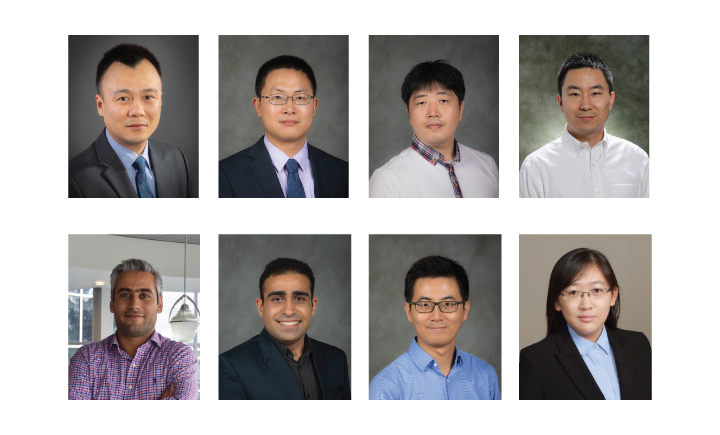
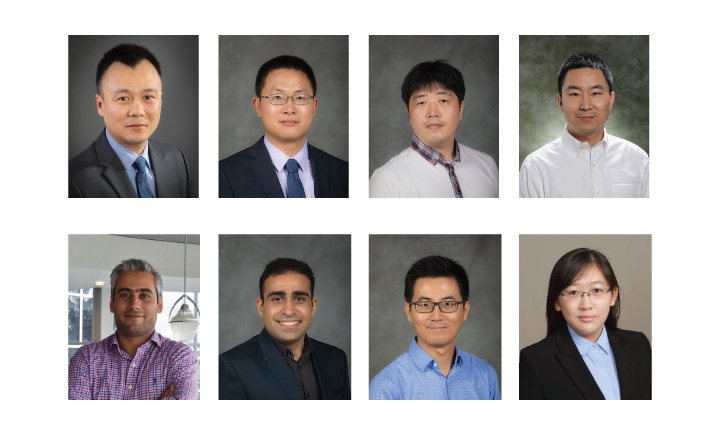
Yuan Wan, assistant professor of biomedical engineering
Yuan Wan received his PhD in biomedical engineering from the University of Texas at Arlington in 2012. In the same year, he immigrated to down under and worked as a research associate at the University of South Australia. He described it as a “three-year joyful vacation.” Later, he spent three years completing his comparatively grievous postdoc training at the Pennsylvania State University. His decade-long research has been focusing on in vitro diagnostics of cancer and drug delivery for targeted therapeutics. He develops biomimetic micro/nano-technologies to help solve problems in life science and translates these technologies into clinical use. His ongoing research interests lie at the cross-section of biomedical engineering and clinical medicine.
Xi Peng, assistant professor of computer science
Xi Peng obtained his PhD degree in computer science from Rutgers University in 2018, his MS degree from the Chinese Academy of Sciences in 2011, and his BS degree from Beihang University in 2008. He was a research intern at NEC Labs America in 2016 and the IBM T.J. Watson Research Center in 2015. He was also a full-time research engineer at Baidu from 2011-2012. His research interests include deep learning, machine learning and intelligent data analytics such as vision/language understanding. His research has resulted in a series of publications in top-ranked journals, conferences and patents. In 2016, his work won the best student paper runner-up in the European Conference on Computer Vision.
Seunghee Shin, assistant professor of computer science
Seunghee Shin received his PhD from the Electrical and Computer Engineering Department at North Carolina State University in 2018. He also has an MS degree in computer science from Northeastern University, where he studied computer networks. He completed his BS degree in computer engineering at Myongji University in South Korea. His primary research interests lie in computer architecture and systems. Specifically, he has high interest in investigating the impact of emerging technologies on memory systems. His studies have turned out publications at renowned venues such as ISCA and MICRO. He also has more than five years of professional system software development experiences in multiple companies where he engaged in mobile and storage-system development projects.
Shiqi Zhang, assistant professor of computer science
Shiqi Zhang received his PhD in computer science from Texas Tech University in 2013. From 2014 to 2016, he was a postdoctoral fellow at the University of Texas at Austin. His research lies in the intersection of artificial intelligence and robotics. He is particularly interested in developing algorithms that integrate computational modalities of planning, reasoning and learning for service robots that work in human-inhabited, everyday environments.
Mir Jalil Razavi, assistant professor of mechanical engineering
Mir Jalil Razavi received his PhD in mechanical engineering from the University of Georgia in 2018. He received his MS and BS degrees in solid mechanics from the University of Tabriz in Iran in 2009 and 2006, respectively. His current research interests include solid mechanics, design and mechanics of soft/bio materials, especially brain mechanics.
Ali Khoshkhoo, assistant professor of systems science and industrial engineering
Ali Khoshkhoo earned his PhD from the Department of Industrial and Systems Engineering at Auburn University. He received his MSc degree from the University of Missouri-Columbia in industrial and manufacturing systems engineering and BSc from the University of Tehran in Iran in industrial and systems engineering. His ongoing research interests lie at the cross-section of 3D printing or additive manufacturing (AM) and surface metrology for a variety of applications such as biomedical, biological and tribology. His laboratory will take cues from development to identify surface characteristics that affect physical surface properties for related applications. He is also interested in design for additive manufacturing guidelines for a variety of AM technologies.
Fuda Ning, assistant professor of systems science and industrial engineering
Fuda Ning received his PhD degree in the Department of Industrial, Manufacturing and Systems Engineering at Texas Tech University in 2018. He obtained his bachelor’s and master’s degrees in mechanical engineering from Dalian University of Technology in China in 2011 and 2014, respectively. His current research interests include laser-based and extrusion-based additive manufacturing as well as non-traditional machining processes. He has authored and co-authored more than 40 publications that have been cited over 500 times. Fuda is an invited reviewer for 20 journals and he is also a member of the American Society of Mechanical Engineers (ASME) and the Society of Manufacturing Engineers (SME.)
Bing Si, assistant professor of systems science and industrial engineering
Bing Si received her PhD in industrial engineering (IE) from Arizona State University in 2018. She received her BS in mathematics from the University of Science and Technology of China and an MS in IE from ASU in 2012 and 2014, respectively. Si’s research focuses on developing data analytics and statistical learning methodologies to support healthcare decisions in diagnosis, prognosis, treatment and care delivery. Her research has been applied to a number of disease domains including Alzheimer’s disease, migraines and traumatic brain injury. She has experience collaborating with medical professionals in the Mayo Clinic, the ASU School of Nursing and Health Innovation and the medical school at the Technical University of Munich.