Students lead the way
Ambassadors promote unique new school
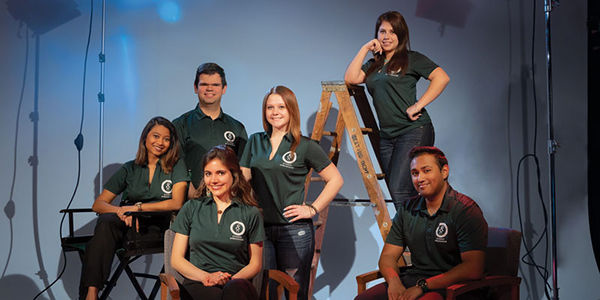
Caitlyn Brown knew she wanted to be part of the School of Pharmacy and Pharmaceutical Sciences when she first visited Binghamton University.
“My world was flipped upside down,” says Brown, who attended St. John Fisher in Rochester, N.Y., as an undergraduate. “I thought: ‘This is where I am supposed to be.’ I knew it from talking to faculty during my interviews. I knew Binghamton was a unique place.”
Brown also knew that she wanted to share her excitement about the new pharmacy school with prospective students.
“To be among the first faces that students see is a great role to take on,” she says.
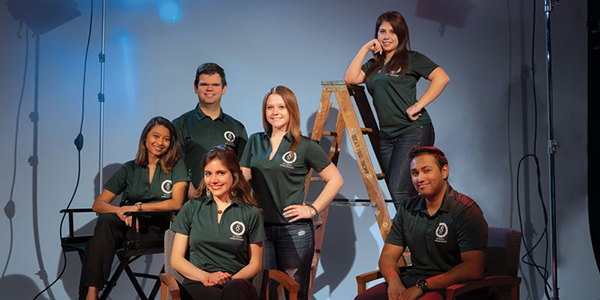
Brown, from Norwich, N.Y., is now one of six students from the inaugural School of Pharmacy and Pharmaceutical Sciences class serving as student ambassadors. The group leads campus tours, attends open houses and undergraduate panels, and represents the school at on- and off-campus events.
Perhaps most importantly, the ambassadors make prospective students feel comfortable and answer their questions during the school’s interview days, says Rachael Perry, director of admissions for the pharmacy school.
“We thought having students talk to [potential] students, sharing their stories and what it’s like to be here, is a stronger voice than me saying: ‘This is a great place to be,’” Perry says. “I haven’t taken the classes. I’m not a pharmacist.”
Applications were sent to the inaugural-class members, who were asked to write an essay about why they wanted to be an ambassador, Perry says.
Besides Brown, the students selected for ambassador roles were:
- Maggie Filja from Hasbrouck Heights, N.J., and a graduate of Sacred Heart University in Connecticut
- Joseph Glowienka from Endwell, N.Y., and a Binghamton University graduate with a bachelor’s degree in biochemistry
- Tahsin Imam from Queens, N.Y., and a graduate of Stony Brook University
- Keri Mastro from Endicott, N.Y., and a Binghamton University graduate with a bachelor’s degree in biological sciences
- Raisa Nishat from Queens, N.Y., and a graduate of Stony Brook University
The students say they sought the ambassador roles because they wanted to give back to the school and to the University.
“It’s our inaugural year, and it’s important to get the program off the ground,” Glowienka says. “We want to make sure future incoming classes are as good as ours. We want the school to flourish and grow for years to come.”
“I chose Binghamton because I wanted to take on a leadership role and help make the (pharmacy) school what it will be over time,” Filja says. “It will be great to come back someday and see how it has developed.”
Besides assisting fellow students, the ambassadors are also developing communication skills, Perry says. This is important for future pharmacists, who will interact with a variety of customers.
“The role provides student ambassadors with the opportunity to develop public-speaking and leadership skills,” she says. “It’s a professional-development position.”
Students find much to promote
The ambassadors are quick to tout the quality of the faculty when asked about the school’s curriculum by prospective students.
“The faculty goes above and beyond to make sure we have every resource needed to be successful,” Brown says. “Every single person is cared about here.”
“The class size is perfect,” Filja says. “Having your teacher know your name is important. That helps me be the best student I can be because I want to be the best pharmacist I can be in the real world.”
Glowienka recalls faculty members carving out extra hours for review sessions to help students who were struggling in a course last fall.
“We have an amazing faculty who have done cutting-edge research into muscular dystrophy and cancer,” he says. “Binghamton University already has a good reputation in the sciences with the Watson School of Engineering and other science-related degrees. There is a track record of success here that I know will carry over to the pharmacy school.”
“It’s like a family,” Brown adds. “Everyone is together all of the time and you know each other’s strengths and weaknesses. You are never alone — and the faculty is on this journey with you. To have that closeness is something special.”
Another special part of the school that the ambassadors got to discuss with prospective students is the $60 million, four-story, 84,000-square-foot facility that is housing the pharmacy school in Johnson City, N.Y. The building, located on an eight-acre Health Sciences Campus that will also include the Decker School of Nursing, opened in August.
The new building was featured during interview days, Perry says, through a presentation showcasing the floor plan.
“Students are excited about having a state-of-the-art facility with exceptional lab spaces,” she says. “But there is a concern about being isolated and having access to everything they need to be successful if they’re not on the main campus.”
That’s why, when the ambassadors took prospective students on a tour of the main campus last year, they highlighted its various resources and transportation systems, while emphasizing that Binghamton already has a successful branch at the University Downtown Center.
“It’s all-around support,” Glowienka says.
Being pioneers in a school of pharmaceutical trailblazers — now in their new building — is something that the ambassadors do not take lightly.
“Being a student ambassador gives me the chance to share my own experiences in the program with my future colleagues,” Imam says. “It also gives me the chance to meet future colleagues from different areas of the country and learn about their hobbies, experiences, culture and reasons for choosing pharmacy.”
“It’s fun, but also a big responsibility to help shape the school,” Brown says. “It’s exciting and terrifying at the same time!”
“A good terrifying!” Glowienka says.
“A very good terrifying!” Brown adds.
Perry hopes to have the ambassadors serve for three years (their fourth year is spent off campus doing advanced pharmacy-practice rotations). The current group will also help select future ambassadors.
“They know what it takes to be an ambassador,” she says. “They can see the qualities in other people that would make a successful student ambassador.”
Filja advises students considering pharmacy schools to determine where they feel the most comfortable.
“You should go where you feel that spark,” she says. “I felt it when I visited here. Every school is going to be hard, so it’s about what you put into it. That will make the difference.”
For Glowienka, the School of Pharmacy and Pharmaceutical Sciences offers a research-focused program that has already been deemed a priority by state and University leaders.
“New York state and Binghamton University are committed to this program,” he says. “That’s a confidence-builder for students. They want us to succeed — and we will succeed.”