Making a racket: engineering student upsets at professional tennis event
In the lab or on the tennis court, Ludovico Cestarollo ’18 is working hard, seeing results and getting support from those around him.
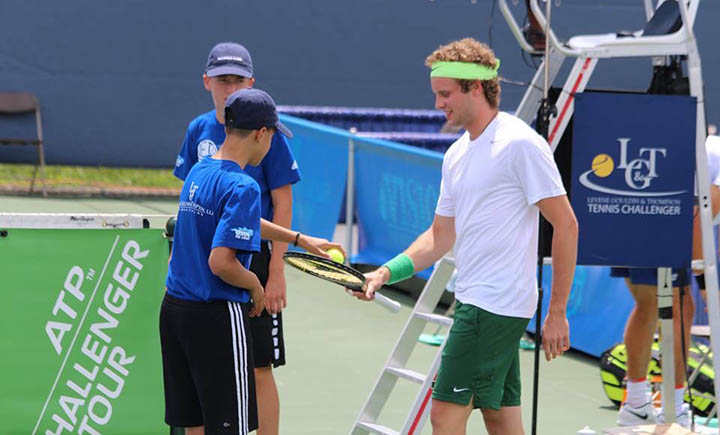
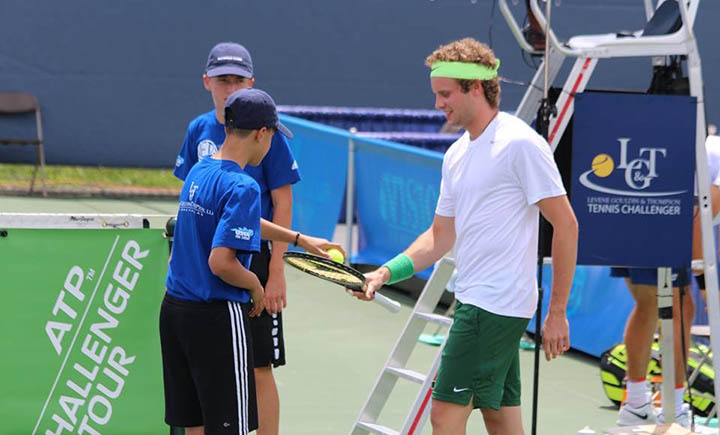
When you can’t find industrial and systems engineering student Ludovico Cestarollo ’18 working on flexible electronics in Professor Mark Poliks’ lab, look for him on the tennis court. This past summer, that passion for tennis shocked onlookers at the Levene Gouldin & Thompson Tennis Challenger (LG&T) when he beat a doubles team ranked in the top 200 in the world with his doubles partner Karl Poling from Princeton University. The next day, he was right back to work in the lab.
Cestarollo is originally from Rovereto, Italy, a town in the northeast corner of Italy near the Austrian border. He first visited the U.S. toward the end of high school when his aunt brought him with her on a visit. He fell in love with the country and knew he wanted to pursue his education in the U.S. His background in tennis helped make that dream possible.
“I pretty much started playing tennis as soon as I could stand up by myself. My dad is a tennis coach and my mom is a physical therapist. I joked that if I’m still in one piece, it’s because of my mom, who patched me up all the time when I was still living at home in Italy,” said Cestarollo.
Binghamton University gave Cestarollo the chance to both play tennis and get a degree in a field he finds fascinating.
“I chose to study industrial and systems engineering because it’s a broader engineering field. It can take you into multiple avenues depending on what you like,” he said.
Cestarollo completed his bachelor’s degree in 2018 and is currently working on his master’s degree. He has been working in the Center for Advanced Microelectronics Manufacturing (CAMM) with Poliks from the Systems Science and Industrial Engineering Department.
“My work focuses on flexible electronics. We develop electronic applications that are flexible compared to the traditional, rigid ones. For example, we are collaborating on the fabrication of a flexible patch that can detect sweat and hydration levels,” Cestarollo said. “The team works with different additive manufacturing techniques for creating those flexible electronics. I mainly focus on precision dispensing, which is a relatively simple technique that has not been used much for these kind of applications, making what we are studying fairly new.”
While innovating in the lab, Cestarollo was also waking up early to get in his workouts and spending as much time as he could on the tennis court. For nearly all of the spring 2018 semester, an injury kept him from playing. When the LG&T Challenger came up that summer, it had been months since his last match.
“I competed in the singles tournament for the first round. It was a relatively close match but I didn’t win. Then, the tournament director decided to give me another chance as a wildcard player for the doubles tournament,” he explained. “I was paired with a player from Princeton and we were set up against the fourth strongest team in the tournament.”
“My friends knew the team we were going up against. The pair was from India and ranked in the top 200 in the world…You never want to go into a match thinking you’re going to lose, but I was at least realistic. The idea of winning that match did not even cross my mind.”
Cestarollo and Poling lost their first set and decided to keep playing with a focus on trying to enjoy the fact that they were up against such strong opponents in such an important tournament.
Then they won the second set.
“We started to feel really good about our chances. We were ahead during the whole third set super tie-break and got really close to winning twice.”
Finally, one amazing shot ended the match in Cestarollo and Poling’s favor.
“It was by far the best feeling I’ve ever had on a tennis court. It was so unexpected, but definitely gave me a boost of confidence going into this next year,” said Cestarollo. “This will be my last year playing tennis, so it was a good way to sort of start wrapping up my tennis career.”
Although he did not make it past the next round, the wildcard match was one he will never forget. Cestarollo said he couldn’t have done it without the amazing support system around him.
“I have to thank my tennis coaches Nicholas Zieziula and Charlie Ellis, my strength and conditioning coach William Bacon and my trainer Christopher Downey. Also, thanks to John Hartrick [the Binghamton University associate athletic director for communications] who followed me during the entire tournament and came to my matches, and Laurie Bowen, the director of the LG&T Challenger who gave me the opportunity to compete. Thanks to my parents, Elena and Alberto, for their continuous support throughout this experience in the U.S. and thanks to my entire family, starting from my grandparents. Of course, thanks to Dr. Poliks for his support on the academic side and how he has been helping me grow professionally. Last but not least, thanks to the entire Binghamton University Athletics Department, which is amazing. I will never forget all the help they have given me throughout this experience.”