Experiential education office relies on preceptors
Preceptors key to shaping the future of pharmacy practice
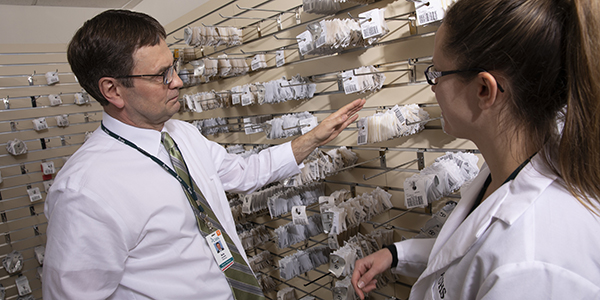
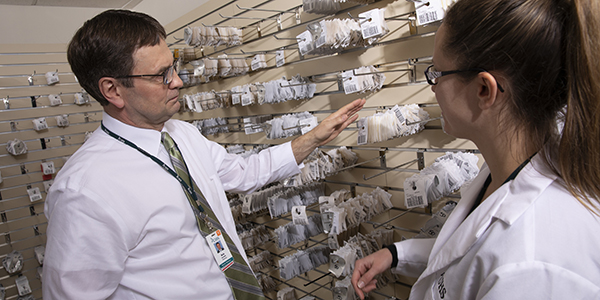
Angela Riley, executive director of experiential education and assistant dean, spends her time in the classroom with students – that is, when she’s not building relationships with hospitals and other pharmacy practice settings where those same students she is teaching will gain practical, vital experience as pharmacists.
The Office of Experiential Education relies on the preceptors at off-site locations to inspire and mentor School of Pharmacy and Pharmaceutical Sciences students – and the office can never have enough. “We’re in a crunch right now and need our colleagues in practice to join our team as preceptors for our second-year (P2) students,” Riley said.
Preceptors gain access to the University’s library; to help meet professional requirements, they are offered free, live and online continuing education, and they are also given a binghamton.edu email address. “This is great access to resources they might not otherwise have,” Riley said.
P2 students begin their institutional practice rotations in spring 2019, and though there are enough preceptors for this rotation, the School of Pharmacy is growing and Riley is looking to the future.
“Our preceptors have the ability to shape the future of pharmacy practice by serving as a one-on-one mentor to our future pharmacists,” she said. “It’s giving back to their own community.
Riley is quick to say that many have already volunteered to assist the school at many levels, including strategic planning and serving on the Dean’s and Experiential Education Advisory Councils, “but serving as a preceptor has long-lasting impact.”
Across the continuum all students must complete several clinical rotations. The school is preparing now for each cohort to complete experiences in the institutional setting – hospitals with acute care patients – in their second and fourth year.
“The early learners (P2s) are exposed to pharmacy operations from provider to patient and should understand everything that happens from the time an order is given from a provider to when the patient receives it. The students should be involved in every step of the Pharmacists’ Patient Care Process, to better understand the role of the pharmacist in practice,” Riley said.
“Typically, students begin to connect the dots in the institutional setting because they’ll be immersed in all levels of patient care.
“They’ll start investigating the drug questions more intensely because they remember the patient’s face at the hospital and how their decision may ultimately affect that patient overall,” she said.
Unlike the two-week community pharmacy rotations during their first summer, P2 students will spend a total of 80 hours over 10 weeks in the institutional setting rotation. In their fourth year, they will experience at least one module of 40-hour weeks for six weeks.
The Office of Experiential Education, which includes Jeannette Cardi, secretary, and Sara Spencer, IPPE coordinator, continues to build relationships with preceptors at all of the local hospitals as well as those in New York City and Long Island. Anyone interested in becoming a preceptor is welcome to contact the Office of Experiential Education at 607-777-5823 or OEE@binghamton.edu.