Harpur student spotlight: Lesia Hrycyna
Russian studies student puts language skills to use in and out of the classroom
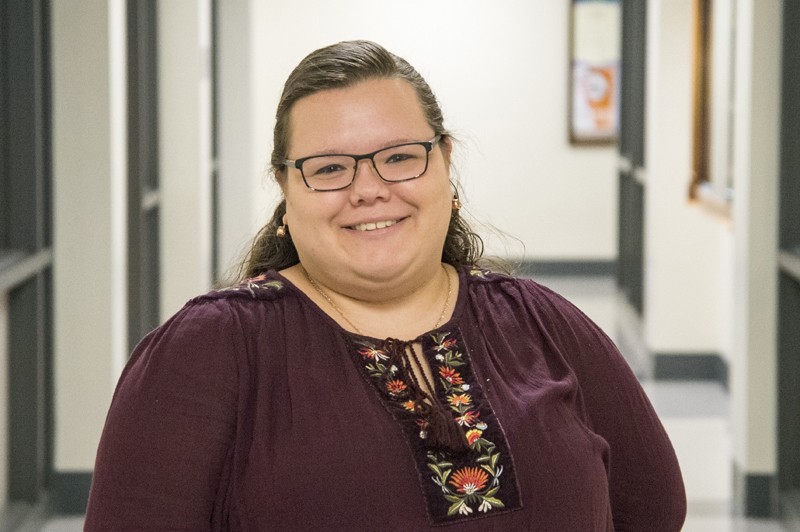
When a local woman wanted to shed light on her ancestry through old family letters written in Ukrainian, Binghamton University’s Russian studies program knew to ask Lesia Hrycyna for help.
“Russian studies does translation for the public community,” Hrycyna said. “So when this woman reached out to see if someone could translate some letters written in Ukrainian, they knew they had no one who could translate Ukrainian besides me.”
Hrycyna is a senior majoring in Russian studies at Binghamton University, but she was raised speaking Ukrainian at home in Rochester, N.Y.
While her professors typically encourage use of the Russian language instead of Ukrainian, the program was now calling upon her native language to help translate these letters that were written during the 1930s between the woman’s mother, who lives in America, and an uncle who still lives in the Ukraine.
“The letters are mostly about daily life,” Hrycyna said. “Such as how much things cost, like wheat, alcohol and other basic necessities. Her daughter is also going to Ukraine and she wanted to see if there’s anything important that could help her find family there.”
This is just one example of how Hrycyna’s Ukrainian background has shaped her academic and personal life. In fact, it was one of the reasons she pursued Russian studies in the first place.
“I work back home in a lot of different Ukrainian groups like the Ukrainian American Youth Association,” Hrycyna said. “I’ve noticed an increase in immigrants and how the language has a huge Russian influence. I wanted to learn Russian so that I can understand other Ukrainians. I would go to Ukraine and I’d be so lost because they’re speaking Russian.”
Hrycyna said her decision to learn Russian was what convinced her to transfer from Monroe Community College in Rochester to Binghamton University for her sophomore year.
“I chose Binghamton because it’s a state school that offers Russian language studies,” Hrycyna said. “When I visited, it felt like the right fit — as if I was at home.”
Though Hrycyna wanted to take Russian classes, she didn’t plan on majoring in it. However, once she engaged with the faculty, she was inspired to pursue it.
“I loved learning the Russian language,” Hrycyna said. “The (program) is great and all the classes are just so interesting. It was actually more difficult for me to learn Russian because I speak Ukrainian and I relied on those skills ... so I would go seek help from my professors every week and ask for help and they were just so hands-on and passionate.”
Hrycyna said her enthusiasm for Russian would be nowhere near where it is today if it hadn’t been for her professors.
“The Russian department almost feels like a small close-knit family because you can always go to them,” Hrycyna said. “They’re just so passionate — you just see how much they all love talking about their subject and just sharing all that they have with you. ... It’s really about being active in class and sharing with them the joy that they have in teaching us.”
Hrycyna’s Russian-speaking skills also improved after she attended the Advanced Critical Language Institute for Russian Immersion (ACLI) in St. Petersburg, Russia. Although the program is through Stony Brook University, most students studying Russian at Binghamton University go on it annually, according to Hrycyna.
“I’ve come to really love studying Russian and practicing it, especially after going to St. Petersburg and just hearing it every day and speaking the language,” Hrycyna said. “Now I can actually have more fluid conversations with my professors — it’s just a huge impact on my conversation skills.”
Hrycyna is combining her knowledge of Ukraine and Russian culture and language for her capstone project. She’s now researching language policies in Soviet states in order to understand the development of their national languages as well as how the Russian language played a role.
“I’m researching this for the same reason I started learning Russian,” Hrycyna said. “I want to be able to communicate with Ukrainians and to do that I needed to know Russian. So I’m just curious as to why and how that came to be.”
Hrycyna said she will be sad to leave the Russian studies program when she graduates in the spring, but added that the faculty’s drive and energy will follow her throughout life.
“This is just another development of my education,” Hrycyna said. “But the passions of the (program) and learning about Russian literature, art and history makes me feel like they’ve instilled a true Russian soul in me.”