Harpur student spotlight: Ava Glasser
Environmental studies major has researched plants from Colorado to Costa Rica
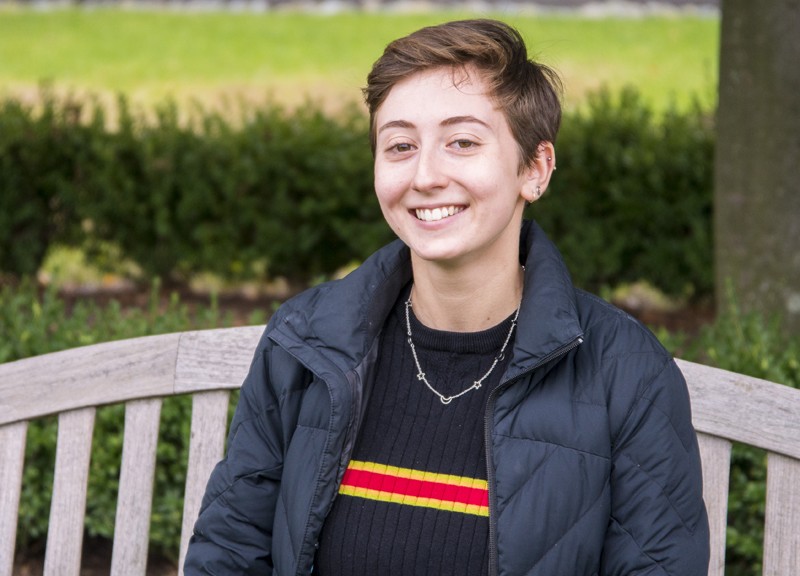
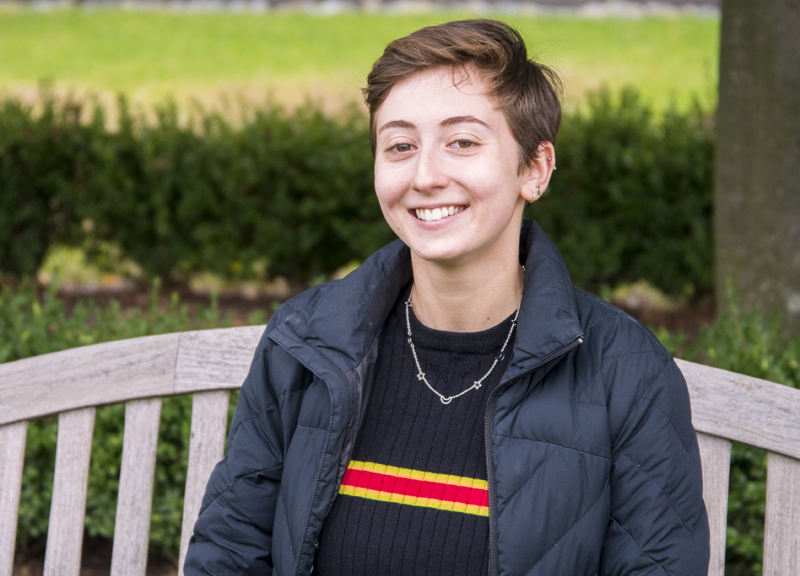
Ava Glasser believes plants have secrets — and she’s determined to find out what they are.
“A lot of people tend to think that plants aren’t really alive because they don’t move, talk or breathe in the same way that animals do,” Glasser said. “But plants have some cool tricks up their sleeves and I want to learn how they do what they do and how they became so dominant on this planet.”
Glasser is a senior majoring in environmental studies and minoring in biology at Binghamton University. Her eagerness to explore nature has led her to study plant life beyond the walls of a classroom.
From examining plants along the East Coast forest to the mountains of Colorado and even to the tropics of Costa Rica, Glasser has had a range of research experience as an undergraduate.
During spring 2018, Glasser conducted her own independent project that she continues to analyze in Binghamton University’s Sobel Lab, established by Assistant Professor Jay Sobel, which focuses on evolutionary and ecological genetics.
Her project examined vernalization requirements of plants along the East Coast – or the amount of cooling a plant needs before it is ready to flower.
“We got plants from way up north in New York, Pennsylvania, and along the whole gradient all the way down to Georgia,” Glasser said. “We want to see how northern and southern plants differ in their cold requirement to flower. Now we’re looking at the data from that and running statistics on it, trying to figure out the patterns.”
That same semester, Glasser went on a 10-day trip with her Tropical Ecology class to Costa Rica.
“It’s one thing to learn about the tropics, but when you actually go there, you realize it’s life on top of life,” Glasser said. “You see a tree, then vines on the tree, and bugs on the vines and then bugs on the bugs. I really learned a lot.”
Glasser also worked at the Rocky Mountain Biological Laboratory in Colorado during the summer of 2017. She applied through the National Science Foundation’s Research Experience for Undergraduates program, where she studied an invasive mustard seed plant in the Rocky Mountains.
Examining new environments and getting hands-on with nature drove Glasser to keep exploring. In fall 2017, she helped Associate Professor John Titus with his forest-restoration research.
“Dr. Titus has been doing this long-term study for 30 years now, where every five to 10 years he and students go out in the College-in-the-Woods woods and there’s this big grid out there where they survey all the trees,” Glasser explained. “We measured all the trees and compared the measurements to previous years to see how the forest is changing. That was another great time to be around plants.”
Glasser said Titus inspired her dedication to research after she took his ecology lab course in fall 2016.
“Dr. Titus has been awesome,” Glasser said. “He inspired me to get into the research side. He’s just been so supportive and a great guy to have on my team.”
Glasser’s love for studying and preserving plant life blossomed when she was a kid growing up in her hometown of South Orange, N.J.
“I just grew up hiking a lot and hanging out in my backyard because I wasn’t really allowed to watch TV and play video games as a kid,” Glasser said. “So my sister and I spent a lot of time just running around outside and I developed an appreciation for plants and animals through that, and then a want to protect them.”
Not only was Glasser encouraged to play outside, but her mother also instilled a sense of environmental activism in her.
“Growing up, my mom would take me to climate marches and has just been really active in environmental justice in both my town and state,” Glasser said. “She’s been a beekeeper, a soap maker and has worked for non-profits. So she’s dedicated herself to the Earth, too, in a different way. Just seeing my mom kick butt has been a big inspiration.”
Growing up around activism had an impact on Glasser, who is now the president of the Environmental Club at Binghamton University.
The club aims to encourage local sustainability. Its members hike, hold educational events and try to make the city of Binghamton a cleaner place.
“I love the city of Binghamton,” Glasser said. “I love the surrounding area and the fact that Binghamton is in an urban area that is right up against nature. We try to go out and pick up trash in the woods and coordinate events surrounding local sustainability. We focus on what we can do right here and right now for the city.”
Glasser makes sure she doesn’t take Binghamton’s nature for granted, noting how valuable the University’s Nature Preserve is to her field of study.
“The Nature Preserve has been something fantastic that I’ve realized a lot of schools don’t have,” Glasser said. “A lot of my classes have been out there, so it’s where I learned plant identification and ended up taking ecology classes that have used the Nature Preserve as a field-trip space. It’s a really good classroom. Instead of going to the Lecture Hall, we can go out and sample pond water for a few hours.”
Although Glasser doesn’t know what life has in store after graduation, she knows that she wants to keep figuring out the secret life of plants and how to keep our world clean.
“I just love being around plants all the time,” Glasser said. “I want to do something that involves conservation, invasive species management, and just being outside and trying to make a difference.”