Harpur student spotlight: Marc Francis Hidalgo
Doctoral student in materials science and engineering aims to build better battery
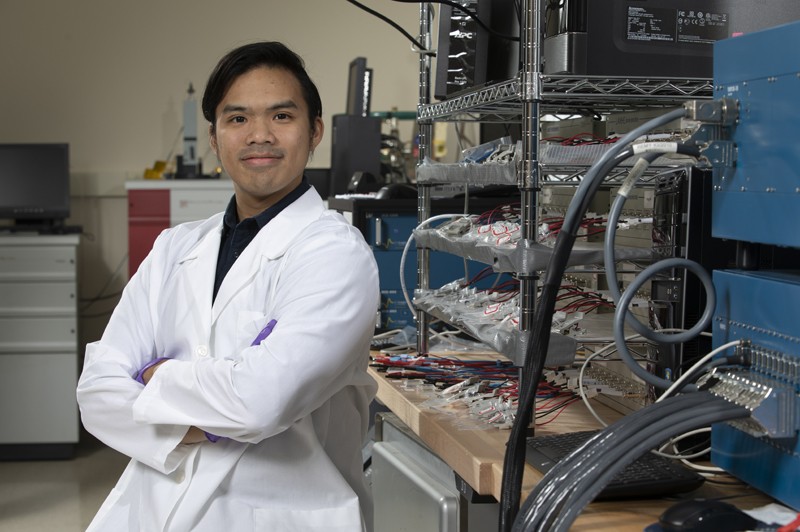
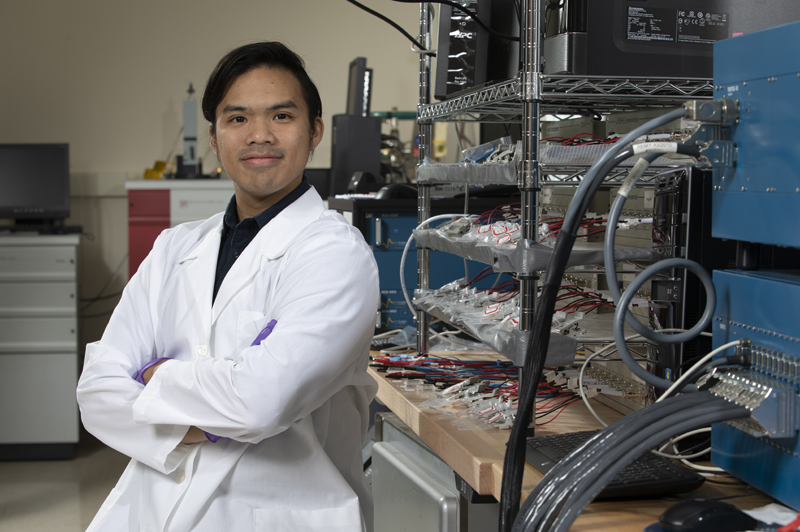
Binghamton University graduate student Marc Francis Hidalgo studies a compound that allows batteries to double their energy capacity.
Hidalgo, who is pursuing his doctorate in materials science and engineering, works with the NorthEast Center for Chemical Energy Storage (NECCES), a network of professors, research scientists, post-docs and graduate students that aims to improve energy storage, focusing primarily on lithium-ion batteries.
These batteries power everyday portable devices such as cell phones and laptops as well as some cars.
They retain and transmit their power by cycling lithium ions (Li+) in and out of certain materials. Distinguished Professor M. Stanley Whittingham, director of NECCES and Hidalgo’s advisor, said batteries can barely cycle one unit of Li+ at a time.
The compound Hidalgo and his colleagues are studying, called vanadium phosphate, is capable of cycling up to two.
“The idea here is that the more lithium you can put in or remove, the more energy you can get out,” Hidalgo said.
To figure out what yields the best battery, Hidalgo and his colleagues tackle the compound from different perspectives.
“It’s almost like cooking. Depending on the pressure, depending on what I put inside, the products will be different, so usually I change something small — the pH, the concentration, the pressure — and the product will be completely different,” Hidalgo said. “If the material is what we want it to be, then we use it in a battery, we cycle it and this process repeats.”
Hidalgo and his colleagues have successfully synthesized a battery that can cycle two lithium ions, and now they are moving on to develop batteries that can cycle more.
“[Now] we’re looking at materials that have more than just one vanadium; the one I’m looking at now has four, and so maybe we could have up to eight lithium ions [cycled at a time],” he said.
Hidalgo, who was born in Japan, moved to the Philippines when he was 7 years old. There, he completed an undergraduate degree in chemistry and materials science and engineering. He received a scholarship to complete a professional science master’s certificate at Binghamton, which trains students in business alongside their science degrees.
“For my scholarship, the idea is that the government will bring people here from other countries to study, and then for those people to bring what they learned back to their countries,” Hidalgo said. “Once I graduate, my plans are to go back home, work for a bit and see what my opportunities are.”
Hidalgo, who did research on solar cells as an undergraduate, said he plans to continue down the energy research path after he completes his graduate work in materials science and engineering.
“He could probably snap up any job he wanted,” said Whittingham, one of the inventors of the lithium-ion battery. “He’s got this natural leadership built into him. He’s enthusiastic; he goes and gets things done.”