How big data can improve healthcare
Annual Kresge event explores nursing and data science
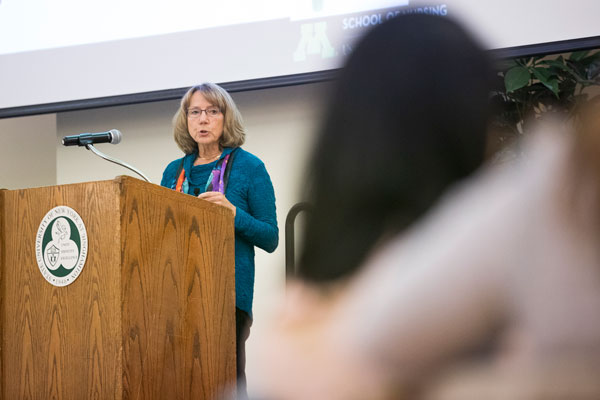
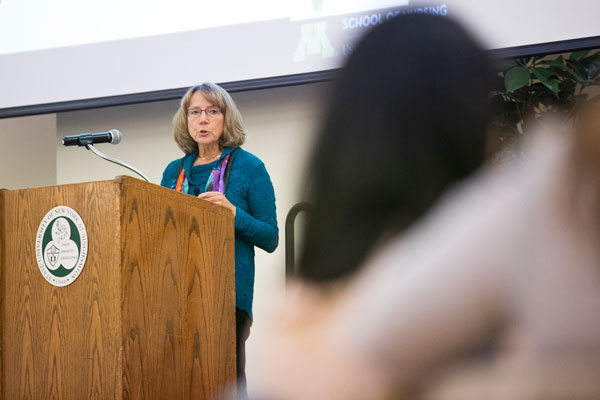
“One of the biggest challenges to nursing’s contribution is how we prepare our faculty, students and clinicians to be more aware of the precepts, methods and analytical tools in big data,” said Mario Ortiz, dean of Binghamton University’s Decker School of Nursing as he introduced the Kresge Center for Nursing Research seminar on March 29.
The seminar drew more than 200 attendees including Decker School alumni, faculty, students and staff; faculty and students from other schools within the University; and healthcare professionals from across the region.
“Biomedical big data is more than just very large data sets or just many sources of data available at the same time,” Ortiz added. “It is diverse, complex, disorganized and multimodal data generated by hospitals, researchers and individuals who wear mobile devices and sensors that provide real-time data about health status and parameters.
“These data sources can include genetic, imaging, environmental exposure and behaviors. The use of these data holds much promise for all, but for nursing, as both a profession and a discipline, this is clearly an opportunity.”
That opportunity inspired Ortiz’s selection of this year’s topic and speakers for the Kresge event, particularly keynote speaker Bonnie Westra, associate professor emerita at the University of Minnesota School of Nursing and co-director for its Center for Nursing Informatics. She has 25 years of combined nursing informatics experience in the software industry, teaching and research.
Westra’s presentation — Nursing and Data Science: Past, Present, Future — discussed the relationship between big data/data science and nursing research. She also identified early nursing data scientists, including Florence Nightingale, who discovered that during the Crimean War more people died of environmental causes than from being shot. Westra called Nightingale a “statistician” and said her work in 1865 makes her one of the first nursing data scientists.
“In healthcare there are provider- and consumer-generated data, genomic data, imaging data, environmental data, the Internet of things, data from social media — the explosion of data is phenomenal,” Westra said.
“Data science is here to stay and rapidly evolving. You can be part of that future and it’s an exciting, challenging one,” she added.
During a break following the keynote address, participants attended a poster presentation featuring research by undergraduate and graduate nursing students and faculty.
Next were brief presentations by three data-science experts: Max Topaz, the Elizabeth Standish Gill Associate Professor of Nursing at Columbia University Medical Center; Sarah Collins Rossetti, assistant professor of biomedical informatics and nursing at Columbia University; and Alvin Jeffery, medical informatics post-doctoral fellow with the U.S. Department of Veterans Affairs and a trainee in Vanderbilt University’s Department of Biomedical Informatics.
Topaz, who focused on data science preparation, told attendees that nursing expertise is essential in medical technology. He also stressed the importance of collaborating with experts in other disciplines.
“You don’t have to do it all,” he said. “We need to rely on other people!”
Rossetti discussed working with clinical data and how academic-hospital collaborations are essential to accessing that data. She also said cleaning data is a large effort and is never completed! Finally, she emphasized that having a nursing perspective is critical for understanding the meaning of data and analytical findings.
During his presentation on educational preparation, Jeffery told the audience, “When I talk to nurses about programming, I don’t call it programming, I call it their superpowers!”
To develop these superpowers, which Jeffery said make a nursing data scientist especially marketable, one needs to have knowledge of statistics and theory, programming and database management, visualization and explanation, and content expertise. He said there are many ways to gain training in these areas, including traditional and online courses, online resources, books, journals and conferences.
Rossetti then gave an overview of how to build a data science program and Westra ended the event with a Q&A session.
The Kresge seminar was endorsed by Binghamton University’s Data Science Transdisciplinary Area of Excellence. The poster presentation was sponsored by the Kresge Center and the Zeta Iota Chapter of Sigma Theta Tau International.