Coordinators for nursing tracks improve graduate student experience
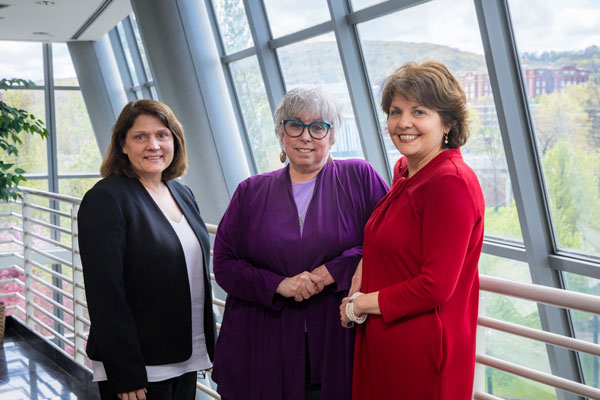
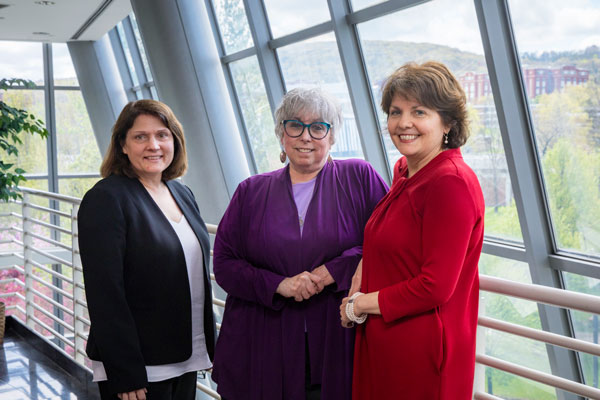
Earlier this year, when Nicole Rouhana, MS ’95, PhD ’11, sought to appoint a coordinator for each of the four specialty tracks within the Decker School of Nursing’s master’s-level and post-graduate certificate programs, she didn’t have to look far. Within each track were faculty with the requisite knowledge and experience to help lead the programs.
In fact, when combined, the four faculty members selected as program coordinators — Nannette Cowen, Nina Flanagan, Mary Muscari and Gale Spencer — have more than 125 years of nursing experience.
Rouhana, assistant professor of nursing and director of graduate nursing programs, said establishing the project coordinator role for the specialty tracks was a necessary and long-overdue step.
“Decker initiated the program coordinators to comply with Collegiate Commission on Nursing Education] requirements that each specialty track is directed by a faculty member with expertise in that specific area,” Rouhana said.
“Each specialty has intricate components, and the National Organization of Nurse Practitioner Faculties has a criterion that the faculty who provide oversight for an NP [nurse practitioner, one of the four roles students may choose; clinical nurse specialist, nurse educator and nurse administrator are the other three] educational track is nationally certified in the same population-focused area of practice,” added Mary Muscari, associate professor and coordinator of the psychiatric-nursing track and the forensic-nursing program.
These professional bodies require that faculty within the specialty have input into the selection, admission and progression of students within those tracks.
Rouhana said having program coordinators assist with admissions decisions brings a much-needed additional perspective to the decision-making. “The coordinator might pick up on something in an admissions application or essay that is significant, but might go unnoticed by someone outside the specialty area,” she said.
Program coordinators also play a role in recruitment, academic advising, student and faculty mentoring, program evaluation, curriculum development, faculty training and more. Rouhana said having an individual within the specialty with whom students can speak about academic, personal or career issues is an enormous benefit to students.
“Having program coordinators gives students another person who is accessible to answer questions and help them,” added Nannette Cowen, MS ’98, PhD ’18, clinical assistant professor and coordinator of the family-nursing specialty track. “I hope students feel comfortable coming to us to ask questions and that we can serve as additional resources for them.”
“Being in the clinical arena and understanding what it’s like doing the work in the specialty is important,” said Nina Flanagan, MS ’92, PhD 12, clinical professor and coordinator of the adult-gerontological nursing specialty track.
“The coordinators are highly specialized; they have a lot of additional, specific knowledge regarding that population,” Rouhana said. “The depth of their experience will make the programs even better than they were and provide students with a better experience.”
“The program coordinators are managing their own study body more closely than one person could,” Rouhana added. “They’ll ensure that the curriculum meets the national standards of educational requirements as well as requirements within their specific populations. They’ll also make sure students have all the content and clinical experiences they need in order to be eligible for the national certification exam.”
Cowen said since the coordinators are also instructors within the specialty, they have “firsthand knowledge of the content that’s being delivered to the students and we can see what is working and what might need to be changed.”
Flanagan added that she believes part of the program coordinators’ role is to help promote the programs. She said increasing awareness of the specialty tracks is particularly important for adult-gerontology.
“I want to spark interest in new generations to work with this population,” Flanagan said. “I want to encourage students who have the commitment and passion to work with older adults.”
While the program coordinator’s role is new, Muscari is already looking to the future.
“While the psych NP program has had almost 10 years of success with online courses, we look forward to having the entire program online to make it more accessible to working nurses, especially in rural areas where there is significant need for mental-healthcare,” she said. “We look forward to broadening our students’ knowledge and experience in working in primary-care settings, and, my continuous personal goal, to increasing their knowledge in working with victims and perpetrators of interpersonal violence, as this underlies many of the mental-health issues we see today.”
Gale Spencer, SUNY distinguished teaching professor, Decker chair in community-health nursing and coordinator of the community-health nursing track, is also making plans.
“I may develop some type of grouping for the community-health students where they can discuss their concerns, suggest ways they can share suggestions regarding the program and communicate with one another and the faculty,” she said.