CCPA helps community identify, satisfy needs
Revitalizing neighborhoods, reducing isolation, reinventing living-learning
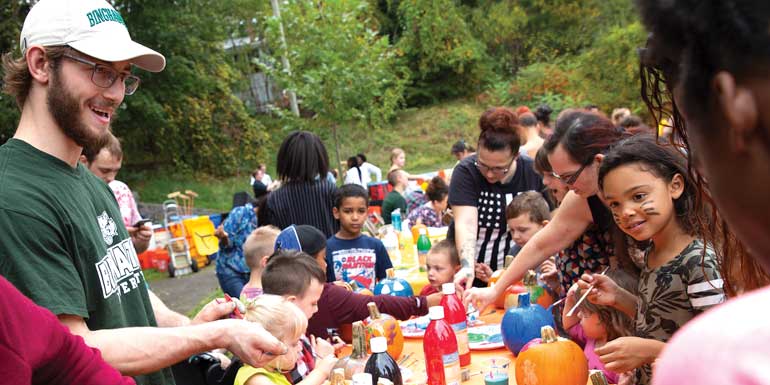
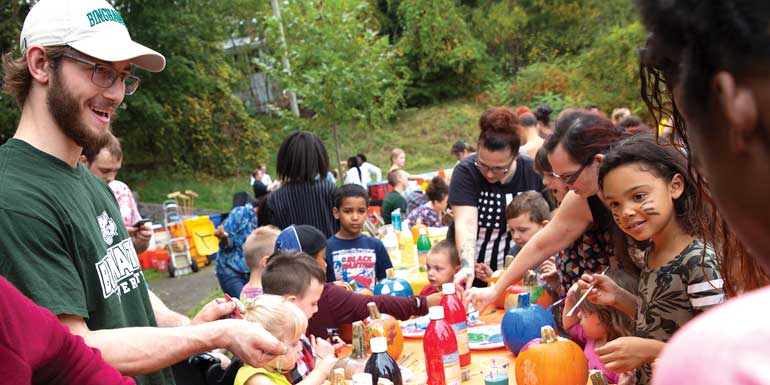
One of Binghamton’s oldest mansions is bringing new life to a portion of the city’s West Side. The brick house at 85 Walnut St. has become a community hub, offering a range of programs from movie screenings to yoga classes to hot meals. It’s also a place where people can exchange ideas on how to improve their community.
George Homsy, assistant professor of public administration, has been working in the North of Main Street neighborhood since January 2015. The area is a mix of Binghamton University students as well as poor and working class residents.
“The goal is to get people to come together to advocate on their own,” Homsy says. “It’s not top-down. We don’t want to come in as the University and tell people what they need. It’s about having people tell us what they need.
“We [want to] get that local knowledge and empower people to stand up and say, ‘Let’s do things differently because this neighborhood is different.’ We have to engage people. People have to feel they have a voice.”
In September, Homsy and a group of students will put on the fifth annual Walnut Street Festival, which has become a neighborhood tradition.
— Julia Carmel ’19
Assessing the need for busing
Just blocks away from Binghamton’s central business district lies the city’s North Side. Despite the proximity, people living in the neighborhood feel they are miles away from everything. Mohammed Rabiu Abubakari, MA ’17, is trying to help reduce the sense of isolation.
Abubakari, a community research and action doctoral student at CCPA, is leading the North Side Transportation Study. The study is one of the initiatives from the University’s and City of Binghamton’s Town-Gown Advisory Board, which formed in 2017 to promote positive relations between Binghamton University and residents of neighborhoods that are impacted by the presence of students.
“My research interest is accessibility, in particular accessibility to public services and basic needs such as food,” Abubakari says. “How can people travel to food sources? You cannot go grocery shopping if you don’t have transportation.”
Abubakari is surveying residents on how often they use public transportation in order to understand the gaps in the current system. Ultimately, he wants to craft a strategic plan that meets the needs of students and residents.
“The big problem that came up was the need to increase the amount of buses that come,” Abubakari explains. “People feel they are waiting too long for a bus. Resources are scarce, but that doesn’t mean that some neighborhoods should be left out.”
— Julia Carmel ’19
Reinventing living-learning on campus
A new initiative will draw on the untapped potential in Binghamton University’s residence halls, where more than 7,300 students live.
Deborah Taub, professor and chair of student affairs administration (SAA), is overseeing the creation and implementation of B-Connected, a residential curriculum launching this fall. Because students spend more time in the residence halls than in class, resident assistants (RAs) will use the time to help students build competency in community, wellness, academic success and life skills.
“We’re not replacing what the collegiate professors or RAs do,” Taub said. “Instead, this is our attempt to make the living experience a more learning-rich environment for all the residents.”
“By defining the needs of our different student populations and viewing learning as a sequential and intentional process, our goal is to make measurable impacts in these areas in a seamless way that enhances the student experience,” said Paola Mignone, interim director of residential life.
Taub’s team of residential staff and student interns is working on one content area at a time, starting with community. Assessment, Taub says, is important because the team wants to know what’s working.
“With our community theme, a measure of success is a student’s sense of belonging, so we’ve collected baseline data and we’ll do a comparison after year one of the program,” Taub said.
Eventually, Taub wants to create an elective course for SAA students tied to B-connected. She feels they would obtain valuable experience working with students in the residence halls.
“We’re preparing professionals who are going to run residence halls, put on orientation, oversee campus activities and more,” Taub said. “For SAA students, campus is their community, so the more service they do, it only helps their job searches.”
— Steve Seepersaud