Reaching new depths at the Public Archaeology Facility
PAF has been part of the Binghamton community for more than 45 years
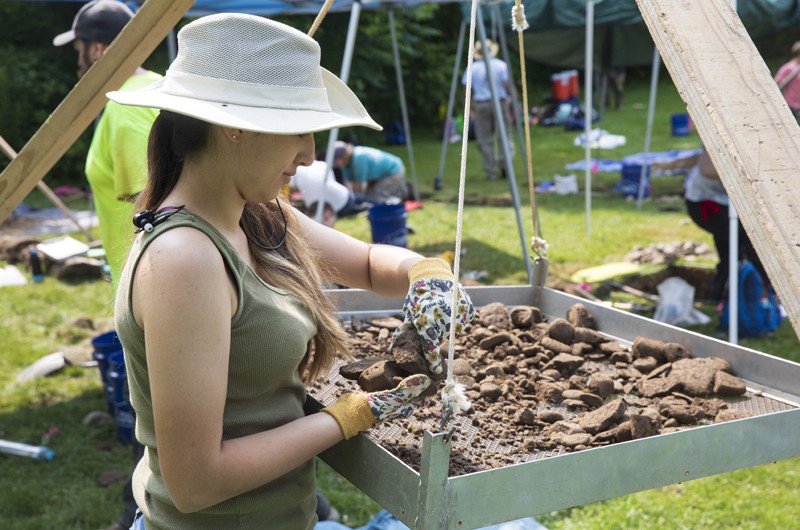
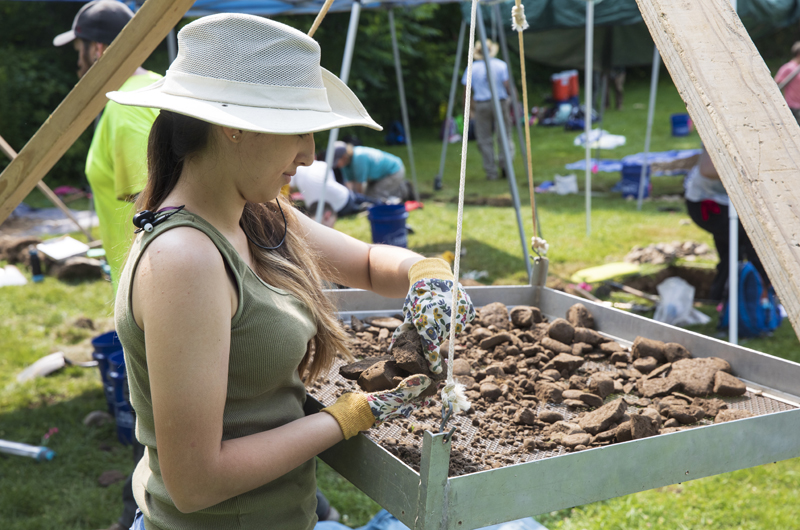
Walk into the basement of Science 1 and you’ll find an organized lab filled with light blue boxes and pieces of history. The staff is there every day, rinsing rocks, labeling bits of pottery and sorting through sherds of glass to organize a collection of more than 2,000 artifacts.
“At the most basic level we do archaeology here,” says Nina Versaggi, MA ’76, PhD ’87, about the Public Archaeology Facility (PAF). “We do analysis of artifacts. But behind all of that, this is a multimillion dollar facility with 25 staff members.”
PAF, established in 1972, links communities to their historical roots.
“We have a mission to do community outreach, to share with members of the public, sometimes whose backyards we’re digging in,” says Versaggi, who recently retired after directing the center for more than 30 years. She was succeeded in June by Laurie Miroff.
PAF gets the majority of its funding by bidding on cultural resource management projects through state and federal agencies. PAF research expenditures for the past decade have topped $23.6 million.
“It’s difficult to get federal grants, so we fund ourselves through cultural resource management [CRM],” Versaggi explains. “CRM is a specialized branch of archaeology; it takes the approach of working within environmental impact and historic preservation.”
When developers want to begin a new project, they must bring in an archaeological team to check the building site. That’s where PAF comes in, bidding on the work contracts that are within its expertise; if it wins the bid it gets to work on the site through multiphase projects.
“We’ll do archaeology within the outline of where [developers] are going to build their project — it could be a road project, a building, a pipeline, sewers, any projects that require a state or federal permit,” Versaggi says. “We’ll go out and do the first phase of work, which asks the question, ‘Is there a site of significance here or not?’ If the answer is ‘There’s nothing here,’ then we move on, but if we find something, we have to see if it’s significant enough to make it a National Register site.”
Through investigating these sites, the PAF team can find artifacts and information that lend insight into the history of an area.
“It’s very satisfying when we can go from our first phase to our final phase and collect significant information that we can research and share without stopping the project from going forward,” Versaggi says. “It’s a balancing act; we want to find sites, but we need to be able to help our clients move forward.”
There isn’t always a simple solution, but the PAF team aims to offer solutions that work for both the site and the developer.
“We don’t bend on the ethics of our profession, but we find ways where clients can create green spaces to protect areas or create an ordinance waiver to cut down on parking lots,” Versaggi says.
PAF has done research across the nation, and each project furthers the skills and the funding for Harpur College’s archaeology initiatives. Notable Southern Tier projects include Revolutionary War battlefield sites such as Chemung and Newtown, and fieldwork at the site of the University Downtown Center before the building was constructed.
Though any project can lead to incredible results and insight, some projects have been particularly memorable for Versaggi.
“The most unexpected and surprising and stunning project — which we had no clue was going to be that way — was when we were asked to work with the Woodstock music festival,” Versaggi says. “They asked for help locating features from the original festival, and we helped them find the vendor areas and certain fence areas, and then the Associated Press descended and that was very cool. [The story] just went viral all across the globe. We were inundated with demands from every state for interviews.”
Working on the Woodstock project last year reminded PAF that its efforts make waves far beyond the Southern Tier.
“It wasn’t one of our interest areas but it’s a contemporary project, and we’re just starting to realize how important that can be,” Versaggi says. “It was an eye opener and it made us rethink; maybe some of our responsibilities are to people living today who want to know more about the recent past.”
Through contemporary projects, PAF connects history to modern communities. This mission also inspired PAF’s Community Archaeology Programs, which allow people of all ages to get hands-on experience. Participants work in the field, uncovering and preserving artifacts with guidance from experts.
“We figured out a way to develop a program for children, teens and adults,” Versaggi says. “It allows nonarchaeologists to have a highly supervised experience with archaeology.”
No matter where its research takes place, PAF is piecing together sherds of the past. PAF’s research support specialist, Mary Lou Supa, knows that her work is shaping our perspective of both the past and the future.
“It’s all a puzzle,” Supa says. “These are pieces of the puzzle, but when we put them together it’s all one beautiful picture.”
Though Versaggi has left her position as director, she’ll still be around campus teaching and doing research. She knows that PAF will continue its mission to share history with the public.
“We’ve been digging up the city of Binghamton,” Versaggi says, “one block at a time.”