Celebration the theme of President Harvey Stenger’s State of the University address
Nobel Prize winner M. Stanley Whittingham and lots more to be proud of
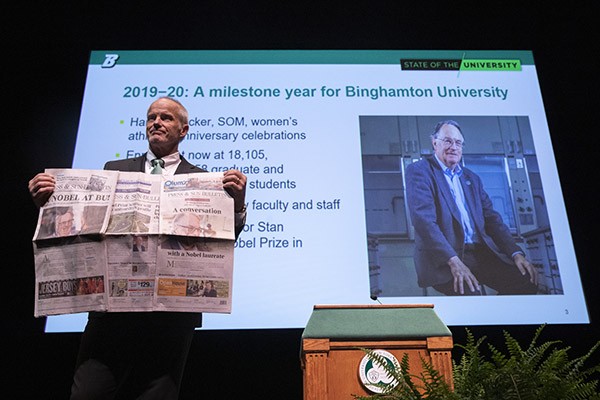
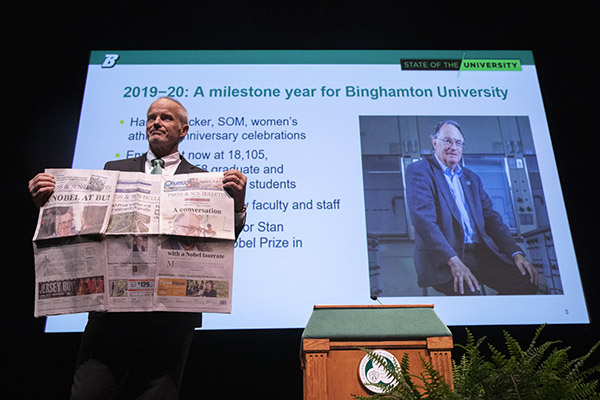
A Nobel Prize winner and a new vision for Binghamton University’s nursing school headlined President Harvey Stenger’s 2019 State of the University address, delivered Thursday afternoon, Oct. 17, in the Anderson Center’s Osterhout Concert Theater.
Opening with a theme of celebration, Stenger said some really big, unbelievable things had happened at Binghamton University in the past year. “We won three rounds of Jeopardy!,” he said, as he pointed out Jeopardy! champion Kevin Boettcher. “Kevin, I’m sorry to tell you that you’re now on the second page because we won the Nobel Prize!” Stenger yelled as he threw his hands in the air and then showed off the front page of the Binghamton Press & Sun-Bulletin to loud applause.
Stenger joked that he would carry the newspaper with him — and not shave again — until the next Nobel Prize comes to Binghamton.
Turning to other causes for celebration, Stenger reviewed the history of Harpur College, the School of Management (SOM) and the Decker School of Nursing (DSON), all experiencing milestone anniversaries this year, along with 50 years of women in athletics.
Harpur, having its 70th birthday, is the core of the University, the heart of the University, Stenger said. “The most integral part of our success is because we keep it and the liberal arts at our core for students in all of our colleges.”
Accolades were also on Stenger’s mind as he noted that the SOM, celebrating 50 years as a school this year, holds one accolade that does not have cost or value attached to it — it’s ranking as the number one provider of recruits to EY (Ernst & Young) and PWC (PricewaterhouseCoopers) in New York City.
DSON is also 50 years old this year, and its big news is two-fold — its new home under construction at the Health Sciences Campus in Johnson City, and its new name. “I’ve been using the term school of nursing to speak of Decker,” Stenger said. But as DSON adds programs in physical therapy, occupational therapy, speech-language pathology and health sciences over the next few years, a name change is in order.
“You need to actually create new schools, and schools can’t be part of a school, they have to be part of a college,” Stenger said. “And since the Decker Foundation is such a great supporter of ours, having given over $10 million, we’ll relabel the school as Decker College of Nursing and Health Sciences to recognize the great partnership we’ve had for many years with the Decker Foundation.”
And as Stenger spoke of the University’s history and growth over the years, he wondered aloud if he had mentioned that Stan Whittingham had just won the Nobel Prize.
Binghamton University uses the term premier public to describe itself, Stenger said. “But what does it mean and why are we talked about like that? It comes back to what Stan says: collegiality and camaraderie, and that comes with excellent people and how they collaborate with each other.”
Stenger said it had been relatively easy for the campus to establish its six transdisciplinary areas of excellence because of this collegiality and the high-quality faculty at Binghamton, and great students as well. “It’s a cycle,” he said.
Speaking of rankings, Stenger noted some highlights, including that Binghamton has earned its first national championship as the “top-ranked university in the country in research in sustainability according to the Association for the Advancement of Sustainability in Higher Education. “If you go to their website, you’ll see that we’re tied with four others, but they’re listed alphabetically, so we’re number one!” he said.
Accomplishments in the past year also included reaching the R1 “very high research” status in the Carnegie Classification of Institutions of Higher Education, based on a combination of PhDs granted and research expenditures, as well as establishment or renewals of several major research centers.
“And did I mention that Stan Whittingham won the Nobel Prize in Chemistry?” Stenger asked.
“But there was a bump in the road last year,” he added, “and we learned a lot.
“We had to rethink how we do business,” he said, as he explained the hiring hold, why it happened and how the University met the fiscal challenges it faced.
“And where are we now? Our budget challenges are manageable,” he said, as he commended everyone who had played a role in meeting the challenges, whether through reorganizing, recruiting students or increasing graduate enrollment.
The hiring hold was lifted two weeks ago and the University is starting searches for the five leadership positions, he said. “And we did it with innovation and creativity.”
Stenger focused on the growth in private philanthropy as the University moves through the quiet phase of a comprehensive gifts campaign, noting in particular gifts from Ellyn Kaschak ’65, the late Distinguished Professor John Eisch and the late Marilyn Link.
“We received 13 $1 million or greater gifts in the past two years, which says our alumni are getting to a point where they can give away a million,” Stenger said. “We are capitalizing on the successes of our students and alumni. We have to keep them proud of us and reading good things about us. Maybe they’ve actually have heard that Stan won the Nobel Prize!”
The Health Sciences Campus, which will see the opening of the Decker College facility in 2020, will also see the addition of a $16 million research and development building adjacent to the School of Pharmacy and Pharmaceutical Sciences, Stenger said, adding that New York state is providing $11 million for construction of a manufacturing facility on the former Ozalid site in Johnson City to further support the Health Sciences Campus initiatives.
“And with private investments, by fall 2025, I predict that more than 1,900 faculty and staff will be at that campus,” Stenger said. “Imagine what can happen in Johnson City with all of those students there.”
Millions of dollars in investments are also underway on the Vestal campus, Stenger said. Projects are bringing energy efficiencies to the Engineering Building and Science 2, as well as improvements to the Glenn G. Bartle Library, Hinman Dining Hall, Cleveland Hall and the basement of the University Union. all Funds for these projects come from the SUNY Construction Fund —and from Sodexo for the Hinman Dining Hall project, Stenger said, and Binghamton is a leader in the SUNY system for garnering these funds. “Our team serves up pre-designed projects, so we get some of the money that can’t be spent by other campuses,” Stenger said.
Finally, Stenger provided an update on the four University Initiatives that were somewhat delayed during the past year’s fiscal challenges.
“We’re restarting them,” he said.
The Health Sciences Campus wasn’t put on hold, but the Health Sciences Core Facilities centered on a Brain and Body Imaging Center that requires a functional MRI (fMRI), he said. Through a partnership with UHS, the University is hoping the Regional Economic Development Council will help purchase the fMRI and house it at UHS where physicians can use it for patients, but also allow University researchers to use it in off hours.
The Data Science Initiative and the Data Science TAE were merged and the University is working on space needs, Stenger said. A main focus will be on the security of data and how protect it and to find areas of data science where it’s not currently being used.
The Post-Doctoral Diversity program had brought two cohorts to campus, “then along came the SUNY PRODiG program,” Stenger said. “Our PRODiG proposal was approved by SUNY and we’ll hire as many faculty as we can in these categories, with salary support from SUNY for the first three years.”
So what’s next?
Working to achieve another Carnegie ranking, Stenger said—this one for community engagement. “We’re putting together a team to find out how we can do this,” he said.
“And we’re going to start a campaign and go public when we reach half our goal,” he added. “We’re in the quiet phase and we hope to raise $150 million. If we can get to $75 million in the next several months, our goal is to launch the campaign probably next fall, but it’s a secret.
“We’re also going to develop a master plan for the Fine Arts Building, which is long overdue,” Stenger said. “We’ll be spending the next year putting a plan together and if we bring it to SUNY, the money will flow.
The Innovation lab where small groups of students work on solving open-ended programs also needs space on campus, Stenger said. The University will also launch new Decker programs, work on a welcome center to improve the experience when you drive onto campus — “When you drive in, did you see the big sign that says Stan Whittingham won the Nobel Prize?” — and continue work on the Living Building at Nuthatch Hollow, he added.
“I really think 2018-19, even with our bump in the road, was successful and what made it more successful was we met the challenge,” Stenger said. “We all worked tougher and we solved that problem. We’re not completely out of the woods, but we’re close and that is an accomplishment. So what’s the future holds, we don’t know, but we have to take the challenges on.
“Finally, refer to our Frequently Asked Questions page for more information or if you have questions — and join us tomorrow to celebrate Stan!”