Students collect data for city of Binghamton’s tree database
Northeast ecology course takes inventory of trees at Recreation Park
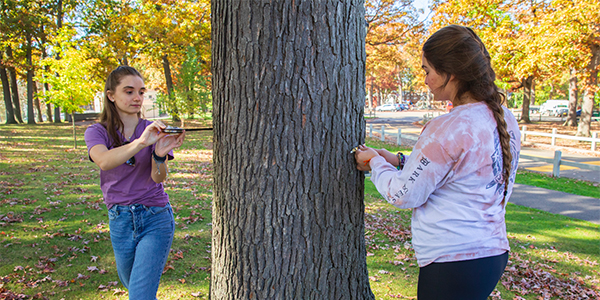
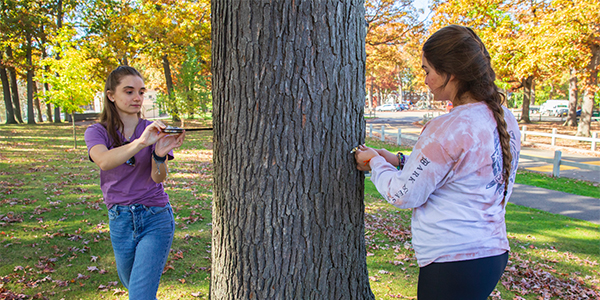
Students in the Ecology of the Northeast course gathered at Recreation Park — a park with roughly 300 trees — to assist the city of Binghamton’s Parks and Recreation Department in taking documenting the trees in the park.
“When I was designing this course, I was researching the local Binghamton area and I came across the urban forestry projects the city was implementing, including keeping an inventory of city tree species with an online Treekeeper system,” said Sara Velardi, lecturer for geological sciences and environmental studies. “I thought this could be a really cool project for the students to be a part of.”
The inventory project also counts as one of the required labs for the course. Velardi wants most of the labs to give students the opportunity to participate in field work. This kind of exposure allows students to gain valuable experience using different techniques and skills pertinent to the environmental studies field, she said.
“I’ve been looking forward to this,” said John Light-Olson, a student in the course. “I think it’s a really cool opportunity to get involved in the greater Binghamton community. It’s really fun to see how it [ecology] affects our community.”
Not only does this project benefit students, but also it comes at a perfect time to assist the city.
“The city Parks Department is applying for a New York State Department of Environmental Conservation (NYSDEC) grant for assisting in the maintenance of our ash tree population,” said Paul Palmer, commissioner of Parks and Recreation. “Part of the grant application scoring criteria is ‘outreach and education.’ Having Binghamton University students and the media involved with the labs gives scoring points for our application. It’s a win for us and hopefully the students as well.”
Keeping a tree inventory is crucial because the data provides an overview of tree types, ages and conditions, said Palmer. The information gathered allows for the creation of proper tree maintenance schedules, helps with budget planning and assists with setting priorities for pruning and removal needs, among other things, he said.
“Keeping an inventory helps the city prioritize areas for maintenance and helps support a healthy, vibrant urban forestry program in Binghamton,” added Velardi.
Students met with Palmer and local arborists Nick Marshall and Nick Ballard at Recreation Park and took diameter at breast height (DBH) measurements and tree height measurements. They also assessed trees for any dead limbs that could indicate its overall health. The arborists also taught students a trick to estimate tree height that requires only the use of a stick off the ground — a different measurement tool than the clinometers (instruments used for measuring angles of slope (or tilt), elevation or depression of an object with respect to gravity’s direction) the students learned about in class.
“It’s been fun,” said Christina Nonnenmacher. “I’ve never learned any of this stuff before, like finding the height of a tree; how people use the stick method versus the actual clinometers.”
It’s not uncommon for Velardi to take her classes outside for labs. In the past, however, they’ve typically frequented the Nature preserve on campus due to its accessibility.
“This is the first time I’ve gone off campus for a lab,” said junior Mia Stewart. “It’s kind of cool to go somewhere else. And learning more practical aspects of how to use this knowledge is kind of interesting I think.”
Velardi hopes her students gain more from this project than just completing it for lab credit.
“I hope they will get more experience identifying tree species using their Tree ID pocket guide and taking DBH measurements,” said Velardi. “But maybe even more important, I hope they learn more about their local community, including the city’s urban forestry program, the Parks Department and the type of work it does, and have an understanding of other potential job opportunities after graduation. I also hope they gain some pride in the fact that they are collecting data that contributes to a data source the city will use for years to come.”