What I’ve learned: Gale Spencer
Distinguished teaching professor reminisces about her 47-year career in Binghamton’s nursing program
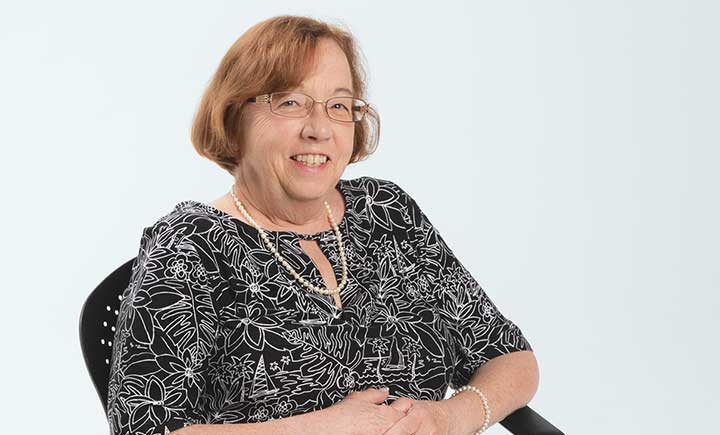
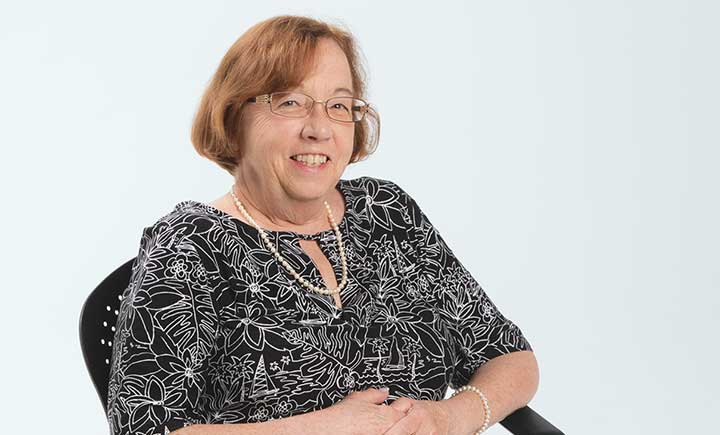
The first class of 20 students graduated from Binghamton University’s School of Nursing in 1972, the same year a young community health nurse joined the school as a counselor for the registered nurses who were pursuing their bachelor’s degrees in nursing.
That young nurse was Gale Spencer, who has the distinction of being the longest-serving faculty member within Decker College of Nursing and Health Sciences.
Spencer is a SUNY Distinguished Teaching Professor (Decker’s only), associate dean, the Decker Chair in Community Health Nursing and coordinator of the college’s Family Health with Community Health Specialization degree and certificate programs. She shares some thoughts about her career, the faculty, the students and the future of Decker College.
WE COULD ARGUE AND STILL BE FRIENDS “In the beginning, there were only about eight of us, and we would get together for faculty-staff meetings. There were all these women with strong opinions about things, and we would argue and yell. Then, Mary [Pillepich, founding dean of the School of Nursing] would say, ‘OK, we’ve had enough of this. Let’s go have lunch.’ We would go eat and there were never hard feelings.”
SOMETIMES YOU NEED SOMEONE TO TELL YOU A HARD TRUTH “Not long after I came to the school as a counselor, Mary Pillepich walked into my office and said, ‘You know you’re in a dead-end job, don’t you? What you need to do is get your master’s degree and then get your doctorate after that.’ I was just 26; who would expect to hear something like that at that age? But, I think you need someone who will tell you the truth.”
KNOW HOW TO GET THINGS DONE “I think my career benefited from the fact that I have a PhD in education, rather than nursing, because I understand how to get things done on campus.”
IT’S EASIER TO BE CLOSE WHEN YOU’RE CLOSE BY “Back when we were a very small school, we had lots of social gatherings at our houses. Then, when we were in Clearview [Clearview Hall, the school’s home before it moved to Academic Building B], everyone had offices on the same floor and we had this big lunchroom where we could socialize, so everyone knew each other. Now, we’re on different floors and you don’t get to see everybody, you don’t get to know everybody. People have their groups, and my concern is that somebody could get left out. We need to work so that doesn’t happen.”
DON’T DRINK IN FRONT OF STUDENTS “In the ’80s, when I was an assistant professor, the undergraduate students invited me and Mary Collins [former faculty member and fourth dean of the School of Nursing] out to celebrate with them. We got to the bar and they wanted us to drink Long Island iced teas. We didn’t know what they were and when we found out, we said, ‘Oh, no, we’re not going to drink those!” We had soft drinks instead. We weren’t about to drink in front of students; it wouldn’t have been a good move for us.”
I HAVE TWO — NO, THREE — LOVES “I love teaching. I love working with students on their doctoral dissertations; they really make it meaningful. But I also love the community health program [Spencer started the school’s Community Health Nursing program in 1985]; it’s my baby.”
DEAN ORTIZ MAKES AN IMPRESSION “You have to think beyond the box because the world is always changing, and I think with Mario [Mario Ortiz, dean of Decker College] we are thinking beyond the box at all times. Mario seems to know where nursing is going.”
CONNECTING WITH STUDENTS IS VITAL “I know it’s important that we do it, but I think Decker’s move from face-to-face teaching to online teaching is going to be a little rough in the beginning [Decker College is launching online programs in 2020]. One of the things our faculty is known for is connecting with students, and how do you do that when it’s online? We’re going to have to really be there for our students during our online office hours, so we can make those connections with them.”
COMMUNITY HEALTH HAS A PROBLEM “The greatest challenge that faces community health nurses is the fact that people make decisions about community health who don’t know about it, who don’t understand it. When the AACN [American Association of Colleges of Nursing] decided on the specialties that could be advanced practice, they got together and there wasn’t one community health person on the committee, and the ANA [American Nurses Association] didn’t send its public health nursing people to the meeting. So, they just decided community/public health nursing didn’t have a population. And that’s what we’ve been fighting ever since.”