Cinema professor’s latest project premieres at film festivals
'Amusement Ride' makes international debut in Toronto, U.S. debut in New York City
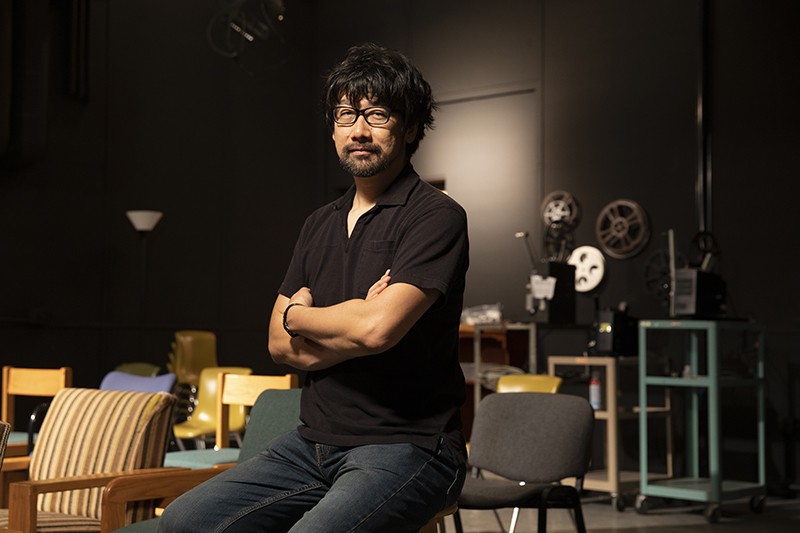
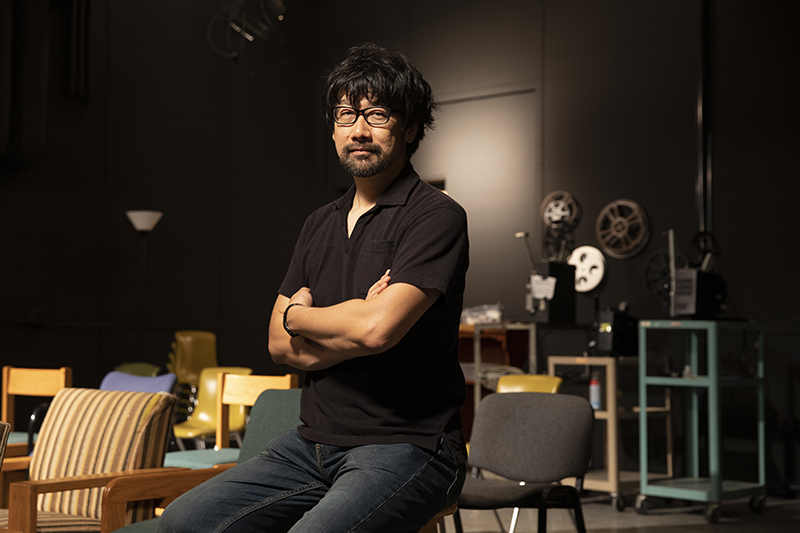
Tomonari Nishikawa wasn’t looking around the theater and gauging audience reaction when his latest short film, “Amusement Ride,” made its world premiere at the Toronto International Film Festival in September.
“I focus on my film on the screen,” the associate professor of cinema said. “Even though I’ve made the film, the projector is different and the sound system is different. I’m always curious about how the space will play the film.”
In Toronto, Nishikawa noticed a slight contrast in color between what was on the big screen and what he observed in his initial viewing in the Lecture Hall of Binghamton University.
“It’s not as if red looked like blue,” he said with a laugh. “It’s about shades.”
Nishikawa has gotten plenty of opportunities to examine his latest work on the festival circuit this fall. Besides Toronto, “Amusement Ride” received its U.S. premiere at the New York Film Festival in October and was also screened at the Vancouver International Film Festival.
The six-minute “Amusement Ride,” shot on 16-mm film, gives viewers a close-up look at the structural support of a Ferris wheel from the inside of a swinging passenger car.
Nishikawa, an experimentalist whose works often focus on the filmmaking process itself, said he came up with the concept three or four years ago.
“A Ferris wheel is interesting because it is not simply going up and down,” he said. “It’s circular movement and gradually goes up and down. I thought changing the visual through a lens would make it even more interesting.”
Nishikawa originally considered filming the ride’s landscape, but decided instead to concentrate his telephoto lens on the structure and pipes of a Ferris wheel.
In the summer of 2018, he traveled to his native Japan to ride the Cosmo Clock 21 Ferris wheel at the Cosmo World amusement park in Yokohama. Built in 1989, Cosmo Clock 21 was the world’s largest Ferris wheel (353 feet) for its first three years.
“It has a large clock attached to it,” Nishikawa said. “People can see the Ferris wheel and also what time it is. There are 60 (eight-person) cabins, so it appears like each one represents a minute.”
Riding alone in the cabin, Nishikawa used 12 shots — each lasting about 30 seconds — to show a full revolution of the wheel.
“I went with 12 shots when I thought about the visual of a clock,” he said.
Nishikawa’s telephoto lens reveals a small part of the view from the Ferris wheel. He even shot upside down in the seventh through 12th shots to provide a continuous ride movement.
“The film doesn’t show the surroundings,” said Nishikawa, who returned to Yokohama in the winter of 2018-19 for additional footage. “No landscapes. Through the pipes, the audience can see what’s in the background and in the cabin.”
Reviewer Phil Coldiron praised “Amusement Ride” in Filmmaker Magazine.
“Nishikawa’s rhyming of the mechanics of both camera and projector is as pleasing as it is obvious, but it’s the sense of floating weightlessly in the midst of a grand machine which finally catches the cosmic on the wing, with an irresistible modesty,” he wrote.
Nishikawa learned about “the uniqueness of the medium” as a Binghamton University cinema student from 2001-03. He had spent the two previous years at a community college studying photography.
“I always wanted to learn how to make a movie,” said Nishikawa, who received his master’s degree from the San Francisco Art Institute. “Before I came to Binghamton, what I knew about cinema was storytelling and acting. This school opened up my perspective toward cinema.”
In the last decade, Nishikawa’s short films (the longest being about 10 minutes) have been screened around the world in places such as Berlin, London, Hong Kong and Singapore. He has also curated screening programs for film festivals in North America and Japan.
Film festivals such as Toronto and New York have enabled Nishikawa to take part in Q&A sessions and receive opinions from his peers and the audience. They have also reminded him of the department’s rich history that dates back to the late 1960s.
“I met three alumni at the New York Film Festival,” he said. “Former students contacted me about going, but they couldn’t get in because it was sold out.”
“Amusement Ride” will receive a wide release sometime in 2020, as Nishikawa is still making the festival rounds. He has submitted the film for the International Film Festival Rotterdam and is considering other festivals.
“It’s a great pleasure and an honor to show my film at these venues and get feedback from people,” he said.