Pharmaceutical sciences faculty member makes the jump from industry
L. Nathan Tumey now helps students appreciate the scientific complexity and importance of the drug discovery process.
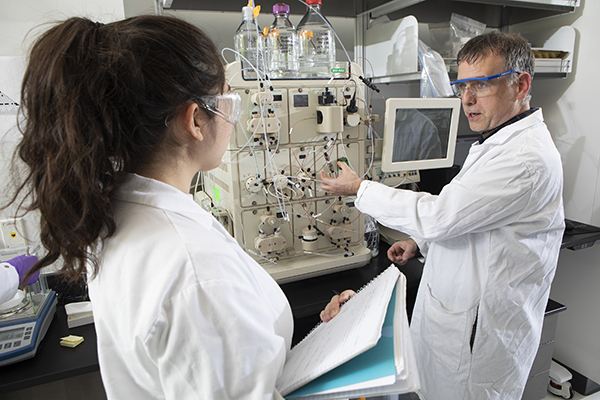
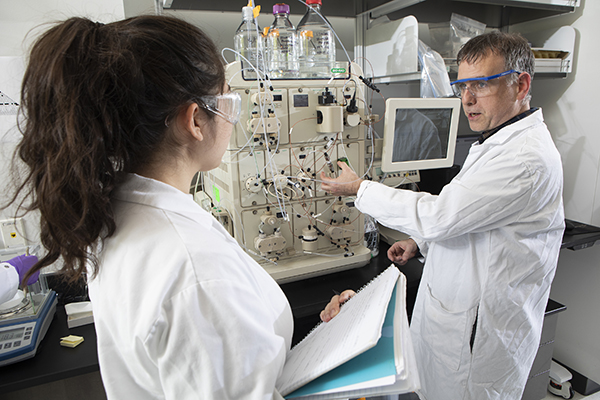
Midlife career changes can be daunting, but L. Nathan Tumey seems to have taken it in stride. After spending over 15 years as a researcher in the pharmaceutical industry, he recently joined Binghamton University’s newly formed School of Pharmacy and Pharmaceutical Sciences.
Over the past 10 years, Tumey’s research in the pharmaceutical industry became increasingly focused on drug-delivery technology, but he wanted to push beyond what he could do with his employer. Industry looks to focus on what will be financially beneficial, so there’s more freedom to explore in innovative ways in an academic setting, Tumey said.
And now, an R15 grant from the National Institutes of Health will support his research for the next three years. The $300,000 grant is for developing targeted inhibitors of an enzyme known as “IRAK4” (interleukin-1 receptor-associated kinase 4). IRAK4 inhibitors are known to shut down the innate immune response and are currently under development for rheumatoid arthritis and Lupus, Tumey said. “Unfortunately, current compounds being studied have significant side effects because they are not terribly selective. I’m trying to improve the selectivity by delivering the inhibitors just to white blood cells.”
He’s looking for antibody drug conjugates to make the delivery.
“By the word conjugate, I mean two things that are joined together,” he said. “In my research, an antibody and a drug are combined. The analogy I like to use is how Amazon uses drones to deliver packages in major cities. In our case, the antibody is the drone — it delivers a biologically interesting ‘package’ to specific cells in our body.
“Normally, all cells in your body are exposed to a medication that you take. This can be good (as with antibiotics), but this can cause major problems when the drug has organ-specific side effects. The approach I’m taking is to try to deliver the drug just to particular cells — to the ones that need it most,” Tumey said. “Once the antibody arrives at the cell of interest, it releases the active drug and the drug does it thing.”
There are currently seven antibody-drug-conjugate therapeutics on the market for the treatment of cancer, but few researchers have tried to use this technology for other therapeutic applications. Tumey is hoping to change that. He and his research team are focusing on auto-immune disorders — Lupus is one he has zeroed in on — with the hope that this method will retain the efficacy of current treatments, but with far fewer side-effects.
“We work with immunosuppressive agents. We attach them onto the antibodies to deliver to leucocytes (white blood cells),” he said. “Many immunosuppressive agents have a variety of side effects due to their exposure to the brain, bone, muscles and other organs. We want to localize their exposure just to white blood cells.”
“The move from industry to academia, in some ways, was more smooth than I expected,” Tumey said. Over his years in the pharmaceutical industry, his career became more and more focused on scientific communication.
“No matter what your field is, it’s not enough to do good science — you also have to convince your managers and others that you are doing good science and that the science you are doing is important,” Tumey said. “Over the past 10 years, I had begun to do more and more public speaking and writing papers in support of our pharmaceutical research. Some might see that as a necessary evil, but I actually found that I immensely enjoyed those things. That was a major part of my decision to move into academia. In that sense, teaching and being an academic researcher has been a natural fit for what I enjoy doing.”
Tumey said that one of his favorite aspects of his job is giving students an appreciation of the scientific complexity and importance of the drug discovery process — the same as he once did for his managers in industry.
For an organic chemist who knew he wanted to relate the chemistry he was doing to the field of medicine in some way, Tumey has found a home, marrying his interests in organic chemistry with biology. “It’s a rapidly developing technology — it’s a struggle to keep on top of the new developments each month — but I find it to be an absolutely fascinating field. I’m so grateful that I’m able to work on something that I find both intellectually stimulating and also useful to society,” he said. “A lot of people have a job that merely pays the bills. I’m fortunate to have one that is lot of fun —one where I’m genuinely excited to come to work every day.”