Undergraduate research opportunities highlight council meeting
First-year Immersion program and Source Project offer first-year students authentic research experiences
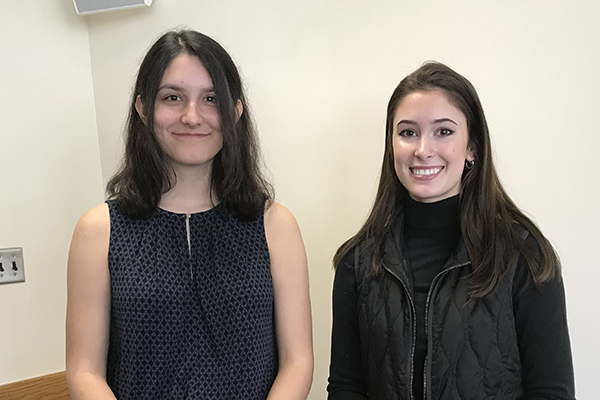
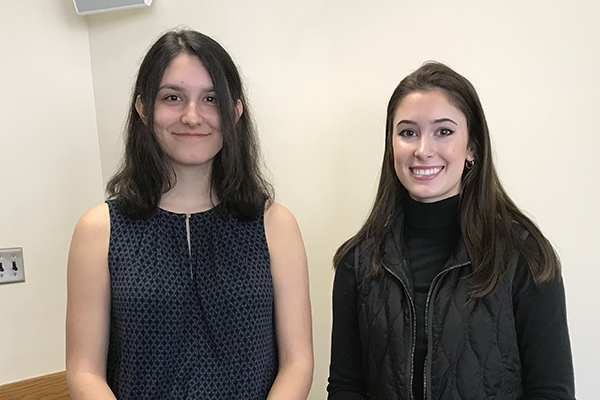
The Binghamton University Council heard reports from the divisions of Academic Affairs and Diversity, Equity and Inclusion at its February meeting, with the highlight presentations by two undergraduate students who are already immersed in research.
“One of the most important initiatives we have in academic affairs is undergraduate research,” said Donald Nieman, executive vice president for academic affairs and provost. “Bright, curious, hardworking students benefit from studying at a research university and students who come to Binghamton have the opportunity to benefit from faculty, postdocs and PhD students who are engaged in cutting-edge research.”
Nieman reminded the council that Binghamton University achieved very high research status (R1 status) from the Carnegie Classification of Institutions of Higher Education in the past year.
“But Binghamton is not just an R1 institution,” he said. “I would argue that it’s in an elite group within R1 institutions. We have highly selective undergraduate programs and use our strength in research to enhance the undergraduate experience. And that’s reflected in our Road Map strategic priorities 1 and 2. We intentionally bring them together to be mutually reinforcing. What we do with undergraduate research exemplifies that balance of teaching research and high-quality education together.”
Nieman focused on two high-impact learning experience programs in his remarks: the First-year Research Immersion (FRI) program, and the Source Project. Both help entering students develop the ability to ask the right questions, learn how to collect data, and find and evaluate information and synthesize, he said. “Research is rarely linear. Our students learn to be nimble and adapt and overcome adversity. And they learn to communicate very complex information and findings clearly. Our students really understand at a pretty sophisticated level how knowledge is created and that’s absolutely essential in today’s world.”
Eliza Klingler and Jordan Thesier, both sophomores, explained how learning to conduct research from their first semester impacted them.
Klingler intended to be a translator when she arrived at Binghamton, but received an invitation to enroll in the Source Project, which provides first-year students in the social sciences and humanities the opportunity to discover sources, and from them, gain new knowledge about the world.
She stressed about whether to accept the invitation. “It was a great opportunity, but my parents said I had to decide for myself because I was going to college,” Klingler said. “I figured if I enrolled and hated it, I would never have to do it again, and if I enrolled and loved it, it would change my life. And it did.”
Klingler, a Korean studies major from Chatham, N.Y., worked with political science Professor David Cingranelli, “analyzing human rights reports to see if we could gauge which specific human rights violations would tell us if a mass atrocity event would happen in the next few years.” She’s currently writing a paper for submission, but more than that, completed what she termed an “amazing internship” with the Committee for Human Rights in North Korea in Washington, D.C.
“I could not have done it without the Source Project,” she said.
Thesier, from Endwell, N.Y., is majoring in biological sciences and came to Binghamton because she was offered a spot in the FRI and Binghamton University Scholars programs.
“I always knew I loved biology, but wasn’t interested in becoming a doctor,” she said. “But I didn’t know what research would look like, and now I know I want to pursue a career in research.
“FRI has taught me the foundational skills I need and the opportunities I could get in research and what a job would look like, and developed a passion for me in biofilms,” Thesier added. “I’m continuing to conduct research in biofilms and am working on acute-versus-carrier strep for the rest of my college career.”
Thesier explained that a biofilm is a community of bacteria that can grow inside the human body but is antibiotic resistant. “In FRI, we’re looking at how changing characteristics can make them [biofilms] less dangerous to human hosts,” she said. “I learned all this without knowing anything about biofilms before FRI. That’s how drastically research can shape your future. I would not have known I loved research without FRI and now I have the skills that I will take into my career. Now I’m extremely prepared for my future.”
Nicole Sirju-Johnson, interim chief diversity officer, also presented to council, providing a review of the Division of Diversity, Equity and Inclusion’s programs and workshops, as well as giving a report on the division’s Road Map strategic priority progress.