The Harpur Law & Policy Panel at Homecoming focused on including everyone’s voice
Faculty, alumni and students discuss key issues of law and policy presented by the 2016 election.
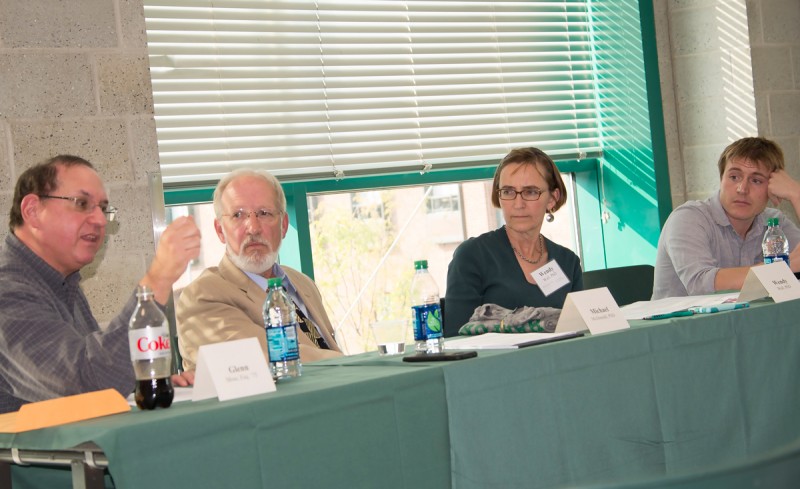
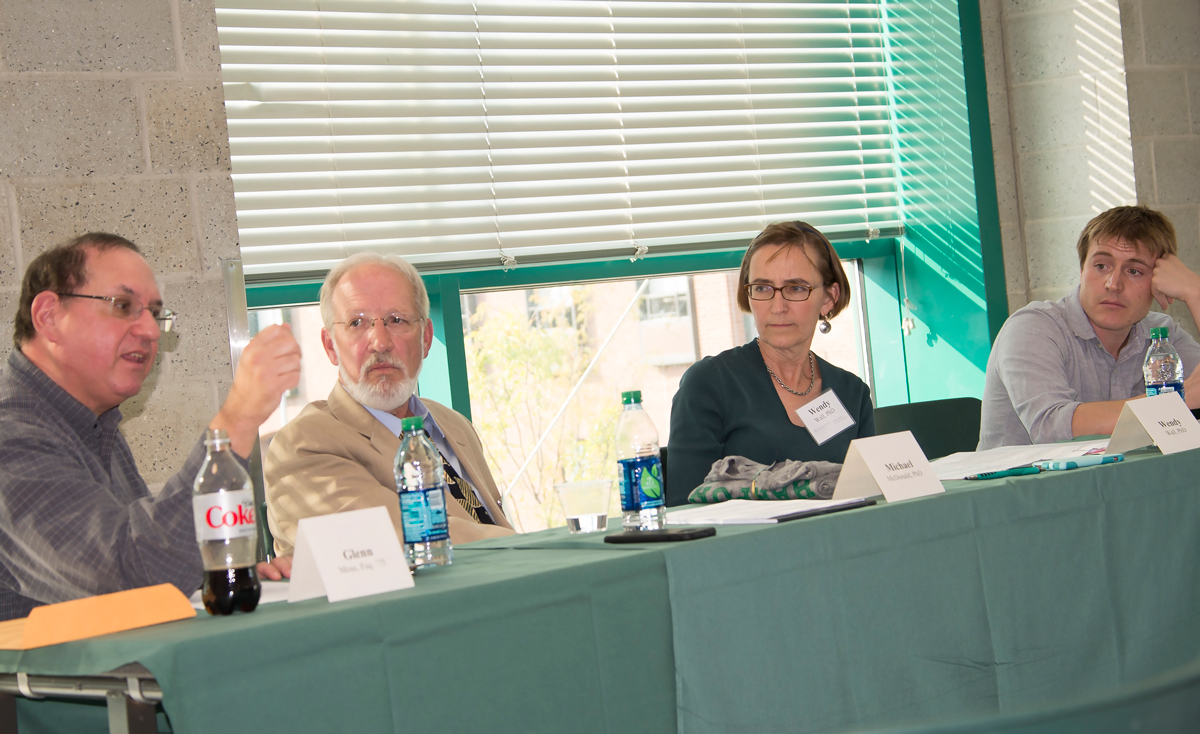
“The theme I take from this election is inclusion and identity,” said Professor Michael McDonald. “I want you to really think about those two ideas as you think about American society, American politics and the American system of self-government.”
The panel consisted of three esteemed Harpur faculty members: professor of political science and director of the Center on Democratic Performance Michael McDonald, associate professor of history and director of the Institute for Advanced Studies in the Humanities Wendy Wall and associate professor of philosophy and director of the Philosophy, Politics and Law program Anthony Reeves.
The homecoming event was led by Harpur College alumnus Glenn Moss ‘75 who is a practicing attorney in New York City, an adjunct lecturer at the School of Management and a steering committee member of the Harpur Law Council of Binghamton University.
Moss wanted to make it clear that despite the level of expertise and knowledge provided by the panel, the event was to be a discussion and not a lecture.
“I believe in civil discourse, and energetic discourse,” Moss said as he addressed the crowd of around 20 students and alumni. “I hope here that we do have differences of opinion, but that it is respected. That doesn’t happen enough and it’s a scary thing to me.”
Moss said he was unsatisfied with the rhetoric surrounding the 2016 presidential election. Normally he does a homecoming event that resembles his School of Management lecture on negotiation, but the fervor of this election cycle made it impossible to ignore. He decided a panel would be the best format to discuss this topic.
“It seemed to me that there’s a cliché that every year there are stark choices to be made and in many ways that’s not necessarily true in U.S. political history,” Moss said. “The next President may appoint two to three supreme court justices and those decisions can determine everything ranging from reproductive rights to whether or not a corporation is a citizen.”
The topics discussed ranged from the possibility of providing voting rights to non-citizens, de-facto segregation in the U.S., the impact that Donald Trump could have on voting coalitions that are seen in this election and the future.
“I think it could have an effect on the short-term, but whether or not 40 years from now it has that effect is another story,” said Professor Wall on the issue of Mr. Trump’s alienation of Latino voters. “If we look at the early part of the 20th century, there were a lot of other groups that were considered maybe not on the same level as African Americans but non-White, Italians, Poles, Jews, and a lot of them faced the same kinds of animosity that’s now directed at Latinos.”
The event provided a forum for students, alumni and faculty to exchange potentially controversial and emotionally charged ideas in a civil environment. This was made clear early on when members of the audience disagreed as to whether or not voting rights should be given to non-citizens.
Some participants were not in favor of providing voting rights to non-citizens, arguing that immigrants may have loyalty to their home countries. Other’s argued immigration is a conscious choice and the desire to be an American should grant you the right.
Professor McDonald quoted a passage from James Madison’s Federalist 57, “the electors are to be the great body of people of the United States,” then added, “We get to quibble over this: Who are the people of the United States?”