Timing is everything for new faculty member
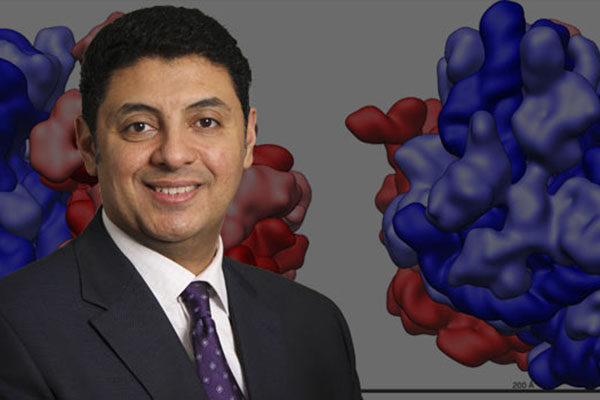
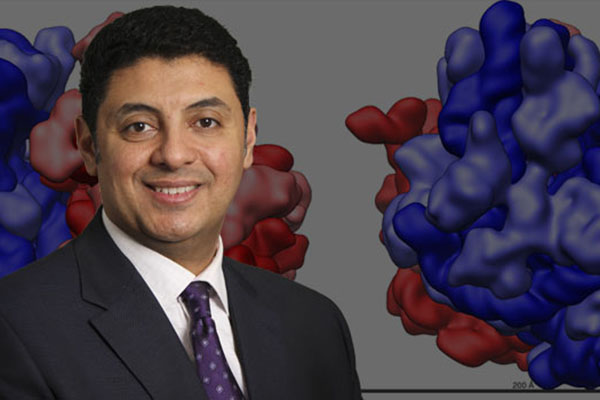
Mohammad Ali, an assistant professor of pharmaceutical sciences, joined the faculty at Binghamton University’s School of Pharmacy and Pharmaceutical Sciences in January, just weeks before classes were moved online and everyone’s world changed. Still, he considers himself lucky.
Talking to him over Zoom, where his background is a stunning view of Jasper National Park in the Canadian Rockies, Ali said dealing with the pandemic has been a challenge, but he likes to focus on the bright side. “Sometimes I think I came here at the wrong time, but what if this had happened in 2019?” he said. “Maybe I wouldn’t have been able to come at all. At least I’m here.”
Here, for now, is an apartment in Johnson City, N.Y., not far from the pharmacy building. His wife, 13-year-old daughter and 9-year-old son remain in Edmonton, Alberta, Canada, where he was a research associate at the University of Alberta until accepting the position at Binghamton. They are not essential workers able to cross the border like Ali, so plans to join him here have been delayed. “Due to all of this craziness, it didn’t work out and they’ll start their schooling in Canada this fall. I’m hoping they’ll be able to join me by the end of the year or for the start of 2021.”
Ali is a Canadian citizen, but an essential worker in the United States. “Funny enough, though it’s quite daunting, my friends say I am like a ghost between the countries,” he said. “I get a lot of questions at the border and explain that I work in Binghamton. I’ve crossed twice now.”
He first crossed when he returned to Edmonton in March after all classes went online. He’s thankful for the support of the dean and his department chair, who allowed him to return to his family while he pursued his teaching responsibilities from afar, but his research was put on hold until the University began opening labs again.
He made the cross-border trip back into the U.S. in early June, after getting approval from the Division of Research to reopen his lab.
“I’m currently aiming to target an NIH grant and need some preliminary data, so I applied to return for research and got approved,” he said. “I came back for six to seven weeks until the end of July and managed to get some good data, but then I felt my family also deserved a break, so I went home to Canada for three weeks to spend some of the summer with them.”
The family time made a huge difference, Ali said, especially given the changes to the fall semester, leaving him to no time to cross the border again until Thanksgiving. He returned to the U.S. in early August, and self-quarantined for two weeks.
He actually self-quarantines each time he crosses the border, even though it’s not mandatory (mandatory in Canada). “I’m doing it anyway to make sure I’m safe and not harming others. I feel an obligation. I care about the community here as well,” he said. “I was required to fill out the New York state form when I arrived in the U.S., and the New York State Health Department phoned me and confirmed that they reviewed my form. They keep checking on me every day. They like to monitor people via text.”
The pandemic has also kept Ali from getting as much done as he had hoped by this time. “I came with a lot of dreams and plans, that by this time I would have established my lab and hired grad students,” he said. “I was just in the middle of building the lab when everything turned upside down and was put on hold, but now it’s slowly coming back — not to normal — but now I’m able to go back to the lab. It’s exciting to continue to build the lab and do some research.”
It’s also good news that the University has put the tenure clock on hold, he added. “These are challenges that we’re all going through, but I like to see it as these are the times that show us how strong we are. We do our best, keep believing in ourselves and have hope and faith.”
Characterizing himself as an international citizen of sorts, Ali is originally from Egypt, but grew up in Kuwait, returning to Egypt for his university and master’s degrees. He first came to Canada as a PhD student, with plans to return to his faculty position at Alexandria University, “but when our kids were born in Canada, everything changed!” he said. “Now we’re opening a new chapter in the U.S. and very excited.”
His advisors at the University of Alberta were the ones to encourage him to broaden his horizons and look beyond Canada for a faculty position.
It was the right advice for him, he said. Plus, as a pharmacist and with teaching experience in Egypt, Qatar and Canada, he put schools of pharmacy at the top of his list when looking for a position.
“I love teaching pharmacy students!” he said. But he also wanted to pursue his research, so Binghamton’s School of Pharmacy and Pharmaceutical Sciences seemed like a perfect fit.
“I liked that it’s a new school and looked at the facility online,” he said. “This is really a nice place, and being a new school, the faculty also match my interests. There’s a cancer biologist, muscle biologists and proteomics — it has all of the techniques and people that I’m planning to collaborate with.
“And also, being at a new school, it’s the best place you can be to pursue a new idea,” he added. “In the new, novel place, this is when you can actually pursue new and novel ideas. I was really fortunate to get the offer from Binghamton. (I actually got three job offers and I chose Binghamton.)”
The research vision of Founding Dean Gloria Meredith was key in Ali’s choice of Binghamton. “Most pharmacy schools are teaching-based, but she has a vision to broaden this and develop a research-based school which is very attractive to faculty like myself and others who are really interested in research.”
Ali’s current research is in the broad field of epigenetics, which is basically a way to control the gene expression without changing the DNA sequence, he explained. “I have two proteins of interest - protease MMP-2 and another protein called RYBP,” he said.
For the NIH grant proposal he’s working on, Ali hopes to focus on a new role of MMP-2 inside cancer cells.
“In my preliminary data, I found that MMP-2 is well known to play a role in cancer, but outside the cell, helping it to move and metastasize; some of the protein also works inside the cell, particularly in the nucleus, but very little research has been done in the role of MMP-2 inside the cell in cancer,” he said. “What I’m proposing is to study the epigenetic role of MMP-2 in cancer. We think that MMP-2 clips certain proteins inside the nucleus, and by doing so, it can modulate the gene expression, which can help a cancer cell proliferate and develop. My notion and my team notion is that maybe we should also think of redesigning those inhibitors to target both outside and inside MMPs.”
Ali hopes to submit his NIH grant proposal next spring and has already received constructive feedback from his mentors, Associate Dean Eric Hoffman and his department chair Kanneboyina Nagaraju. “I’m an early investigator,” he said. “I know that I’m going to learn a lot during this journey. I’m trying to do my best!”
As for settling in at Binghamton, Ali said every place on earth has its own beauty if you’re willing to see it. “Here I like the landscape,” he said. “In Alberta, we live in the prairie part of the province where it’s all flat. I enjoy the ups and downs and hills and houses on the hills. It’s beautiful, even while driving I enjoy the nature and I do believe my family will like it.”
And his final comment? “I really like the people here. They’re extremely nice!”