Pharmacy White Coat ceremonies welcome Class of 2024
Two socially distanced ceremonies held for 90 incoming students
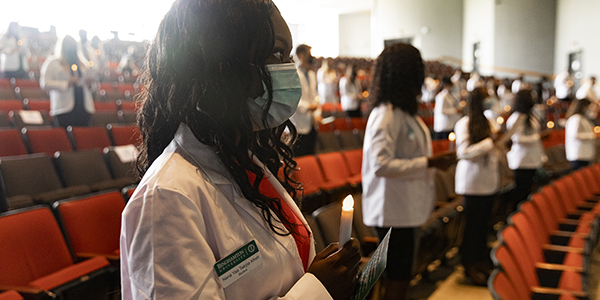
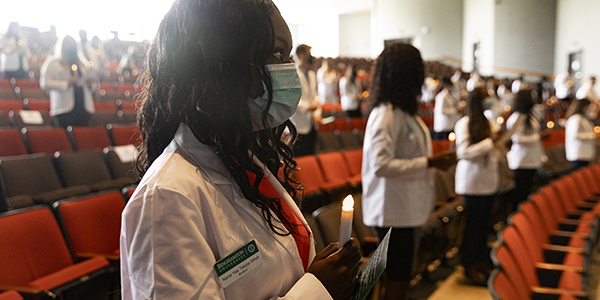
The School of Pharmacy and Pharmaceutical Sciences welcomed its fourth class Saturday, Aug. 29, as 90 students took their Pharmacy Oath in two separate, socially distanced White Coat ceremonies that included a few students joining remotely due to out-of-state quarantine requirements.
With the enrollment of the Class of 2024, the school now has a full cohort of students, with the first class set to graduate in spring 2021.
Following welcomes from Founding Dean Gloria Meredith, President Harvey Stenger (by video) and Executive Vice President for Academic Affairs and Provost Donald Nieman, the students heard video remarks from John Darcy, MS ’07, MA ’10, PhD ’14, medical science liaison and associate director of Novartis Pharmaceuticals, who represented the school’s Advisory Council.
Stenger thanked the students for choosing Binghamton and spoke of his confidence that they will excel while here. “You are at the center of the largest and most important project the University has ever been involved with,” he said. “Your class and school represent a new outpost that will continue to define our great University.”
The future of the discipline of pharmacy is expanding and particularly timely in the age of the COVID-19 pandemic when pharmacists and pharmaceutical scientists will be addressing the impacts of the disease for years to come, he said. “Indeed, Binghamton’s faculty are actively developing technologies that are targeting some of the most difficult healthcare challenges we are facing. At the same time, our pharmacists are often the public face of interactions with the healthcare system.”
The students have arrived at Binghamton at an auspicious time and are now part of an active, energetic and forward-looking program dedicated to improving lives, Stenger said.
“The medical professions are unique among professional schools in having a ceremony like the donning of a white coat,” he said. “As you put on your new coat, you are actually shouldering a new role with new responsibilities. I’m confident that all of you will rise to these responsibilities and make Binghamton University and our community a better place.”
Nieman, able to attend the ceremonies in person, termed them very important rites of passage.
Putting on your white coat marks the beginning of your path to becoming a pharmacist, he told the students. “It’s a symbol of professionalism and dedication to patient care,” Nieman said. “The white coat also inspires confidence in the patients you will serve.
“You are taking a big step today because you are beginning a challenging academic program that will test your stamina, your commitment, your intellect and your compassion during the next for years, but we know you have everything it will take to succeed.”
In the next four years, students will work harder than they ever thought they could, Nieman said. “But it will be a rewarding experience. You’ll discover mentors who will guide and inspire you, meet friends who will help you through the hard times and remain part of your professional network 20 years from now,” he said. “You will enter a profession with unlimited possibilities whose scope of practice is expanding and will continue to expand. You will be part of dramatic changes that are taking place in healthcare — America’s largest industry — that will provide better patient care, extend that care to underserved populations and do it in a more cost-effective manner. And when you graduate, you will be prepared for the full range of opportunities that this exciting profession has to offer.”
Reminding the students that they showed grit and determination to reach this point in their education, Darcy said that, when he was starting his academic career as a student at Binghamton, a wise staff member told him: “A great institution of higher learning is not made of bricks and mortar, or glass and steel. It is made of people who care, people who challenge you, people who help you grow as a person and as a student,” he said. “It is these people who are the foundation and complete architecture of an institution of higher learning.”
At the School of Pharmacy and Pharmaceutical Sciences, these people are everywhere, Darcy said, and he implored students to take advantage of these people and the opportunities before them. “Your futures are unlimited,” he said. “To help you find your way, make connections with faculty, staff and preceptors, your fellow students and even patients who will be in your care. They will help you find out who you are as a pharmacy professional.
“You have so many options, so work hard, be open, imagine your future and become one of those people who help keep this institution great,” he said.
The keynote speaker, introduced by Vice Dean Gail Rattinger, was Lynette Bradley-Baker, the senior vice president of public affairs and engagement with the American Association of Colleges of Pharmacy.
Bradley-Baker said that the students’ white coats represent their entry into the profession, but also their compassion, competence, communication, curiosity, integrity and sense of community. She spoke to students about three areas of focus: opportunities to gain knowledge and experience, ways to expand their network, and how to embrace and grow leadership skills.
Warning the students that pharmacists use many acronyms, she encouraged them to take advantage of their experiential opportunities (IPPEs and APPEs) because “there’s no other time that I had and that you may have when you will have the opportunity to have so many varied and diverse experiences.”
“Ask questions of one another and of faculty. Challenge one another and this will help with your professional development,” she added.
Advocating for lifelong learning, Bradley-Baker reviewed a number of national pharmacy organizations and collaborations, emphasizing the diverse areas that pharmacy students can pursue and the 13 different board certifications that pharmacists currently have available. “Pharmacists are becoming such a vital part of patient’s healthcare teams that there are so many opportunities that you can pursue,” she said.
Telling her story of how she believed she was destined to be a community pharmacist but, after working as a community pharmacist for a year, she returned to school for her PhD in pharmacy administration, Bradley-Baker said she’s now earning a certified association executive credential.
“Many of the opportunities that I’ve had have been due to the network that I’ve established both inside and outside of pharmacy,” she said.
“Healthcare is very small and pharmacy is even smaller, so reach out to your cohort here, but also to those that you’re going to meet on campus and in other professions. Your administrators and faculty will become part of your network as well, so I encourage you to engage with them,” she said. “You’ll find that their journeys to where they are are so diverse. I’ve never met two faculty who have had the same trajectory in terms of their journey.”
Share your own stories and be a resource to others as well, she said.
Reinforcing the importance of professionalism in their role as pharmacists, Bradley-Baker also talked of the value of interprofessional education, understanding the role of those in other healthcare professions and being practice-ready and team-based ready upon graduation.
Her final topic, embracing and growing leadership opportunities, will be a key to success, she said.
“Regardless of your title, you will be looked upon as a leader,” she said. “Everyone is a leader in healthcare.”
Patients, no matter the setting, will look to their pharmacist as a leader, she said. “But leadership is not about managing; it’s not about directing; it’s really about the ability to inspire and influence others.
“Take advantage of all the opportunities you’re going to have through classes, special projects or research activities, or through your student organizations to learn more about the goal or that initiative, but also to stretch some areas of leadership or taking charge or thinking differently,” she said.
Be present in all of your activities and classes during pharmacy school, she added. “Ask questions, read. There is no shortage of information in the lay press or in peer-reviewed literature about the role that pharmacy has and can have in the future. And be an active participant in organizations that are on campus, pharmacy-related or not. Find that interest that makes you happy and you can work on and continue to learn about while you are in pharmacy school.”
Collaboration and the ability to build consensus will always be a hallmark of leadership, she added. “Leadership is about vision, direction and being effective and creating change, and I have no doubt that you will be able to do that,” she said. “And I know you will become great members of our profession.”
The ceremonies continued with students walking across the stage and, instead of being coated by faculty as they would in a non-pandemic world, putting their own white coats on. After passing the light of knowledge (electric candles), Rattinger led the new class in the Oath of a Pharmacist, and the students turned to the livestream camera to wave to their families and friends to conclude the ceremonies.