A passion for statistics aids muscular dystrophy research
Utkarsh Dang teases out data to answer questions
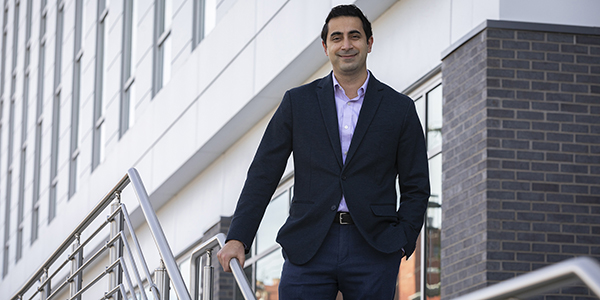
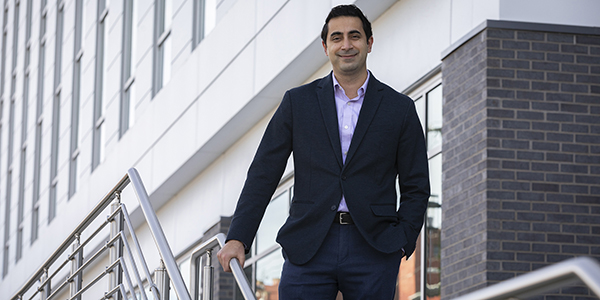
Utkarsh Dang loves statistics. His PhD from the University of Guelph, Ontario, Canada, is in statistics, and his postdoctoral research at McMaster University, also in Ontario, Canada, was in bioinformatics and computational statistics.
Now, he uses his knowledge of statistics at the School of Pharmacy and Pharmaceutical Sciences to delve into data in ways that fellow collaborators haven’t been able to in the past.
Take his work with colleagues on muscular dystrophy, for example. He collaborates with a number of pharmaceutical scientists working on efforts to improve the lives of patients with Duchenne and Becker muscular dystrophy. The data these scientists collect from clinical trials and observational studies can provide a wealth of information and Dang is the one to help them tease out what the data mean.
“The idea is simply this. Everyone is an expert in their field. I’m an expert in statistics, so when I collaborate with someone who has these data sets, I can help them get insight into the data sets that they might miss if I wasn’t there,” Dang said. “We use state-of-the-art statistical and machine learning models as needed.”
Duchenne muscular dystrophy is a rare, severe disease that affects boys, and data can be hard to get, Dang said. “It’s a progressive disease, so by the time these boys hit 7 or 8 years of age, they’ve already basically started declining in terms of what we can see clinically,” he added. “There can be honeymoon periods early on between 4 and 7 years of age when they’re still improving because they’re growing up and their strength is getting better, but because the disease is so progressive and severe, once they hit age 7, 8 , 9 or 10, they’ve started declining. In their teens, many young men end up in wheelchairs and by the time they’re in their 20s and 30s, they pass away.”
A real challenge, Dang said, is how to determine which boys with Duchenne are more severe and will progress faster than others in clinical trials and observational studies.
It’s possible to have these children perform some motor skills tests to measure how long it took them, but the age of the boys can be a factor.
“There’s a component when you’re working with young children,” Dang said. “How motivated are they to perform well that day? Or how willing are they to cooperate? We’re talking about 4- to 5-year-olds sometimes.”
As a result, there’s been a push toward working with biomarkers where a blood or urine sample is taken, in addition to asking these young boys to complete motor skills tests. In the future, these may replace a majority of the motor tests, Dang said.
“If we can do that, we can cut down on the burden on the families of traveling to clinical sites,” he said. “We can also do a better job of setting up a clinical trial.”
The variability in how these children manifest Duchenne is also a challenge. “Some of the children with Duchenne might be in a wheelchair by the time they’re in their teens, and some might be by the time they’re 11, whereas others not until they’re 17 or 18,” Dang said. “Imagine when you’re working with a rare disease, and there’s a ton of variability, and in a clinical trial you can only enroll so many people because it’s a rare disease, it can be hard to tell if a drug is really failing or did the trial just get the really severe subjects who could not have been helped anyway.”
To meet this challenge, Dang can use statistical models and the noninvasive biomarker data to better model what level of severity and outcomes these children would have.
“That’s an area where we published a paper in Human Molecular Genetics this year,” Dang said, “where we used circulating proteins in blood to be able to better model pre-treatment clinical outcomes, with an aim of better explaining this variability in severity.”
Dang works primarily with Eric Hoffman, associate dean and professor of pharmaceutical sciences, and Yetrib Hathout, professor of pharmaceutical sciences, and had hopes to be involved in these types of collaborations when starting at the School of Pharmacy and Pharmaceutical Sciences.
“This is real-world data and this is a chance where we could actually help these people with these rare diseases,” he said. “It’s exciting because there’s a real opportunity to make a difference in someone’s life, but also we’re pushing science forward in many ways.
“Just from a statistics point of view, putting aside the pharmaceutical sciences collaboration from where I’m getting the data, there are newer methods, techniques and methodologies coming out every month and I have to stay on top of those so I have the latest, greatest tools to achieve the greatest amount of insight from a particular data set. It’s a good challenge.”
Yet another challenge is working during a pandemic. Dang is lucky, he said, because he can work wherever there is a computer as long as he has access to papers that are coming out. The delay for him has been the ability of collaborators to generate data for him to analyze.
“We were supposed to generate some data in the early summer of 2020, but there were few researchers in the lab at that point due to the pandemic restrictions,” he said. “In other cases, some of the clinical trial data has been affected by whether subjects can get to a clinical trial site, or whether they feel comfortable in doing so.”
So the pandemic hasn’t stopped Dang, and has barely slowed him down. On the tenure track for the first time, with the pressure to produce papers and garner grants, “it’s really brought into focus that I do absolutely love research,” he said.
He also loves teaching, especially courses such as biostatistics and public-health courses.
“The thing that was newest to me as a tenure-track faculty member because I’d done teaching and lots of research before was service, sitting on committees and making sure you can prioritize these things because that runs the school,” he said. “It’s not going to get you a paper, but those are essential parts of the job.”
Dang chairs the Assessment and Evaluation Committee and sits on others. He is also the school’s diversity officer and, as every pharmacy faculty member does, advises anywhere from three to six PharmD students every cohort.
“It’s nice to be able to talk to my advisees and other students and offer my insight; I have worked in so many different areas and my academic background is quite diverse in many ways,” he said. “It’s also nice because I’m learning every day I’m in the school just being on committees with pharmacists and being on the Accreditation Committee and so on. It gives perspective and if there’s a question I can’t answer, I refer them to a pharmacist.”
One example of how Dang works to open up students’ eyes to the many career opportunities they have is through co-curricular activities. “I ran a co-curricular last month where, through a pharmacy colleague at Binghamton, I was able to invite a couple of pharmacists who work at the Poison Control Center in Syracuse through Upstate Medical,” he said. “Some of the students didn’t know that was a possibility, so there are lots of paths forward and it’s interesting to help the students learn that.”
On the home front, Dang and his wife met the pandemic head-on when their 5 ½ and 2 ½ year olds were home for three solid months, though now they are back in school and daycare. “It was an interesting challenge to juggle the work and make sure that they were thriving at the same time,” he said. “Now, when we have free time, we’re spending it with the kids.”