Demand for quarantine/isolation housing has risen this spring
Campus quickly scales up quarantine/isolation housing support
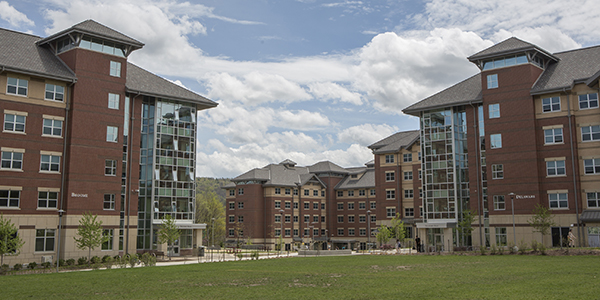
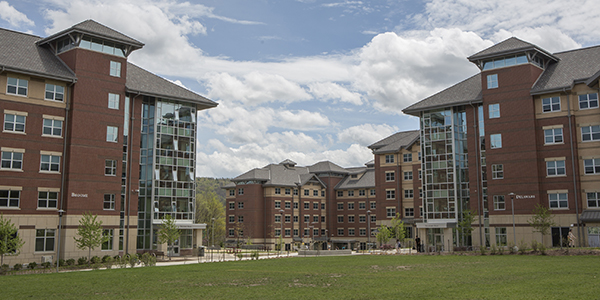
Binghamton University’s fall 2020 semester proved the need for quarantine and isolation (Q/I) housing on campus but could not have predicted the large volume of daily positives early in the spring 2021 semester that has stretched Q/I staff and resources. Q/I housing never extended past 50% in the fall semester, but the spring semester is proving to be something different.
The University has scaled up operations to meet demand and currently has 601 beds available for Q/I housing, including quarantine-only accommodations at local hotels. A team of 30 people ranging from emergency health and safety staff to University President Harvey Stenger meets daily to discuss any issues or upcoming challenges. Each day the team addresses issues that include transportation, meals, laundry, technology, package delivery, communications, wellness, cleaning, academic support, worker safety, discipline, COVID testing, student communications, parent communications and Q/I housing.
This effort scaled up quickly during the early weeks of the semester as an unusually high case count overwhelmed the original Q/I configuration established last fall. “Every positive case produces one person in isolation and, depending upon contact tracing, four to five others who must be quarantined,” said Tim Faughnan, the University’s associate vice president for emergency services. “It took us a few days, but with the help of staff across campus taking on extra duties, we’ve been able to accommodate all of the students who have required Q/I housing.”
Though there’s no definitive answer to what caused the surge in positives, more than likely, it came from large social gatherings when students were not wearing masks. “Our first few weekends indicated as much,” Faughnan said.
The University’s goal is to help make students’ time in Q/I housing manageable, as well as productive, Dave Hubeny, executive director of emergency management, added. “If they are healthy enough, we support them so they can continue their studies remotely without too much interruption.”
Current support runs the gamut, but food is at the top of the list:
- By closing CIW Dining Hall to everything except meal preparation for Q/I students, it has been possible to produce freshly prepared, consistent, quality meals delivered on time, said Deanne Ellison, director of Auxiliary Services. “Students can order their meals online in advance, so these changes have streamlined our meal delivery process right to the students’ doorstep twice daily,” she said. Also, there is a meal hotline that provides service to newly quarantined or isolated students and a safety net for students who are in transition during a meal period and cannot pre-order. “We have reassigned employees from different operations and units to supplement our workforce, which has enabled us to address meal delivery needs as they surge.”
- “We provide safe transportation for students and their belongings to their Q/I destinations,” said Tanya Husick, executive director of Transportation and Parking Services. “Our objective is to move people into Q/I housing as quickly as possible, which helps cut down on the transmission of the virus to the general population. When students are released from Q/I housing, we also transport them back to their res hall.”
- A group of consultants managed by the Care Team checks in on students each day to make sure they are feeling well or if there has been a change in their health status. After considerable effort, the University recently retained a third-party, after-hours medical service that provides 24-hour coverage.
- A system has been put in place to ensure that any packages sent to students in Q/I housing are delivered to them wherever they are. Importantly, the University has created a process to pick up prescriptions from local pharmacies as needed for Q/I students.
- Early on, the University made Wi-Fi hotspots available to students quarantined at hotels to provide internet access for classes. Recognizing that hotspots were only a short-term solution, the University installed dedicated Binghamton University campus Wi-Fi within the hotels to ensure that the students housed there receive quality internet service. Q/I students have also had additional needs, such as loaner laptops and printing.
- Academic support is also crucial and the provost has asked that faculty be aware of students in Q/I housing. If in-person testing is necessary, proctor services are provided. Furthermore, collegiate professors are reaching out to students who are in their residential communities to offer support.
And what if a student is celebrating a birthday while in Q/I housing? They will get a special-delivery cupcake and a phone call from President Harvey Stenger wishing them a happy birthday and speedy recovery. Along the same lines, the Dean of Students Office provides regular contact for niceties (special needs, scheduling outdoor visits by student performing groups, etc.).
None of this was easy from a resource perspective and it took some time to get up to speed, said Faughnan. “It has taken the work of many staff from all across campus who have reworked schedules and volunteered for other duties. The current Q/I setup is prepared to scale up even further if necessary, but we are hopeful that our positivity numbers will continue to remain low and it won’t be necessary.”