Student gains experience, finds direction through summer internships
A few weeks into her final semester, Zarayli George learned she was shy of the required coursework for graduation. Not wanting to close out her undergraduate career in summer school, she weighed the idea of an internship. She would satisfy the academic requirements and would also gain some real-world experience as she considered post-graduation next steps.
As a member of the Collegiate Science and Technology Entry Program (CSTEP) during her final year, George elected to apply to CSTEP’s six-week summer internship. Like other summer internship programs, students earn a stipend while participating in faculty-led research — gaining knowledge of project proposal and development and other practical research skills.
George, a biological sciences major, was considering graduate programs in either midwifery or psychology but was unsure which direction to take. So her mentor, Sharon Bryant, associate dean for diversity, equity and inclusion at Decker College of Nursing and Health Sciences, connected her with faculty members doing research that would help her explore her competing interests. Both Nicole Rouhana, assistant professor and director of graduate programs at Decker School of Nursing and a nurse practitioner in obstetrics and gynecology in private practice, and Myra Sabir, retired associate professor of human development and associate dean at the College of Community and Public Affairs, agreed to work with George.
Building a comprehensive internship experience
Rouhana had a Health Resources and Services Administration (HRSA) grant with expiring funds that she wanted to donate to a community organization working on rural health issues. Partnering with the Broome County Office for Aging, Rouhana proposed a project to examine and address social isolation in rural senior populations. This project provided the basis for George’s CSTEP summer internship, “Reducing Social Isolation of Rural Elders Using Digital Technology.”
Along with the research project, George worked with Rouhana one day a week in an OB-GYN office, gaining insight into the day-to-day practice of a women’s healthcare provider.
Social isolation in rural populations
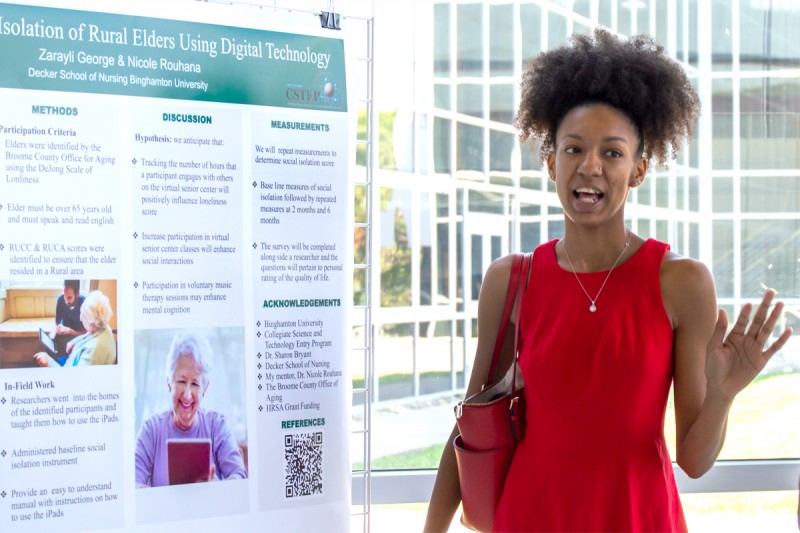
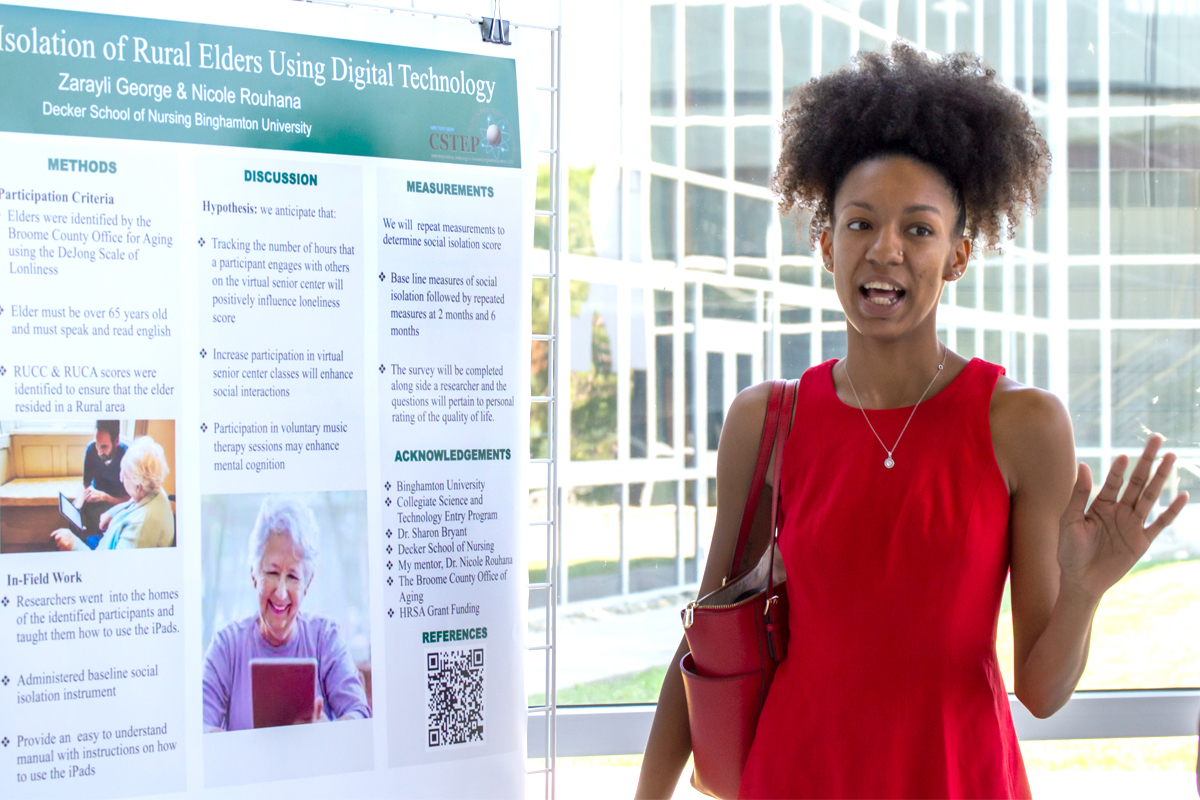
The social isolation project proposed that connecting seniors virtually would help decrease feelings of isolation and loneliness. Fifteen iPads were purchased with the HRSA grant and distributed to local seniors who were part of the Office for Aging’s Meals on Wheels program and identified as at risk for loneliness and social isolation based on a sociological survey the office had conducted the previous year.
The Virtual Senior Center (VSC) app was the primary portal installed on each iPad. The VSC connects users through chat rooms, live online classes, virtual travel and museum tours, and other opportunities for social interaction. Access to virtual health services like telehealth visits and electronic medical records management was also an essential feature. The Office for Aging addressed internet issues, and George would provide in-home, hands-on instruction plus customization specific to user interests and needs.
George developed the project parameters under Rouhana’s direction, and in mid-July, she presented hypotheses and predicted outcomes at a research poster symposium when the CSTEP program officially concluded.
Although the internship program ended in July, fieldwork was still not completed. So, in late August, George returned to the task, meeting with five of the 15 participants in their homes to help them set up and personalize the electronic devices.
“It took a while before I was finally able to get the fieldwork off the ground,” George said. “Because of the delay and new competing commitments, I was unable to meet with all the participants. However, I left the project in a good place, and I am hopeful that someone will be able to easily pick up from where I left off.”
Although George’s participation ended, Rouhana intends to move forward with the project through the end of this year.
“I envision this as a pilot program that I would like to eventually grow,” Rouhana explained. “We’ll look at the results of the study based on several follow-up surveys that participants can access on the iPads. If we can demonstrate successful outcomes and find additional funding, I’d like to expand the program to other seniors in the area.”
Internships clarify direction
In addition to the social isolation project and internship at the OB-GYN office, George worked with the recently retired Sabir on a novel online learning studio. While Sabir developed course material, George assisted with the technological aspects of creating the digital platform. The project is ongoing, and George plans to continue her work with Sabir in the future.
For George, the internships provided clarity and a sense of direction.
“My time in the OB-GYN office showed that it was not the right path for me,” George said. “Working with Myra helped shift my focus toward psychology and mental health. And after helping develop the social isolation project with Nicole, I realized how much I enjoyed fieldwork and overseeing the development of a research project. With a deeper understanding of research principles, I feel better prepared to apply directly to a PhD program.”
In mid-October, George will travel to Tanzania for an internship coordinated through Medi Trip Volunteers and the Tanzanian-based Siret Volunteers program. Over the next few months, George will shadow psychiatric professionals in the mental health unit of the Mount Meru Hospital in the Arusha region of Tanzania, while conducting community outreach at local schools, helping to reduce cultural stigmas around mental health issues through education and early intervention initiatives.
“My time at Binghamton was super busy and went by quickly, but I am glad I took advantage of all the opportunities that came my way,” George said. “Having hands-on experience this past summer helped me understand what I wanted to do with my life and gave me the knowledge and confidence to pursue it.”