What do you get from a college education?
Student Assembly leader contemplates the future of public education as he embarks on new chapter
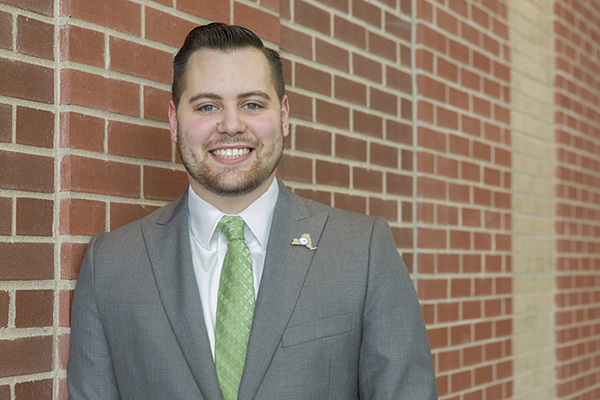
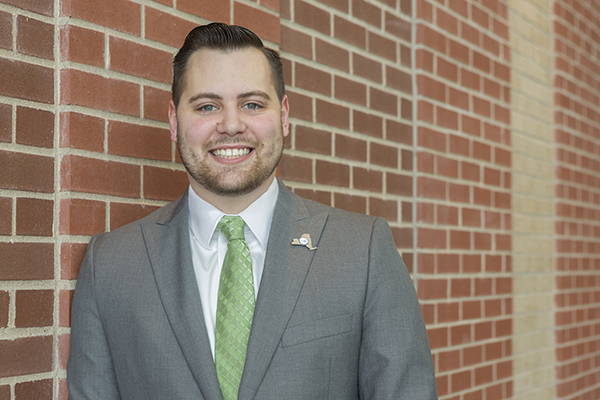
Many young adults struggle to come up with a confident way to answer the most daunting question for recent grads: You’re done with college, now what?
Thomas Mastro ’16 has prepared a smart, straightforward response.
“I want to be a senior administrator at a university,” says Mastro, who majored in human development and is planning to pursue a combined master’s in public administration and higher education.
The decision, rooted in his passion for student affairs, culminated with his tenure as president of the State University of New York (SUNY) Student Assembly (SA). During his 2015–16 term, Mastro “worked to unite the many voices of one of the most diverse student bodies in the country.”
“Many” may be an understatement. The SUNY SA represents more than 463,000 students attending the country’s largest system of public higher education.
Mastro, who transferred to Binghamton from SUNY Broome in 2015, was active in the student associations of both SUNY campuses, igniting the desire to elevate his leadership with a new role.
“I saw the potential in the SUNY SA,” Mastro says. “I looked at the organization and asked myself, ‘What can I do better?’ I knew that if we worked together, we could actually make the SA reach its full potential.”
As president, Mastro set his sights on building a comprehensive system of student government in New York state to bridge the gap between public and private schools. He also testified at a joint legislative budget hearing on higher education with SUNY Chancellor Nancy Zimpher.
“It was a unique experience, and it was the first time an SA president had the opportunity to sit in on that type of panel with the chancellor and work on the SUNY-wide budget proposal,” Mastro says.
Mastro also served on the SUNY Board of Trustees, the governing body of SUNY, which allowed him to take part in major changes to SUNY such as tuition regulation, admission requirements and new campuses.
“The trustee position required my participa-tion in policy and deci-sion making, whereas the president position was more hands on,” Mastro says.
While Mastro served at the helm of the SA, he says his coursework was always his priority.
“One of the biggest things that I said to my executive committee was, ‘classes come first.’”
The human development program prepares its graduates to work in a variety of education settings. Mastro says the community schools model — taught in one of his favorite courses — has affected his outlook on public schools.
“A community school emphasizes partnerships between the community and the educational entity,” Mastro says. “When I go into higher education, I really want to focus on this model and how I can impact not only a campus, but an entire community.”