The closest look: When art hits the lab, a filmmaker discovers new perspectives
To create his latest experimental film, Associate Professor Monteith McCollum used something unexpected: an electron microscope
During his final trip to Alaska in 1923, Warren G. Harding’s health began to fail.
The 29th U.S. president and newspaper editor died shortly after “The Voyage of Understanding,” as the tour was known, only two years into his term. He’s the subject of a new experimental film by Binghamton University Associate Professor of Cinema Monteith McCollum that premiered at the 61st annual Ann Arbor Film Festival.
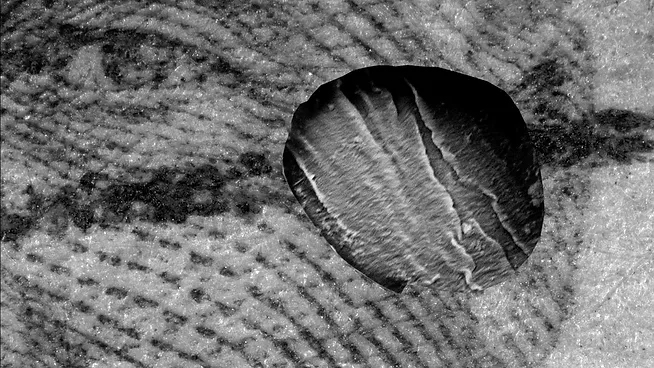
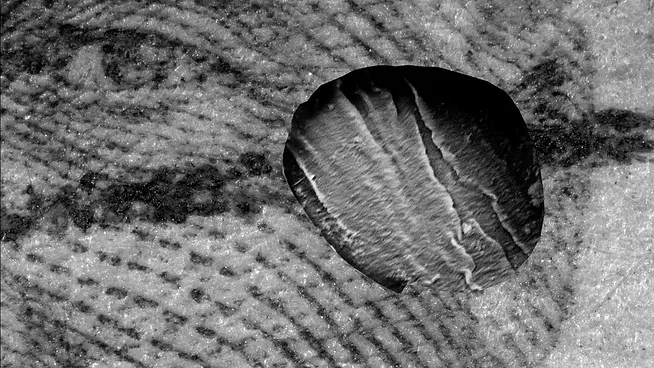
McCollum created 2cent / 10coil with a technology that Harding himself could never have imagined: a scanning electron microscope, part of Binghamton’s Analytical and Diagnostics Laboratory (ADL). The film ended up winning the festival’s Gil Omenn Art & Science Award.
In the film, he uses an electron microscope to scan sectors of an antiquated U.S. postage stamp featuring Harding. The film begins with a recording of Harding’s voice, and then integrates philosophical musings and speeches he penned during his final trip to Alaska, accompanied by field recordings from the Adirondacks.
“It’s an amazing tool,” he said of the microscope.
McCollum is no stranger to the festival: He’s shown work there multiple times and served as a juror in the past. But the ADL was entirely new; he received a grant giving him access to its state-of-the-art equipment, used for the characterization of materials and devices.
He worked closely with research scientists Jenny Amey and In-tae Bae, research engineer William Butler, and Biological Sciences Professor Karin Sauer on the project, which began during the pandemic. Using a scanning electron microscope is no simple affair; he spent months working with optical microscopes first.
An electron microscope is very different from an optical microscope or camera, McCollum explained.
“You can’t physically touch the material that’s being filmed or rendered; you have to place the object in a sealed pressurized chamber, then the sample is rendered through the process of electrons bombarding the object,” he said. “There is a black-and-white camera that shows where it is located within the chamber but that’s just there to see how to move the sample around. It’s a unique experience; as a filmmaker I’m used to looking at the object I’m filming.”
He was initially interested in using the electron microscope to look at samples from old-growth hemlock and oak he acquired in the Adirondacks. Scanning electron microscopes, after all, are used to create highly-detailed images in black and white that sport an almost solarized look, McCollum explained.
What would natural fibers look like using this kind of microscope? he wondered.
Looking for a central concept or story, he settled on the postage stamp; still composed of fiber derived from trees, a stamp also has a shape and boundaries that allow for different compositions depending on the point of focus.
Prior to scanning, the object is coated with carbon, giving it the appearance of opaque silver. The chamber takes 10 to 15 minutes to pressurize; after that, still images take up to a minute per scan.
Assembling these still frames into a time-lapse sequence, McCollum noticed something strange: some of the fibers appeared to be moving. This was realized much later, after the series of frames had been compiled. From conversations with the ADL scientists, he found that heat from the electrons was causing the pulp of the stamp to move in unexpected ways. As an artist, McCollum was interested in replicating the phenomenon and using it as the basis for movement within the film.
“He was on the train looking out at the passing landscape, trying to comprehend the sheer beauty and vast forests,” McCollum said of Harding’s final trip. “He was also talking to Alaskans about the importance of the land and resources including the lumber industry. There’s this interesting connection between my original interest in fiber and wood, and what this man was going through on his travels during the last days of his life.”