Donor speaks about ‘Works on Paper Between the Wars’ exhibition
Gil Williams and his wife, Debra, donated thousands of pieces of art

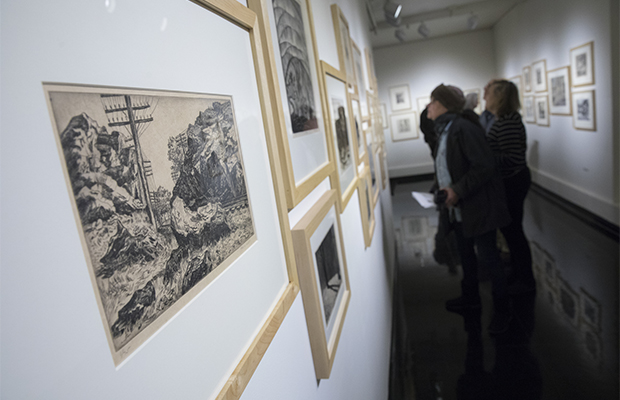
The Binghamton University Art Museum on Feb. 16 welcomed art collector Gil Williams to speak in its main gallery about his recent donation of over 400 pieces of art.
Williams donated various forms of art to the museum, predominately dating from the 1930s, to give his treasures a new home.
“This fall, Gil was incredibly generous with a loan of about 50-60 19th-century photographs,” said Museum Director Diane Butler. “He said, ‘take what you want,’ but of course we couldn’t take everything.”
The first floor of the museum currently features over 100 prints donated by Williams and his wife, Deborah. A series of prints is also on display on the mezzanine level, paired with vintage clothing from the 1920s, ’30s and ’40s from the Theatre Department’s costume collection.
“I want this art here at the University so current students and future students can learn more about American art,” said Williams. “Hopefully in the future someone will come in and add a chapter two.”
Williams grew up in Rockland County, surrounded by artists and artistic culture. He began collecting art at a young age when his mother took him to museums in Manhattan, and now he acquires about a print per week, making his collection incredibly large and growing exponentially. Much of Williams’ collection was given to him directly by the artists as gifts. He showed interest in the artists through letters and even by visiting them and their homes. He hopes to grow his donation over time, with art produced after 1945.
The Williams’ collection includes work from over 900 men and women, many of whom Williams and his wife visited. Among the collection is work from Clare Leighton, a 1930’s English/American artist, writer and illustrator most famous for her woodcarvings and depictions of rural life.
“I don’t collect art, I collect a time period,” said Williams.
In keeping with the manner Williams collects, the current museum exhibit is hung by subject matter, not time period. Each piece represents a time period and although is typical to the era, doesn’t duplicate another artist’s work.
Art in the University’s collection is available for viewing regardless of whether or not it is currently on display. The gallery has a study room where visitors are welcome to request to view any works the University has.
“There’s nothing like seeing a real work of art as opposed to a reproduction in a book,” said Butler.