Bearcats on the Bench: Alumni follow diverse paths to the judiciary
A liberal arts education prepared these alumni for the pinnacle of the legal profession
Some people have a deep knowing that shapes their path, from their earliest childhood: This is what I am meant to be, the deeds I am meant to accomplish, the societal role I am meant to fulfill.
“I wasn’t one of those people,” admits Lillian Wan ’97, who weighed her post- Commencement options: Teach for America, a master’s in social work, a law degree. “At the time, I really didn’t have a clue what I was going to do with my English major, but I knew there were so many things I could do.”
The same could be said for fellow English major Michael J. Garcia ’83, who spent some time as a journalist, or history major Elaine Debra Kaplan ’76.
All found their way to successful law careers, and eventually to the judiciary: Wan is an associate justice in the Appellate Division’s Second Department; Garcia is an associate judge of New York State’s Court of Appeals; and Kaplan is the chief judge of the U.S. Court of Federal Claims. They’re not alone; you can find Binghamton graduates in many courtrooms, as judges, attorneys and clerks.
The journey to the judiciary is notoriously winding: You don’t enter its ranks directly, but often after long years in a variety of different roles, from corporate law firms to government service. A robust liberal arts education is one of the ingredients for success.
“As a trial attorney, you need to be able to think on your feet and handle arguments made by an opposing counsel whose understanding and theory of a case may be different than yours,” says Kyung S. Auh ’02, a sociology major who now serves as a judge in the Ulster Immigration Court. “My time at Binghamton gave me the foundation I needed in critical thinking, being open to viewpoints and opinions that were different from my own, and engaging in discussions with others while remaining civil and respectful.”
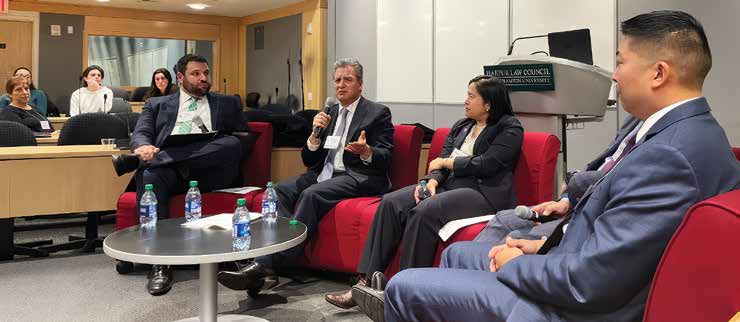
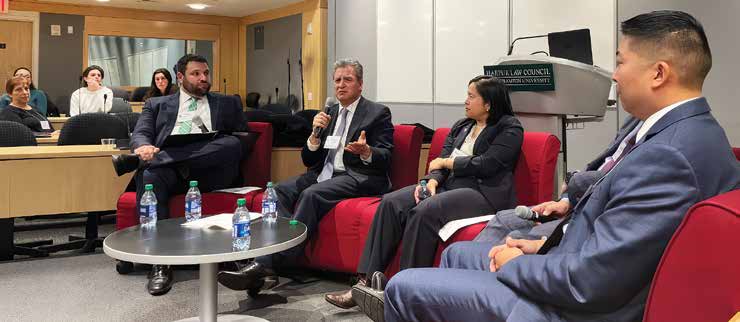
A quartet of alumni judges shared their journey with Harpur students and alumni during a November 2022 panel discussion dubbed Bearcats on the Bench. Held in the SUNY Global Center in New York City, the event featured Wan, Garcia, Auh and Joel M. Cohen ’83, a New York State Supreme Court Justice in the Commercial Division; it was moderated by Seth Meyer ’07, an attorney who represents businesses and individuals in the construction, energy, healthcare and real estate sectors.
Learning from the judges
“As a board member of the Harpur Law Council, I wanted to offer something that would give a fresh, interesting perspective to students, law students and practicing attorneys,” says Meyer, who earned his undergraduate degrees in political science and history. “Who better to learn from than the people who are making the decisions?”
About 100 people attended the event, including two-dozen Binghamton students as well as recent graduates, alumni in law school and in the early stages of their careers, and seasoned attorneys. They included Leticia Fabene ’23, a psychology major now enrolled in the Master in Public Administration program. A first-generation college student, Fabene’s parents migrated from Brazil in the late 1990s, which sparked her interest in immigration law.
“The experience of being my parents’ translator, teacher and advocate has stuck with me throughout the years and has been the cornerstone of my desire to help other families and individuals who go through similar situations,” she says.
The panel discussion introduced her to the wide variety of fields within law, some of which she had been unfamiliar with. She was struck by how unique the panelists’ journeys were, and how they were able to build off their particular interests, backgrounds and life experiences during the course of their careers. After Bearcats on the Bench, Fabene found herself even more dedicated to her dream of becoming an immigration lawyer.
“I feel more confident and excited about what the future has in store for me,” she says. “I especially know that I have an extensive network of alumni and mentors at Binghamton that is ready to support and assist me through this journey.”
Many paths to the bench
Every path to the bench is different. Auh and Cohen decided on legal careers early in life, drawn by the intellectual challenge and potential for practical impact.
“Plus, arguing comes naturally when you’re from Brooklyn,” Cohen jokes.
After earning his bachelor’s, Auh needed to find a route to law school, which is notoriously expensive. His brother had enlisted in the Marines years before; he decided to go the military route himself and chose the Air Force, entering as an officer.
After leaving active duty in 2007, the Queens native became a reservist in the Air National Guard, allowing him to attend law school full-time during the day. Summer internships in prosecutors’ offices in Manhattan and Queens led to his first post-law school job as a prosecutor. After six years, he became a trial attorney for the Department of Homeland Security, handling immigration cases; sitting immigration judges later encouraged him to apply for the judiciary. He did and has been hearing cases since March 2019.
After Binghamton, Cohen headed to Georgetown University Law School, where he was among seven SUNY grads in his class; several of them worried how they would fare in a school full of Ivy League alumni, he recalls. At the end of that first year, they compared notes.
“All seven of us did really well; it was illuminating,” Cohen says. “The point is that once you’re in law school, everyone is on a level playing field. The same is also true once you get into practice. In the end, hard work and skill are the most important factors.”
He spent 30 years at a law firm, and then heeded the call to public service by applying for an appointment to the New York Court of Claims, which then led to the New York Supreme Court and ultimately its Commercial Division. It’s a dream job for him.
“I couldn’t be happier with my Act II,” he says. A native of Brooklyn, Kaplan attended Harpur from 1972 to 1976 — a time of political upheaval, which inspired her to make a difference in the world in the area of civil liberties. Still, she didn’t consider law school and her post-Commencement plans until her senior year, and also ended up at Georgetown.
“My career trajectory only makes sense to me when I look in the rearview mirror,” Kaplan says.
She sent 34 years as an attorney before becoming a judge; 20 of those were spent as a litigator first for the U.S. Department of Labor and then for a labor union. In 1998, then-U.S. President Bill Clinton nominated her to head the Office of Special Counsel, a small federal agency tasked with protecting merit-based civil service. That political appointment led to others: She was asked to join President Barack Obama’s transition team, then became general counsel — and eventually acting director — of the U.S. Office of Personnel Management before she was appointed to the U.S. Court of Federal Claims in 2013. She became chief judge in 2021.
“As the first term of the Obama administration ended, I started to think about next moves and decided that maybe it was time to think about joining the bench. I had been a lawyer for a long time,” she reflects. “I thought maybe it would be the appropriate capstone to my legal career.”
Taking a break before law school, or even pursuing law later in life, isn’t an impediment to a successful legal career.
The accidental attorneys
A Long Island native and a first-generation college student, Garcia had a love for reading and writing. His high school English teacher mentioned Binghamton’s English Department — then home to celebrated author John Gardner — as a good option. He went on to earn a master’s in English from the College of William and Mary, and worked as a journalist until the economic downturn in the 1980s led him to rethink his plans.
After law school, he spent a year at a corporate law firm on Wall Street before becoming a law clerk with the State Court of Appeals — the same court he works at today. Afterward, he spent eight years as a federal prosecutor before opting for a different kind of public service as an assistant commerce secretary for export enforcement, a position that deals with export controls on sensitive technology.
Then the Sept. 11 terrorist attacks sparked significant changes in U.S. government agencies.
Already confirmed by the U.S. Senate, Garcia moved into the Immigration and Naturalization Service, where he was the last acting commissioner while the agency was remade into the new Department of Homeland Security. After the transition, he worked as assistant secretary of immigration and customs enforcement for Homeland Security.
“It was a very creative time in government; it was complete reorganization of these various groups and assets,” he reflects.
He returned as U.S. Attorney in the Southern District of New York for three and a half years, served as vice president of the Americas for the international police organization Interpol for a three-year term, and then spent seven years at a large international law firm. He also chaired the investigatory chamber of the Federation Internacionale de Football Association’s ethics committee, looking into corruption issues.
Garcia jumped at the opportunity to come full-circle, so to speak, and apply for a judgeship in the same court he served as a law clerk early in his career.
People ask, ‘Did you always want to be a judge?’ and the answer is no,” he admits. “You want different things at different stages in your career. I’ve always loved public service and I thought that this would be an opportunity to achieve that in a very meaningful way, but I hadn’t really considered it before.”
Also a Long Island native and the daughter of Chinese immigrants, Wan’s interest in family law drew on one of her college experiences: At Binghamton, she interned at the Broome County Department of Social Services, shadowing social workers and helping them out with cases. As an attorney with the New York City Administration for Children’s Services, she appeared in New York Family Court nearly every day for nine years, but had no idea how the court’s judges ended up on the bench.
“I thought they just dropped from the sky,” she admits. “I had no idea about the different pathways to becoming a judge, the elected route and the appointed route, or the different appointing authorities.”
Prior to taking the bench, Wan was a court attorney-referee in Kings County Surrogate’s Court, where she handled cases related to adoption, guardianship, trusts and estates. The jurist there became her mentor and encouraged Wan to pursue a career in the judiciary.
“It wasn’t a mystical process; it was actually a real application that you could download from the website; you fill it out, and you apply and you get interviewed,” Wan recalls. “It took someone else pushing me for me to realize I know exactly what I want to do when I grow up, and that this is where my talents lie.”
Since then, her career has included a lot of firsts. In 2012, she became the first Asian-American woman appointed to New York City Family Court, where she spent six years making tough decisions about child abuse and neglect cases. In 2018, she was the first Asian-American woman appointed to the New York State Court of Claims, where she presided over jury and nonjury trials. In 2021, she was the first Asian-American elected to the Supreme Court in Brooklyn; a year later, she became the first Asian-American woman appointed to New York State’s Appellate Division.
When she was originally appointed to the bench in 2012, there were only 20 Asian-American judges statewide; now they number more than 60 — although they’re still only about 4% of the entire state judiciary, she says.
“We’ve made a lot of progress, but we still have a long way to go,” says Wan, who was president of the Asian American Judges Association of New York for three years, and currently co-chairs the New York State Unified Court System’s Advisory Committee on Judicial Ethics.
Judges find it deeply rewarding to help individuals, companies and organizations resolve disputes peacefully and fairly. But there are downsides, too: The workload is heavy, with a constant flow of cases, motions and trials. The subject matter is also weighty and difficult, from deciding custody arrangements for children, whether someone is deported or jailed, or the levying of fines and penalties.
Rewards and challenges
“When litigants come to you as a judge, they are there because there is a matter in dispute they are asking you to resolve. There are times when there is no clear precedent or one right way to resolve the matter,” Auh says. “Sometimes, I just have to use my best judgment while being fair to both parties.”
To become a judge, a good reputation is a must — as well as the right kind of legal experience and connections built upon that experience, Kaplan says. But that focus on reputation and impartiality can also be isolating: Everything a judge does, writes or says will be scrutinized, particularly in a public setting — including social media, Kaplan points out.
“Some people may find that to be too oppressive a way to live and I get that. But if you want to be a judge — especially one who goes through a confirmation process — it’s important,” she says. For those who thrive on intellectual challenge, however, the judiciary offers innumerable rewards.
For example, as an appellate judge, Wan’s docket consists of both civil and criminal cases — a family court case one day, a medical malpractice or breach of contract case the next, or perhaps a criminal case dealing with alleged suppression of evidence. Motor vehicle crashes, elevator accidents — you never know what a day can bring, she says.
“What I love about it is the challenge of taking up the case, trying to get underneath those issues and trying to arrive at what you think is the best answer,” Garcia reflects. “You’re so focused. I pick up and open a brief, and it may be in an area I’ve never seen before or a nuance I’ve never thought about.”