All In: Public health grad returns to help others find their fit
Mitchell Brooks, MPH '21, came back to Binghamton University in 2023 as field placement coordinator for the Master of Public Health program
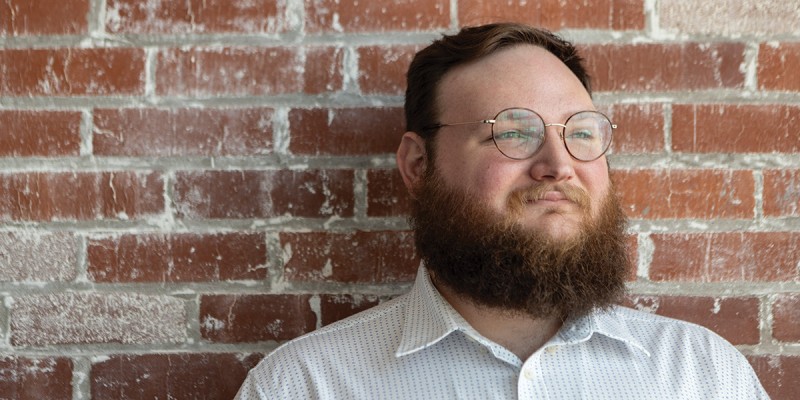
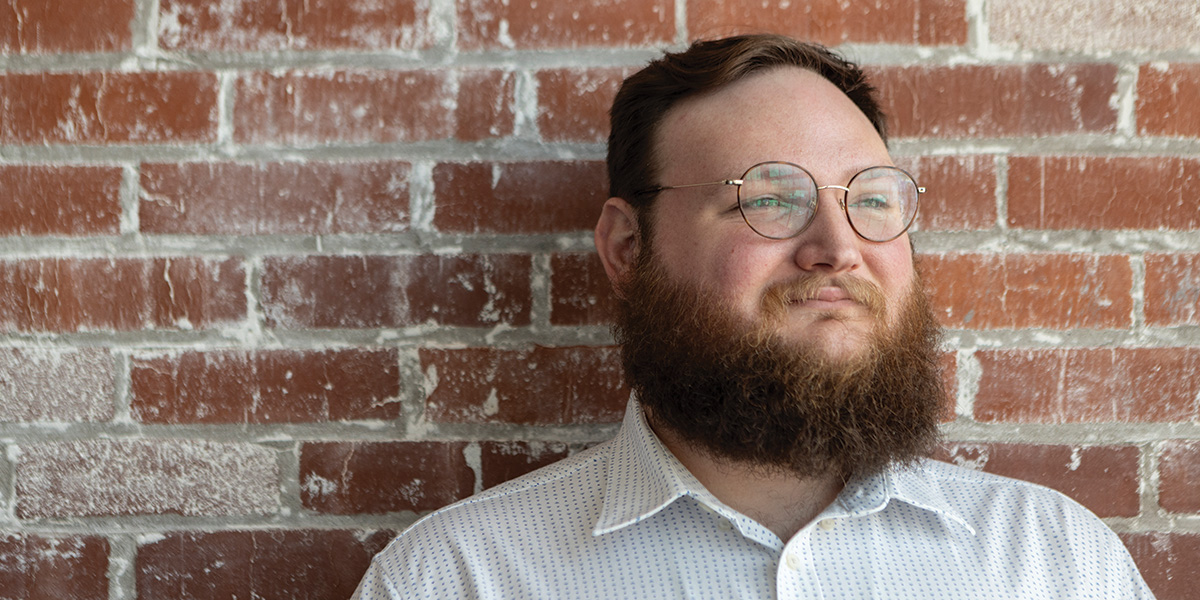
Mitchell Brooks, MPH ’21, was already promoting public health before he even knew it was something he wanted to study.
As an undergraduate art history major in Tampa, Fla., Brooks volunteered his time packaging safe-sex kits for the city’s LGBTQ+ center and serving as a crisis counselor for a nonprofit that provided free mental health services over text.
“One of my friends recommended that I take a class in public health because of the volunteer work I was doing,” Brooks says. “I loved it and realized I wanted to make it a career.”
It was a natural fit for Brooks, who has always been driven to help others. At one point, he considered becoming a lawyer, and his art history major was sparked by his interest in learning about different cultures. He learned about Binghamton University’s Master of Public Health (MPH) program, which had only been running for a year when he started in fall 2019.
A lifelong Florida resident, Brooks quickly adapted to Binghamton.
“I wasn’t accustomed to all the hills up here,” he laughs. “The landscape is certainly different.”
Brooks, despite being new to the area, actively participated in the community outside his classroom activities. He helped students register to vote through the University’s Center for Civic Engagement and carried out his field placement with the Southern Tier AIDS program. There, he led Narcan and opioid overdose prevention training and provided safe injection supplies and education.
“The fieldwork made me feel connected to this area,” he says. “It’s an integral part of the MPH program because it’s teaching students how to apply what they are learning in the classroom to real-world situations while also getting them more involved with the community.”
Persevering during the pandemic
Brooks continued his fieldwork throughout the COVID-19 pandemic, something he’s very proud of.
“Everything changed, but we still found a way to continue our work safely while supporting the community,” he says. “If anything, the pandemic reassured me in making the decision to get into public health.”
The fieldwork inspired Brooks’ MPH capstone project; he researched burnout among employees of syringe exchange programs throughout the U.S.
“A lot of the burnout research coming out at the time focused on frontline hospital workers,” he says, “but I saw the pandemic’s impact on harm-reduction healthcare workers, and I wanted to look into that.”
Intrigued by the research aspect of public health, Brooks sought out a graduate assistantship with the University’s Division of Research.
“I took an epidemiology class during my first semester that completely changed my perspective on what I wanted to do with public health. I didn’t realize how much I enjoyed research until that class,” he says.
After graduation, Brooks’ love of research led him to a job in Washington, D.C., as a research manager at Us Helping Us, People Into Living Inc., which works to achieve health equity for underserved and marginalized populations in the area. Brooks worked on federally funded projects examining health disparities among racial, ethnic, gender and sexuality minorities.
It wasn’t long before Brooks was drawn back to Binghamton. In June, he joined Decker College of Nursing and Health Sciences as a field placement coordinator for the MPH program. After learning so much from his field placement, Brooks now helps students find the right placement to enrich their experience.
“It feels so good to be back and see the MPH program from this side of it,” he says. “Binghamton taught me essentially everything I know about public health and played a big role in shaping my interest in the field. To now be able to help students on their journeys is very fulfilling.”
While public health was once a field he hadn’t considered, Brooks is now all in. He plans to pursue a PhD and hopes to continue doing research.
“Public health is such an important field that encompasses so much,” he says. “What sets Binghamton’s program apart is that it’s very connected to the community. Students learn about public health and put it into action.”