Campus collaboration brings message of hope to Binghamton community
The 20:1 interpersonal violence prevention program decorates tree for Home for the Holidays at the Roberson Museum and Science Center
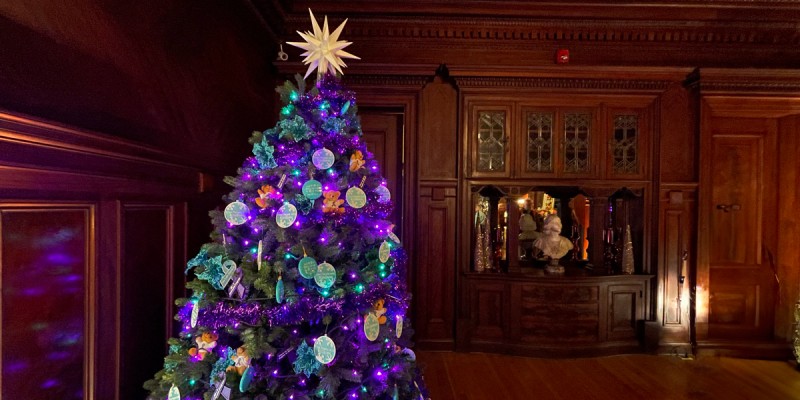
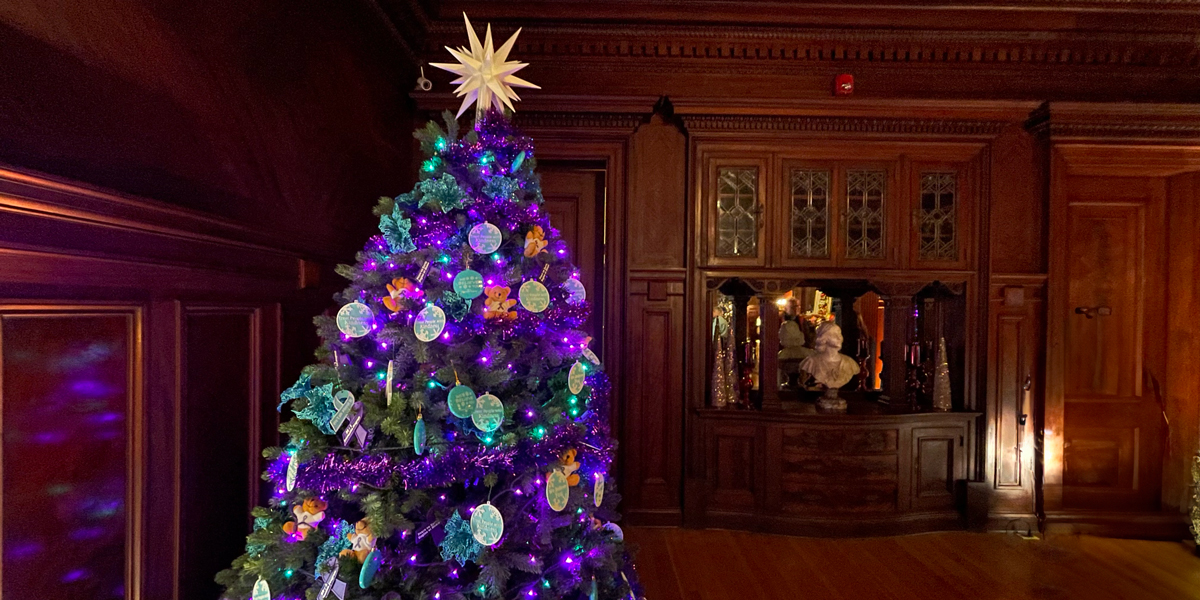
For more than 60 years, Home for the Holidays at the Roberson Museum and Science Center has been a holiday tradition in Binghamton. The event features trees, holiday displays and the “International Forest” — a collection of adorned trees and displays that represent the holiday traditions of cultures from around the world. And for the past three years, it has also displayed a tree decorated by the Binghamton University 20:1 Interpersonal Violence Prevention Program.
“We were trying to decide on ornaments and colors and how we would do this tree in a way that would get our message across and show the work that we do in 20:1,” said Dara Raboy, a senior counselor and the coordinator/co-founder of 20:1 Interpersonal Violence and Bystander Intervention Prevention program on Binghamton’s campus. “We present on sexual assault prevention, which includes things like affirmative consent, victim blaming and predatory behavior. We also present on bystander intervention, rape culture, healthy and unhealthy relationships, and dating violence. It is a prevention program.”
The organization wanted to present a tree for the 20:1 program that projected a deeper meaning than simply a traditional holiday display.
Lauren Prendergast was a senior intern and social media manager for 20:1 at the time. She believed this was an important project because it would help spread awareness of a significant issue that impacts many people. “By creating ornaments for the tree display, we’re able to raise awareness and bring attention to this issue during a time when people are more receptive to messages of compassion and support in a unique way,” Prendergast said.
Raboy and Prendergast worked together with members of 20:1 to loosely design some concepts for the ornaments they wanted to display. “We decided to use teal and purple, as teal is the color that represents sexual assault prevention and purple is the color that represents domestic violence prevention or awareness.”
The unique sentiment and colors that would communicate 20:1 message required the ornaments to be custom built. The solution would be found right on campus.
Prendergast became aware of Binghamton’s Emerging Technology Studio (ETS) after visiting the IT department to fix her computer. ETS is the on-campus MakerSpace where Binghamton University students, faculty and staff are welcome to gain or refine their skills in 3D printing and design, virtual reality, photo and video editing, and Cricut crafting.
Collaborating with the student technicians at ETS, Prendergast worked to refine the designs and brought them to life. Prendergast said after a couple trials and errors, she used a software called Thinkverse and adjusted the measurements. “We were able to print the ornaments that are currently on display,” she said.
Now a crisis mental health counselor at a residential treatment center for children in foster care, Prendergast says she is honored to have the designs still in use three years later. She says the goal for ornaments along with the other design aspects was to encourage conversations. “It is really awesome to hear our ornaments are still in use and spreading awareness in their own unique way,” Prendergast said.
Raboy said the display seeks to destigmatize the topics so that people feel safer to talk about them. Someone going by an ornament with the message “We believe you” can be very powerful to someone who has been victimized. “I think these ornaments are amazing,” said Raboy.