Hit the books: History alum finds a career in academic publishing
As an editor at Cambridge University Press, Rachel Blaifeder ’17 works with authors on a variety of projects
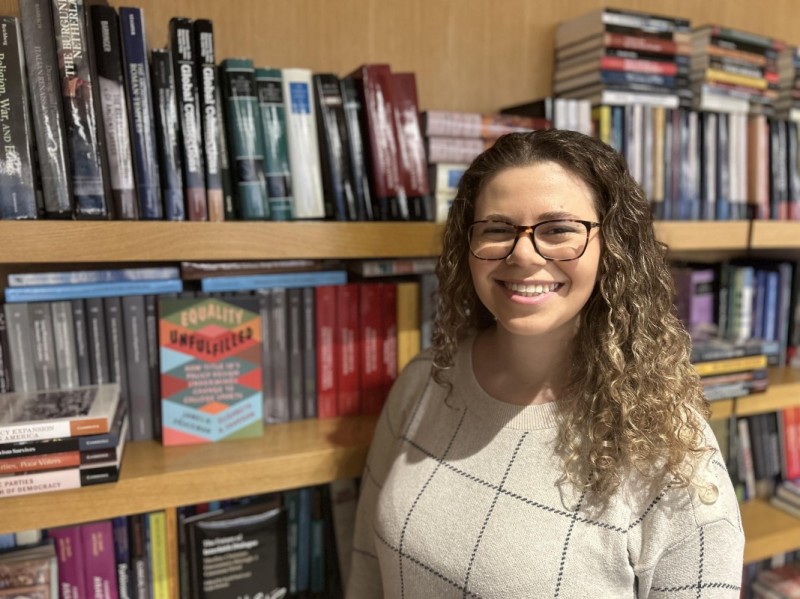
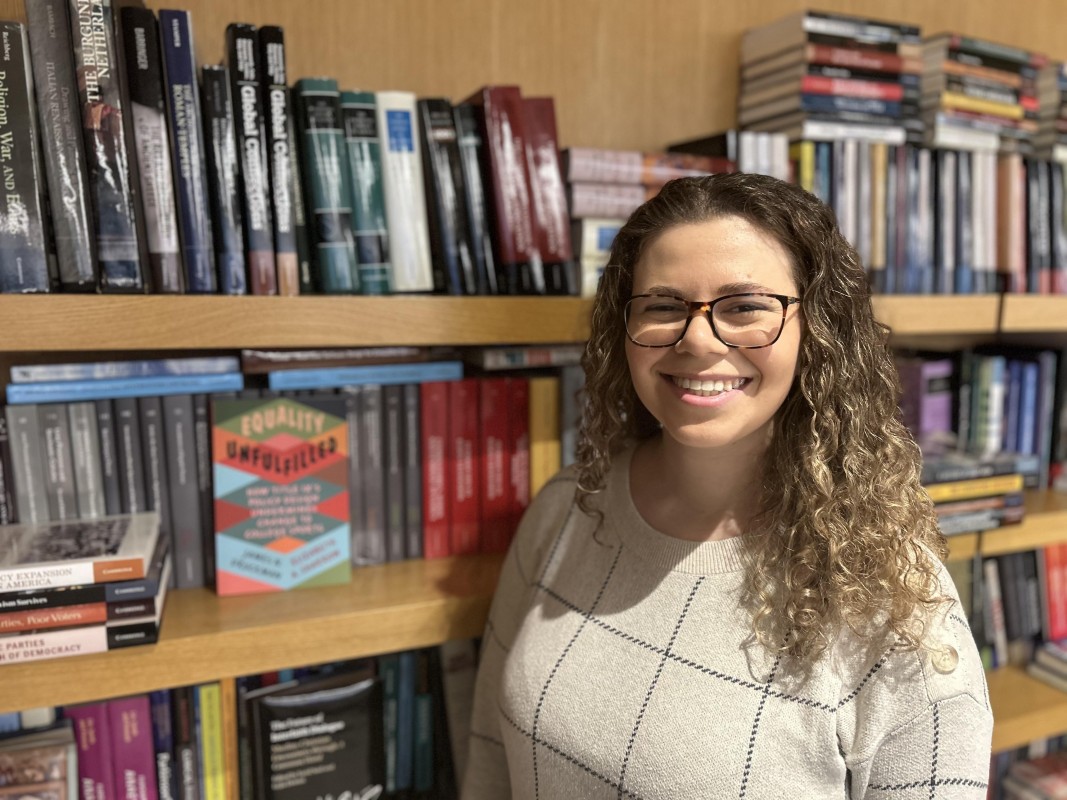
Like most students, Rachel Blaifeder ’17 didn’t ponder the publishing industry when she picked up her textbooks at the Binghamton University bookstore.
“I never once thought about where those books were published; it simply didn’t cross my mind,” the history major said.
Fast forward to today: Blaifeder is now an editor at Cambridge University Press. Some of the authors she has worked with are the very same ones whose work she read in her Binghamton courses — plus other familiar faces.
“Now that I work in academic publishing, I’ve noticed that a lot of Binghamton’s history professors have published at Cambridge,” she said. “It’s cool to see from the other side the high caliber of professors who teach in Binghamton’s history department.”
A Queens native, she excelled at history in high school but wasn’t sure of her future trajectory once she reached the University. During her first year at Binghamton, she took a class on the history of immigration and ethnicity in the United States that proved transformative.
“My grandparents had immigrated from Eastern Europe,” she said. “The class also propelled me to say, ‘If other classes are as interesting as this one, I want to make it my major.’”
She stumbled upon the immigration theme again during an internship at the Roberson Museum, which was conducting a local history project on immigration to the Binghamton area. Drawing on that experience, she decided to focus the capstone project for her history senior seminar on the different immigrant groups who came to the Triple Cities to work at the Endicott Johnson shoe factory. The work fascinated her, and she enjoyed the time spent in the archives reading and learning, she said.
“It absolutely was the best thing I did in college. I will always be grateful that Professor Ortiz pushed me to do it,” she said. “I believe it also helped me get to where I am now in my career.”
Blaifeder’s journey wasn’t straightforward. The traditional career options for a history major — becoming a teacher or a lawyer — didn’t appeal, and museum curation is highly competitive, she reflected. For the first eight months post-Commencement, she worked at a Jewish nonprofit and interned with the development team at the Children’s Museum of the Arts in Tribeca.
‘A big job’
Associate Professor of History Stephen Ortiz keeps an eye on his students even after graduation and sent job opportunities Blaifeder’s way, including one for an editorial assistant in history at Cambridge University Press. Publishing hadn’t been on Blaifeder’s radar, but the job proved a perfect fit.
“An editor at Cambridge had published one of my books while at a different press. When she shared an opening for an assistant, I immediately thought of Rachel,” Ortiz said. “They share many attributes — both super smart with broad interests and good people skills. I knew Rachel would excel if she got a foot in the door.”
Blaifeder started at Cambridge in March 2018, working on books on economics and U.S. and Latin American history. Typically, editorial assistants at Cambridge work with two editors and not necessarily on subjects in which they have a background; Blaifeder, who minored in economics, was the exception.
“I would see the names of authors who I had read in some of my classes, and it was very exciting for me because I’m a big nerd,” she said.
After a year and a half, one of her editors retired and another left for a new job. Blaifeder ended up taking on more responsibility and eventually became a temporary history editor working on Asian Studies, and then, in 2021, transitioned to working on political science and sociology full-time. Political science is among Cambridge’s largest subject areas, and Blaifeder is responsible for bringing in new books.
Oftentimes, authors will reach out to her. She reads dozens of 8- to 10-page proposals a week and knows what to look for: Have the authors published in academic journals or given talks on the subject matter?
She joined the social media platform X as an editorial assistant back when it was known as Twitter; watching academics on the platform interact with one another provides insight into emerging topics of interest. She also goes to academic conferences to see who is participating in panel discussions on comparative, American and Latin American politics, her areas of focus in political science at Cambridge.
“My inbox is full every week with lots of projects to consider and think about,” she said. “It’s a big job and it’s sometimes hard to balance the amount of stuff that comes my way versus what I seek out.”
When most people think of publishing, they may imagine the large commercial publishing houses such as Penguin Random House or Simon and Schuster, and best-selling novels. Academic publishing, however, is just as robust and diverse.
Interested in the field?
If you enjoy research, academic publishing may be the career for you, she advises fellow Bearcats. Opportunities go beyond book editing, and include journals, marketing, sales, publicity and more.
To learn more, Blaifeder suggests The Scholarly Kitchen, a blog focused on news from the academic publishing field, and the Association of University Presses (AUP), which holds an annual professional conference. Other resources include Publishers Weekly and Publishers Lunch, which contain job boards and industry news.
She also appreciates that the books she works on now may, in the future, be used by college students in the classroom.
“Don’t be afraid of thinking about publishing because the book business is shifting a bit,” she said. “There’s a huge amount of opportunity and it’s a great option.”