Director of intercultural affairs takes pride in his roots
Leonel Diaz brings a diversity of background and experience in his new Division of Diversity, Equity and Inclusion role.
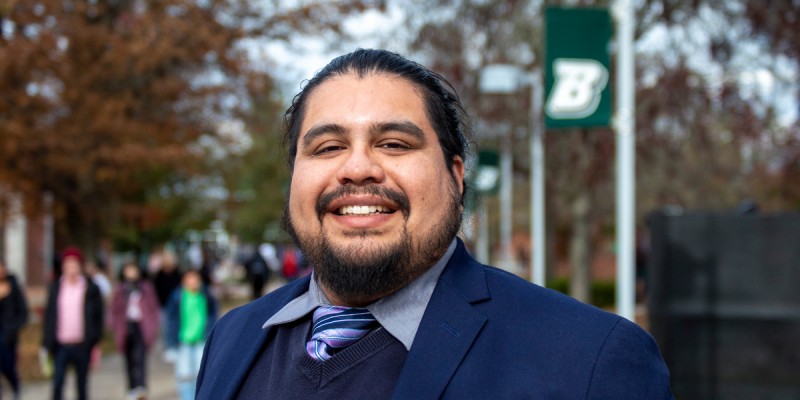
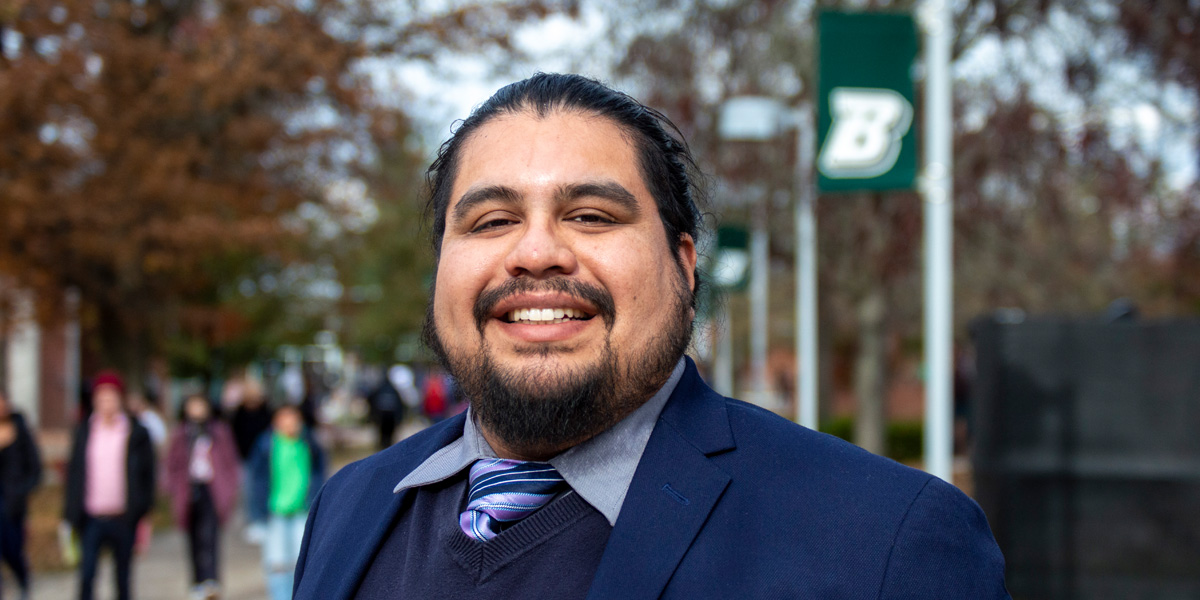
Leonel Diaz, the new director of intercultural affairs in the Division of Diversity, Equity and Inclusion (DEI), has made the most of the opportunities his migrant parents worked hard to provide.
He is a first-generation Mexican American whose parents migrated from Yucatán, Mexico, seeking opportunities for their family. He also identifies as an Indigenous North American with solid familial roots in the Mayan culture. “Most of my relatives live in Mérida [capital of the Mexican state of Yucatán],” said Diaz, “a city rich in Mayan history.”
Throughout his childhood and young adulthood, people were often surprised to learn he was Mayan. “I recall people being shocked to learn I identified as Mayan, believing that Mayans were a lost civilization that no longer existed.”
But his family was proud of their Indigenous heritage, passing that pride to Diaz’s generation.
“My siblings, cousins and I are tri-lingual and are able to have tri-lingual conversations,” he explained. “We grew up understanding the accomplishments of our ancestors— the incredible use of math, science, engineering and art that is evident in our Mayan calendars and pyramids. These were always sources of inspiration to remind ourselves we belong to a highly intellectual civilization.”
Diaz was born in Compton, California, in a community-oriented neighborhood where people supported one another through shared food, tools, labor, guidance and other resources. His mother is a baker and his father is a professional plasterer who encouraged their children to pursue educational opportunities as a way out of poverty and entry-level jobs.
Diaz not only earned a bachelor’s degree from the University of California at Santa Cruz but went on to a master’s from the University of Southern California in postsecondary administration and student affairs and a PhD from the University of New Mexico in organizational development and learning sciences.
He was inspired to work in education through his own struggles as a student: indecisive about a career and struggling with undiagnosed learning disabilities, introverted and struggling to find meaningful friendships and feeling misunderstood. He credits a group of mentors he met in college with helping him find his path.
“Their gracious support allowed me to develop into the person I am now,” said Diaz. “Their mentorship made me realize I wanted to pay it forward and genuinely wanted to help students like myself persist through college.”
Diaz has served as an academic advisor, coordinator for leadership and engagement, research coordinator for vaccination uptake and responsible beverage service, project coordinator for substance use prevention and, most recently, was the associate director of a multicultural center.
Q: What causes are you passionate about?
A: There are many causes I care about. Migration, mental health, veteran transition to civilian life, underserved populations, universal design for learning and teaching, and environmental protections are causes I support. Of all these, mental and physical well-being have been at the forefront.
Q: What made you interested in this role at Binghamton University?
A: I attended the Men of Color Summit in 2022 with a group of students. It was an excellent opportunity to network and meet the Division of Diversity, Equity and Inclusion staff and several other campus departments. We had a wonderful experience during the summit and our self-guided campus tour. The amazing programs and projects happening at Binghamton allowed me to see myself working here. Given my interest in DEI over the last five years, this position was a perfect fit to continue my professional development and career interests.
Q: What skills do you bring to the director of intercultural affairs role?
A: I have a diverse and well-rounded view of the student experience as I have worked in residence life, academic support, recruitment, research, leadership development and many other areas. I have learned to be efficient with resources and alter my approach based on the situation. Most importantly, I look for connections with others, especially those significantly different from me, as a way to demonstrate that, as humans, we can always find commonalities to identify shared interests, beliefs and perspectives.
Q: What are some of the challenges you see in your new role and, more importantly, what are some of the opportunities?
A: Events occurring throughout the world can make any role challenging. We never know what reaction will come from society and how we will respond. The recent pandemic impacted our youth in ways we are just beginning to understand, such as their communication preferences and digital literacy. Communication, conflict resolution, problem-solving, active listening, leadership and other skills remain important in student development. This also creates opportunities for us to rethink and reshape how we address identity development and provide the appropriate support.
Q: What are some goals for the centers you oversee?
A: Student engagement has decreased throughout the country due to the pandemic. My current goal for the Q Center and Multicultural Resource Center (MRC) is to increase student participation. To do this, we have to begin with understanding what is behind the reluctance to participate. Another goal is to focus on the intersectionality of student identity through our programs. Intersectionality provides a lens to best understand how the various pieces of our identity shape our actions and knowledge.
Q: What would you like to accomplish in the first three months? In five years?
A: In my first few months, I am taking the time to understand the history and community within the Division of DEI and across the University. My primary focus is to become familiar with our students. In five years, my hope is the MRC and Q Center will be viewed as centers to be modeled, known for research collaborations and celebrated for innovative programming approaches.