Binghamton University’s Living Building takes shape
A conceptual design for the Living Building was presented to the campus April 3.
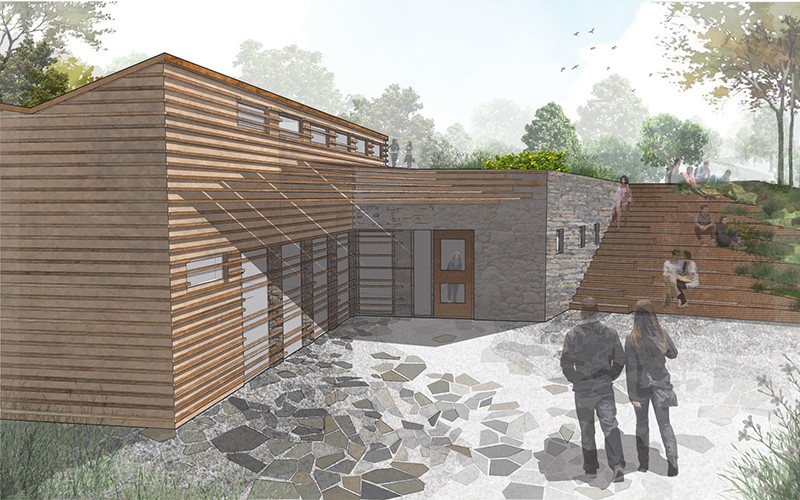
About 50 people were on hand April 3 to learn about progress on the design of the Living Building at Nuthatch Hollow on Bunn Hill Road.
The project, which is benefiting from $1 million thanks to the recent reimbursement from FEMA for damage to the University Downtown Center in the 2011 flood, is expected to go out for bids late this year, with construction to begin in 2018, and occupancy in 2019, said Pam Mischen, associate professor of public administration and chair of the Transdisciplinary Area of Excellence (TAE) in Sustainable Communities. “Everyone involved in the project is also volunteering their time,” Mischen said.
The Living Building program is based on seven “petals” said Matthew Broderick, principal for college and university projects at Ashley McGraw Architects, which is partnering with Binghamton University to plan and construct the building. “And under the seven petals there are 20 imperatives,” he said. “We have to meet every one.”
Goals of the Living Building are that it:
· Is a place for environmental research
· Is a hub for interdisciplinary collaboration
· Uses an interactive design process
· Uses smart energy technology
· Is replicable – “We don’t want to spend this kind of money and effort for a one-off project,” Broderick said. “We hope our experience can be used elsewhere in Binghamton and beyond.”
· Achieves Living Building Certification – which won’t be determined until after the building is in use for one year.
A January on-campus presentation of three concepts was refined into one following feedback received. “We want to involve as many as possible and get them hands-on for this, and that’s really happening,” Broderick added. “We’re diving deeper into this and that’s part of the joy of doing a living building.
“The ‘reveal’ design concept from January generated the most interest. There’s an existing building on the site now and this scheme utilizes part of that existing building (foundation, floor) to help reduce carbon footprint and site impact,” Broderick said. “There’s nice synergy from that perspective, reusing the existing lower floor nestles into the site and presents itself to you in steps.”
Nick Corcoran, Binghamton University landscape architect, reviewed possibilities for the site plan, including access, pathways, what could be done with the current driveway and how to make the site accessible to everyone.
“We listened to the January comments and heard that it would be nice to keep parking and buses as close to Bunn Hill Road as possible,” he said. “And to keep deer out of the site.”
Corcoran said much of his presentation was still conceptual, but he spoke about repurposing the existing drive as much as possible, and creating a path system, possibly using natural stone. “On the site plan, we could have informational nodes, capture storm water and reuse it for irrigation if possible, use native plantings and take advantage of the views. We’re looking to potentially create some bridges to match the style of those already on the site.”
The building would have a green roof on the portion of the house that is repurposing the foundation, a sitting area built into the slope leading to the main entrance area, an outdoor patio area for multipurpose use and another set of stairs down to an agriculture component area, Corcoran said.
“This project is an amazing opportunity,” said Ashley McGraw architect Christina Aßmann. “The site is very interesting and beautiful and we wanted to work with the existing slope we have so we stayed with the concept of reusing existing foundations.”
We want to put support spaces into the spotlight and show them off, she added. “Nothing is arbitrary in our designs. We look at them scientifically and through poetry, aesthetically.”
Aßmann is working to maximize the design for daylight and to feather in the roof plan to connect with the landscape, with a path down to an amphitheater for outdoor seating. “There will be a very dynamic outdoor space for classes and research and an inspiring outdoor area,” she said. “We hope we’ve captured the spirit of this, connecting to the landscape so building and nature become one.”
Bill Bishop, senior energy engineer at Pathfinder Engineers & Architects LLP, is overseeing work on the water and energy petals. To meet the water petal requirements, the design will emphasize on-site water sources, rainwater harvesting, minimal service water loads, composting toilets and low-water HVAC systems.
“Nuthatch Hollow must generate 105 percent of its annual energy usage, and not use combustion for site energy,” Bishop said. “It also has to have energy storage on site.”
Bishop said the building will have a 60-person occupancy, and how it will be used is critical to the design of its energy systems. “We’re making some assumptions, using the academic calendar for when classes are in session, including winter and summer breaks, and weekend schedules. We’re limited to all-electric systems for cooling, heating and elimination modes.”
Koen Gieskes, lecturer in the Watson School of Engineering and Applied Science Engineering Design Devision, addressed perhaps the most difficult aspect of constructing a living building – the Red List.
The Red List currently contains 815 different materials and chemicals that cannot be used in Living Building construction, Gieskes said. He’s working with students to investigate materials. “We created a system of vetting the materials,” he said. “Everything has to be documented. Each subgroup of students has contacted multiple manufacturers for the products, first by calling the companies.
“Where are we going with this?” he asked, as he noted that the list of materials is constantly growing. “We’re getting more materials for the students to work with and it’s a daunting task as the semester wraps up. On average, to vet a material takes about three to four hours and we are looking at hundreds of materials with multiple sources. We’ll continue into the summer with a team of students.”
Those interested can follow the Living Building blog to stay updated on its progress.