TEDx 2017: Alumna examines if ‘seeing is believing’
Acclaimed psychologist Ellyn Kaschak discusses latest research.
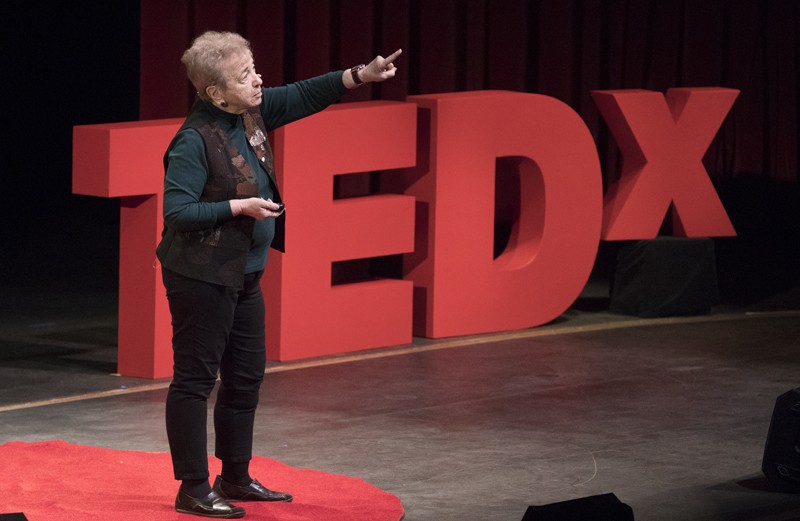
When Ellyn Kaschak first visited Costa Rica, her friends were adamant about showing her the ecological sites of the Central America country. One stop was a jungle famous for its thousands of monkeys.
“I couldn’t see the monkeys,” the 1965 Harpur College alumna told the crowd at TEDxBinghamtonUniversity. “I’m a New Yorker and I can see a mugger or taxi two blocks behind me. But I could not see the face of a monkey.”
The friends finally had to direct Kaschak to a flower and then to distinguish black dots near the flowers in order for her to see the monkeys.
“Once I saw the monkeys, I couldn’t unsee them,” Kaschak said. “They were everywhere! I had not been taught to see monkeys as a child. Vision is a language and you learn it before you ever see.”
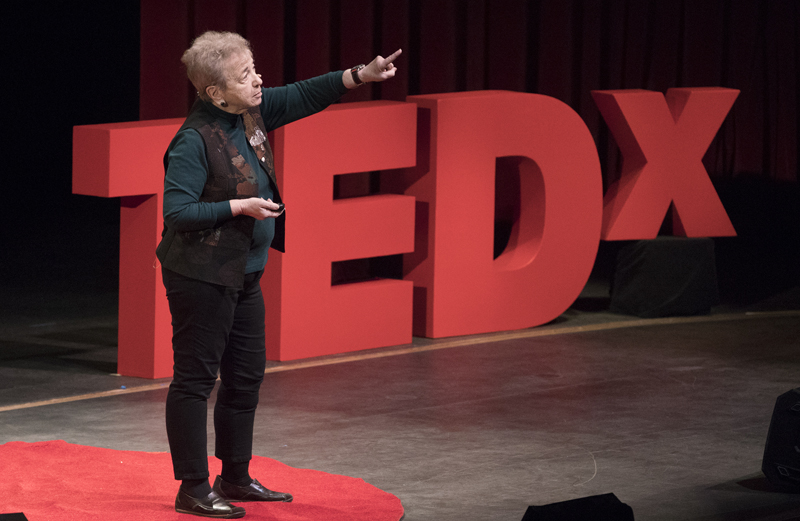
The monkey sightings served as the backdrop of Kaschak’s TedXBinghamtonUniversity talk on March 26 at the Osterhout Concert Theater. The internationally acclaimed psychologist/author/professor’s discussion — “Is Seeing Believing or Is Believing Seeing?” — was based on her 2015 book “Sight Unseen: Gender and Race Through Blind Eyes.” She
now teaches at the University for Peace, a United Nations campus in Costa Rica.
Kaschak was one of seven speakers at the seven annual campus event. The other speakers going “Beyond the Canvas” were:
• Eric Butorac, an 18-time Association of Tennis Professionals doubles winner and 2014 Australian Open finalist: “Don’t Dream Big.”
• Ranier Maningding, a Filipino-American advertising copywriter and writer for The Love Life of an Asian Guy (LLAG), a growing social media platform for race, politics and pop culture: “Social Activism is the New Civil Rights Movement.”
• Mollie Teitelbaum, a senior at Binghamton University majoring in philosophy and comparative literature: “So that’s why you annoy me! “Combating peccadillic implicit bias.”
• Gunnar Garfors, one of the few people to have visited every country in the world: “World’s Least-Visited Countries Revisited.”
• Cevin Soling, a writer, scholar, music producer and award-winning filmmaker: “The Truthiness of School.”
• Chris Koch, who was born without arms and legs, helped on his family’s farm, and played sports such as baseball, soccer and snowboarding: “If I Can…”
Kaschak’s book developed from a study she conducted that was based on a simple question: How do we know what we know?
“It’s the question that has accompanied me through my studies of gender, race and ethnicity all these years,” she said.
Kaschak decided to examine how people who have been blind since birth conceptualize gender and race. A study she anticipated taking six months ended up lasting 10 years.
“Having been blind since birth, they haven’t seen any of the cues that those of us who are sighted use to think about gender and think about race,” she said. “I didn’t approach it as a disability. I approached it as a difference.”
It took about two years before research subjects invited Kaschak to their homes. She recalled how one apartment’s interior “looked like every apartment I had ever seen. What I saw was a world designed for sighted people.”
Kaschak asked her research participants: Why do you have pictures on the wall? Why are the colors coordinated?
“Each and every one of them said they did it so a sighted person would feel comfortable,” she said.
On the subject of gender, Kaschak found that more blind women (with the help of sighted friends) were wearing eye makeup. Many also wore matching clothes, with men sticking to brown colors.
“I was beginning to see how the people who are non-sighted wanted to cater to the people who are sighted rather than develop their own universe,” Kaschak said.
Kaschak also discovered that the blind were listening to voices to try to learn about race. Blind people even admitted that they had trouble telling the races of southerners because of similar accents.
“What they were doing was trying to develop the prejudices of the sighted,” she said. “They were passing the same way other groups had. … They were trying to fit in and trying to speak the sighted language. They weren’t ‘speaking’ it fluently, but they were speaking it.”
Kaschak said she learned a lesson from the research project: “We see what we already believe.”
“The blind taught me an enormous amount about the sighted and how unconscious we are about what is built into our vision,” she said. “The blindest people in the world are those who are sighted. I think our eyes are colonized and we are not aware of it.”
Kaschak offered some suggestions for those in the audience “interested in resisting that colonization.”
“Pay attention to how you are seeing (things) and why you are seeing (things),” she said. “I ask you to ‘stay woke’ and most of all – in my language – I ask that you keep looking for the monkeys.”