Professor links Nuthatch Hollow project to Pacific island
Carl Lipo shares Easter Island research at University Forum
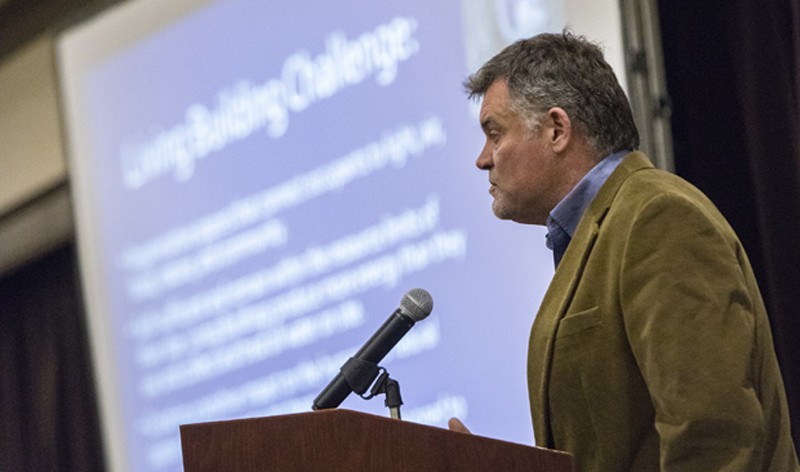
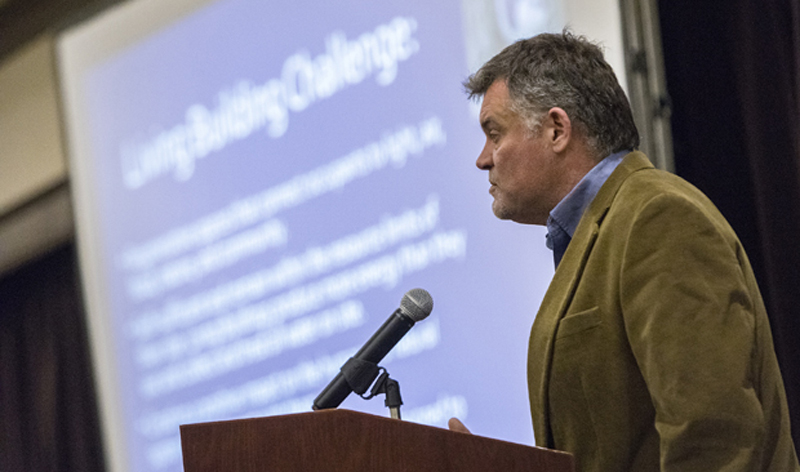
Studying the history of a remote island in the southeastern Pacific Ocean could be the key to developing a sustainable Binghamton.
That was the message Carl Lipo, anthropology professor and director of the Environmental Studies Program, delivered at a University Forum held Feb. 8 at the Doubletree by Hilton Hotel in downtown Binghamton.
“We should follow the example Easter Island set, not avoid it,” Lipo said. “We can learn from Easter Island not in a negative sense, but in a positive way.”
Lipo’s talk comes as Binghamton University is creating a “living building” at Nuthatch Hollow, a 75-acre property on Bunn Hill Road donated to the University. There are now only 11 “living buildings” that meet the world’s most rigorous proven performance standards.
“It’s the kind of idea that Binghamton University wants to be known for,” Lipo said. “We’re going to push the envelope.”
Lipo has already pushed the envelope by spending 15 years examining the mysterious demise of the Rapa Nui people on Easter Island. The 63-square-mile island is located 2,300 miles west of Chile, alone in the Pacific.
“If you use up a resource there, it’s gone,” Lipo said.
Easter Island is often talked about as “a story of collapse and failure,” Lipo said. Jared Diamond’s book Collapse proposed that the Rapa Nui people committed “ecocide” as they
overexploited their resources and did irreparable damage to the environment. By the time the Dutch arrived in 1722, the island was a shell of its former self.
Not so fast, Lipo said.
“What we’ve learned from my research is that it is a very different story,” he said. “We do have evidence of a European post-contact collapse.”
When the Dutch arrived, they described the 3,000-person island population as healthy, Lipo said. But by 1877, only 111 people remained. That number confused historians in the early 20th century and they assumed that the Rapa Nui suffered a prehistoric collapse.
“Populations isolated from diseases are entirely susceptible to them,” Lipo told the audience. “It’s catastrophic when that occurs. That’s what happened to the Rapa Nui (after Europeans arrived).”
Easter Island is also home to nearly 1,000 stone statues called “moai.” These statues weigh up to 70 tons and were carved by the Rapa Nui people from their arrival in 1200 through the late 17th century.
“They are massive,” Lipo said of the statues. “They can be as tall as a three-story building. It’s mind-blowing to find some of the most extraordinary archeology anywhere in the world there.”
Historians have speculated that the creation of the statues contributed to the island’s “ecocide.” Lipo, however, said the “moai” prove that “local ingenuity” was responsible for civilization to thrive in a natural environment that was poor to begin with. For example, the Rapa Nui would break pieces of bedrock and use them to enrich the soil. This helped to grow sweet potatoes.
Physically moving the statues while in a standing position also allowed the Rapa Nui to work in a collaborative – and sometimes competitive – manner.
“Moving 1,000 statues isn’t inconceivable,” Lipo said. “It just takes good engineering, creativity and innovation. If you live on an island in which the pastime is moving giant rocks around, you’re going to be really good at it! And they certainly were.”
The Rapa Nui were able to flourish for 500 years without stress and warfare, Lipo said.
“The statues were perfectly suited for solving the problems that the community faced,” he said. “These were cooperative efforts that led to the well-managed sharing of resources with mitigated competition and benefits at all scales. … The moai were the engine for developing a successful, integrated community.”
The collaborative, we-can-move-a-boulder approach of the Rapa Nui could help build sustainability in Binghamton, Lipo said. Besides working together, competitions that promote recycling, composting, exercise, nature and history may also prove beneficial.
“We need a buy-in from a wide range of organizations: governments, cities, agencies, families, neighborhoods and, of course, the University,” Lipo said.
Nuthatch Hollow is Binghamton University’s sustainability “buy-in.” It will not only be a place for research in the natural environment, but a site where students, faculty and community members can work together on a variety of projects.
Perhaps most importantly, Nuthatch Hollow is about “investing in the common good” in ways that maximize long-term shared benefits, Lipo said.
“We want to go beyond the (current building’s) 1973 architecture and even beyond what we are doing on campus in terms of LEED construction,” he said. “We want to demonstrate what a building should look like in the future and what is possible if we put our minds to it.”
Now in the design stage, Nuthatch Hollow is scheduled for construction in 2018. For Lipo, Nuthatch Hollow is more than just a building.
“We see it as a center for collaborative community engagement,” he said. “We see it as bringing education, research and community activities together as we share a place to engage in these kinds of things. Nuthatch Hollow is a single piece of a bigger puzzle that is going to be central for a sustainable Binghamton.”