Olympic triathlete visits Binghamton University
Swimming, biking and running are the easy part, Joe Maloy tells students
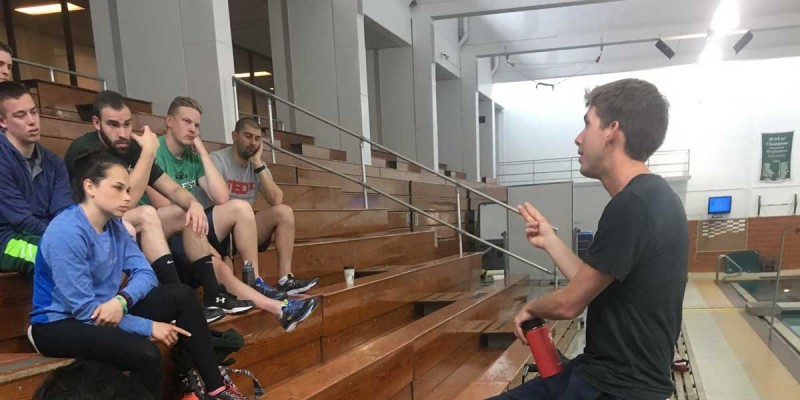
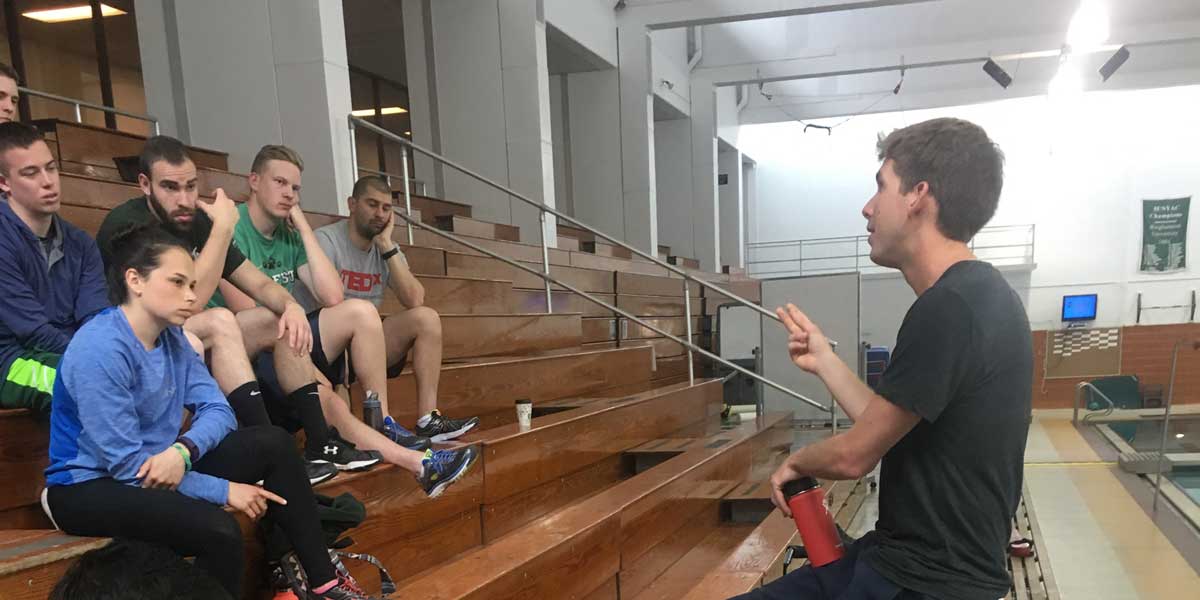
If triathlon were just about swimming, biking and running, it would be easy. It’s the thinking that’s tough, said 2016 Olympic triathlete Joe Maloy in a talk at Binghamton University on Wednesday, April 19.
Maloy was on campus to talk to Health & Wellness lecturer Harry Back’s “Triathlon Training” class. He also put in some miles with the campus running club in the afternoon.
A swimmer and runner in high school in Wildwood Crest, N.J., Maloy swam for Division I Boston College for four years and then returned as assistant coach for swimming and diving. Looking for opportunities to compete after college, he took up triathlon.
“I could stay in shape, be outside and meet new people,” he said.
In 2009, Maloy crossed the finish line as the overall winner of the National Amateur Triathlon — ahead of 2,000 other triathletes. He turned pro the next year.
“The Olympics was always in the back of my mind,” he said.
Over the next six years, the road to the Olympics took him to races in 21 countries on six continents. But it was early in that journey, at the 2011 USA Triathlon National Championships in Buffalo, N.Y., that he began to realize his brain needed training as much as the rest of his body.
“My results were terrible; I was 33rd and that was not acceptable, “ he said. “I came close to leaving the sport.”
His father asked him, “Are those guys that much better or are you doing something wrong?”
What he was doing wrong, Maloy realized, was that he wasn’t listening to himself. He was ignoring the fact that he wasn’t having much fun and that he felt alone.
“A trap for triathletes is to make it an individual sport,” he said. The Latin roots of the word “competition,” the English major said, break down to “com” — together — and “petere” — to strive. “We are seeking something within ourselves, yet other people are necessary.”
A new coach and a new environment were part of the solution; the rest came in learning to use failure as an opportunity for improvement.
“I always viewed sports as a meritocracy; if you work hard you are rewarded. It teaches you to connect what you do in practice to results in competition,” he said. But it turns out that that connection, he learned, extends to how you handle failure, work and relationships.
Over the next three years, Maloy took 3rd, 2nd and 1st places, respectively, in USA Triathlon national championship races.
Then, in Yokohama, Japan, in May 2016, Maloy was one of six American men vying for three spots on the United States Olympic team. On the day of the qualifying race, there was enough down time that he started to fill it with anxiety, tears and worries about all that could go wrong.
After talking to his parents and his brother, Maloy said he realized he needed to shut out the “noise” and rely on his training to act appropriately to whatever might happen.
Triathletes go into races with a plan — where to start in the swim wave, how to get through transition (swim to bike, then bike to run) in the least amount of time, when and what to eat, how to attack hills on the bike. Trusting your strategy — and the work that goes into developing it — means having faith in yourself, he said.
“In competition, you have to be in the moment. What matters is how you make the most of the situation; what strengths can you call upon, and can you filter out the noise of what other people are doing?”
Once he got on the run course, and most of the external variables were gone (no chance of an elbow to the head from a swimmer or a flat on the bike), he knew he was going to the Olympics.
Three months later, Maloy finished 23rd in the Rio Olympics; he wasn’t happy with the place but he was happy with his performance. A problem with a shifter on his bike left him with fewer gears than normal, but his mental training had taught him to not let it ruin the race. “I repositioned myself in the pack and did the best I could.
“That’s racing. That’s life,” he said. “I crossed the finish line knowing I gave everything I had.”
Maloy retired from professional triathlon in fall 2016. It wasn’t from disappointment at the Olympics, he said, but from a sense that it was time to try something new — although he doesn’t know what that is yet.
But even that falls in line with his belief in listening to yourself and believing in your strategy, even though he might not have realized it in November 2011 when he wrote in his first blog: “Swimming, biking, running, and studying performance continues to make me feel alive. When I can’t commit myself 100% to my pursuit, I will find a new career.”