Want to teach? Alumnus advises students to find their ‘why’
Michael Piccirillo ’84, MAT ’91, discusses his journey as an educator during Harpur Edge event
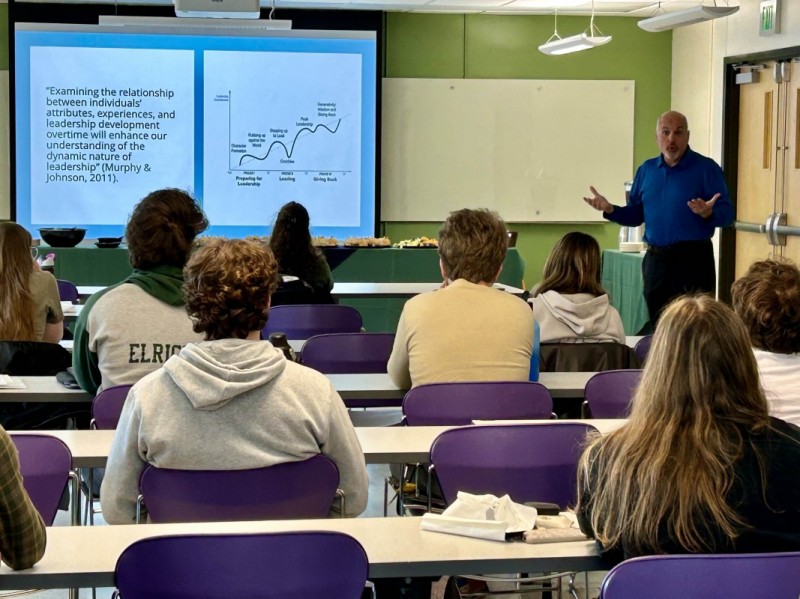

Aspiring educators must understand their purpose before stepping into the classroom, alumnus Michael Piccirillo told students at Binghamton University on April 15. Speaking in person as part of a Harpur Edge alumni event, Piccirillo drew from decades of experience as a teacher, administrator, superintendent and now a college professor to share his journey in education and urge students to reflect on their “why.”
“There is the beauty of interacting with kids. There is the hope that you can instill [in them]. There is the lasting impact you can have,” he said. “But it is not perfect … and you need to have a secure understanding of what your purpose is to get through those challenging moments.”
Piccirillo, who graduated from Binghamton in 1984 with a degree in sociology, described his unconventional path to education. Initially uncertain about his future, what is now the College of Community and Public Affairs reached out to him about the Master of Arts in Teaching program a year after he graduated with his bachelor’s. His student teaching experience at Binghamton High School cemented his passion for education. Piccirillo later served as superintendent of schools in Saratoga Springs, where he focused on building equity in education and instilling hope in students.
Piccirillo opened with a discussion about systemic issues in education, such as outdated school policies, equity gaps and the lack of authentic student representation in decision-making processes.
“Funding is always a big issue. It is an issue of equity,” Piccirillo said. “And you have to constantly adapt policy to the needs of our students and the needs of our communities.”
He also emphasized that being an educator is about building relationships with students. Reflecting on his struggles as a disengaged student, Piccirillo recalled how a single teacher’s encouragement changed his mindset.
“Mr. Allen took me aside and said, ‘You know, you are wasting your potential,’” he explained. “Something clicked in my head and I was like, ‘I think I am better than I have been showing.’”
To illustrate his point, Piccirillo showed an image of a squiggly line, reminding the audience that life rarely follows a straight path and that real growth often comes from unexpected turns and setbacks. He explained that this depiction mirrors both personal and professional journeys, and he found that success often comes from navigating challenges rather than avoiding them.
To illustrate his point, Piccirillo showed an image of a squiggly line, reminding the audience that life rarely follows a straight path and that real growth often comes from unexpected turns and setbacks. He explained that this depiction mirrors both personal and professional journeys, and he found that success often comes from navigating challenges rather than avoiding them.
“The reality is that everything you do is more like this squiggly line,” he said. “It is full of twists and turns, and you have to adapt all the time. Education is an important part of adapting to what life throws at you.”
Lila Boukarim, a senior psychology major and education minor from Troy, N.Y., said the visual stood out to her.
“I really liked the discussion about the pathways,” she said. “I think that meme-style photo is something that can catch college students’ eyes. The details he included were very meaningful.”
Personal loss also shaped his educational perspective. During his first year of college, he lost his brother to cancer. Before his passing, his brother gave a speech called “Hope Means People,” which Piccirillo later shared with his staff as superintendent. His purpose became his commitment to offering hope and support to his students.
“If you think that you are going to go into education and be a content expert, and that kids are going to love you and fawn over you for all your knowledge, do not go into education,” he said. “They love you for who you are and how you connect with them, and then they will be open to your content.”
His doctoral research explored how childhood experiences shape leadership styles in education, revealing that while all 14 superintendents he interviewed were impacted by their upbringing, few had consciously reflected on it. Piccirillo urged aspiring teachers to consider this concept in themselves.
“Understand where you really came from,” he said. “And how you can build on that, and what you are going to leave as your legacy going forward.”
Piccirillo encouraged future educators to step outside their comfort zones, prompting them to embrace the growth that comes with risk and uncertainty in this field.
“Push yourself, challenge yourself,” Piccirillo said. “Do not inhibit yourself because you are afraid.”
Grace Scollo is a junior English major, and works in the Harpur Edge office.