Anthropology students compete in national Ethics Bowl competition
Sponsored by the Society for American Archaeology, the event showcases the importance of ethics in the discipline
After paying for an expensive field camp, a group of undergraduates follows a graduate student into the desert to conduct an archaeological survey.
But the group becomes lost and spends 17 hours wandering among the dunes and rust-colored rocks with no water. When they finally arrive back on campus, the head of the field school quips, “Now you’ve earned your archaeology stripes.”
“How do the students respond in this situation? It’s obviously not a safe environment, but they need the experience, and it’s a lot of money,” reflected anthropology graduate student Julia Coverdale, who took part in Society for American Archaeology’s Ethics Bowl competition this spring. “You have to take that into consideration.”
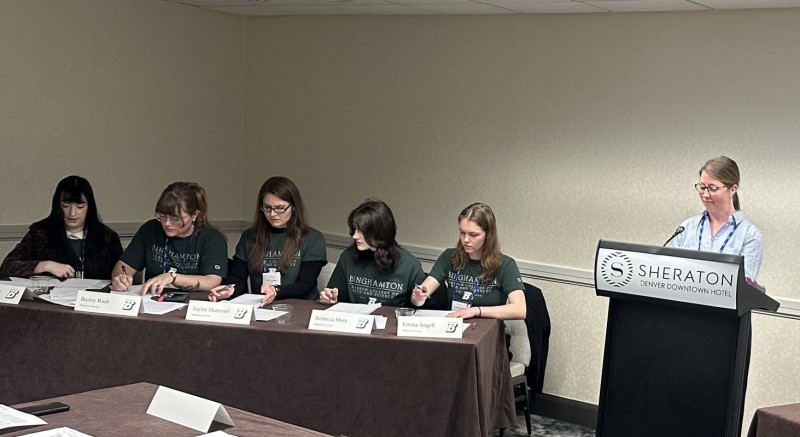
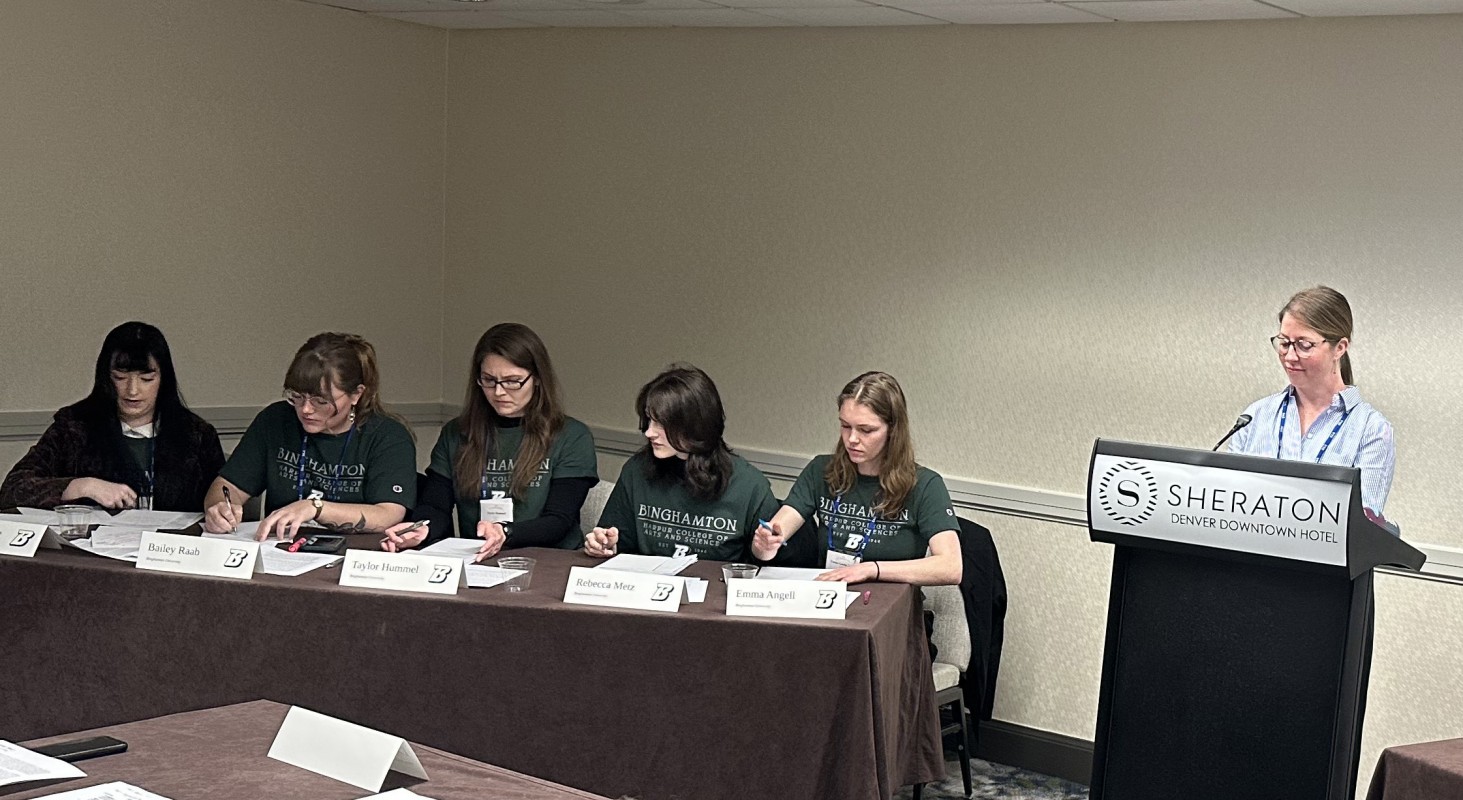
The competition took place at the SAA’s annual meeting in Denver, Colorado. Coached by Associate Professor of Anthropology Kathleen Sterling and Associate Professor of Ancient Mediterranean Studies Hilary Becker, the Binghamton University team also included Bailey Raab, Rebekah Metz, Taylor Hummel and Emma Angell.
“For the past 20 years, the conference has been hosting the Ethics Bowl as a way to hear from students and to develop stronger ethical standards in the field, as well as to encourage future archaeologists to consider the best ethical practices when given situations we may encounter in our future work and research,” said Metz, an undergraduate anthropology major in her junior year.
During the semester, Metz took a course in archeological ethics with Becker that discussed scenarios similar to those in the debate-style tournament. She had already planned on attending the conference to present a poster detailing research she conducted with Assistant Professor of Environmental Studies David Mixter at the archaeological site of Actuncan in Belize. The Ethics Bowl proved a natural fit.
In preparation, each team is given 10 case studies to research and study, inspired by real problems in archaeology.
The desert scenario was among them. It’s not as far-fetched a scenario as you may think, according to Coverdale. In 2022, a 24-year-old woman died from suspected heat stroke while conducting an archaeological survey at Kisatchie National Forest in Louisiana. According to news reports, the temperature that day was 98 degrees, with a heat index of more than 107.
Many of the problems involve power dynamics, such as an undergraduate or graduate student interacting with a tenured professor.
While material is provided for prior study, during the competition itself, participants are limited to a pen, paper and the workings of their mind. They don’t find out until the event which of the 10 cases they will be discussing, and there are two cases per round. In addition to arguing the cases, teams are given the opportunity to respond to the opposing group’s argument.
“We’re not necessarily taking sides, but we’re debating the ethical considerations of the situation,” Coverdale explained.
The Binghamton team won their preliminary round but lost in the semifinals. However, the competition provides a wealth of opportunity beyond the prospect of victory; it hones public speaking skills and teaches participants how to quickly structure arguments in their heads, Coverdale said.
“A lot of times at conferences, you end up seeing the people that work in your area,” she added. “Through the Ethics Bowl, I got to meet archaeologists concerned about ethics that I don’t think I would have met otherwise.”
Working with Distinguished Professor of Anthropology Ruth Van Dyke, Coverdale focuses her research on Chaco Canyon in the American Southwest. Ethics play a key role in their work, especially through partnerships with Indigenous communities descended from the people who once dwelt at the canyon site.
Laypeople may think of archaeology as excavating and collecting artifacts, but many Indigenous communities in the Southwest have concerns about these practices. The project that Coverdale is working on focuses instead on surveys and surface artifacts, in respect to these concerns, she noted.
Just as in the case study, Coverdale’s project also takes place in an arid environment. Safety is a priority, she reflected.
“We’re working out in the heat and there’s not a lot of shade coverage, so we need to be mindful of our bodies and our limits,” she said.