More than a ‘desk job’: His career was defined by change. Now, he brings lessons back to Binghamton
Robert Cline, MA '68 shares experiences from leadership roles at Raymond Corporation, Crowley Foods with Binghamton School of Management students
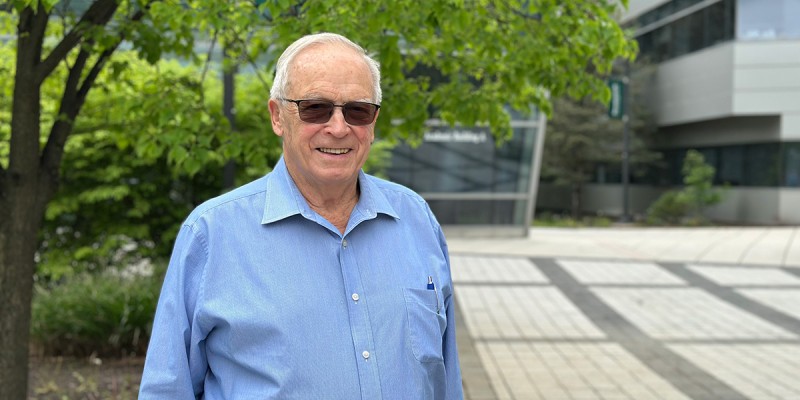
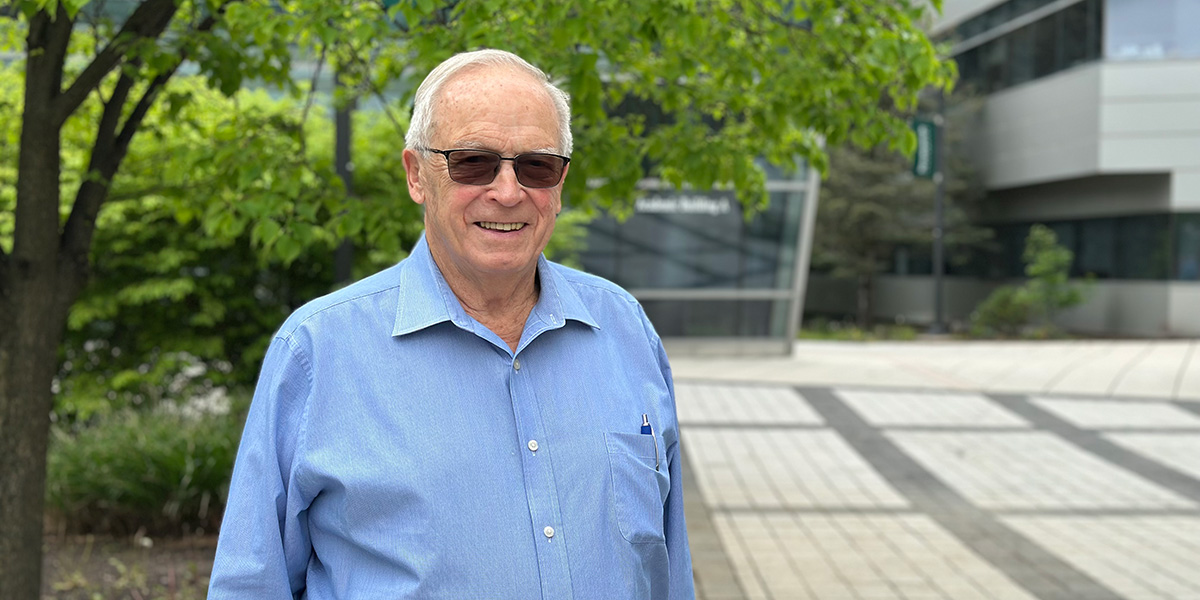
Robert Cline, MA ’68, has never liked the idea of a “desk job.”
A quick scan of his resume, which spans nearly 60 years of professional and academic experience in the Binghamton, N.Y. area, might suggest otherwise:
- Management positions at Raymond Corporation, where he launched a company-wide strategic planning system and an employee empowerment training program.
- Working his way up to become a vice president of corporate development for Crowley Foods, Inc.
- Taking the lead on human resource administration for some 1,800 Raymond workers and launching a host of initiatives designed to improve the employee experience.
However, Cline’s career path has always been about finding new ways to adapt. And if there’s one lesson he’s shared throughout that time, whether it’s been with his colleagues or the students he teaches at Binghamton University’s School of Management, it’s that change is inevitable.
“Everything is going to change, so to succeed and be happy and fulfilled, what everybody has to do is create value,” Cline said, “whether for the client, your family or yourself.”
Cline earned his graduate degree with a concentration in management from what was at the time Harpur College of Arts and Sciences (SOM was originally a department in Harpur College, but became its own school in 1970, then took on its current name a year later).
For the last 23 years, Cline has been an adjunct professor at SOM. He began teaching courses in strategy for seniors and later switched to graduate-level classes in leadership and ethics — anything other than computers, as he likes to say. He’s also served as an advisor for Binghamton’s Emerging Leaders Program.
What has motivated Cline to keep returning to Binghamton’s classrooms?
“I love passing it on,” he said, “and I’ve learned the importance of asking ‘What can I do now? How can I do it?’ I want students to have a notion of what they think they want to do, have that drive to know where they want to go, but also make sure to have the flexibility to take whatever changes or new opportunities life throws their way.”
These are the types of lessons Cline has experienced firsthand. After his undergraduate years at Cornell University, he initially planned to stay there as a personnel officer. But he pivoted to serve in the U.S. Army, which took him to Korea during the Vietnam War.
When his service was complete, and after earning his graduate degree from Binghamton, he was more interested in a job with a stable employer. That brought him to work at Raymond, where he spent 17 years in managerial roles.
“My drive was to help make things better for the company or the people working there,” Cline said. “My boss, George Raymond, seemed to think I was doing okay because he kept moving me from troubled department to troubled department, wherever I could help most. And so, I became more of a change agent.”
Throughout that time, Cline likes to say he never had “a sit-down desk.” He recalls that whenever he did sit down, people knew it was for two reasons — either he was sick or having a hard chat with someone — memories that still stir up a smile.
Cline is especially proud of helping Raymond grow to a company of some 1,800 employees, but later, he joined Crowley because he was ready for a new challenge.
He quickly recognized one reason why Crowley was still faring well in a tough business with small profit margins: 10 plants and 17 sales divisions were wise enough to make slight adjustments in their tactics depending on what would work most effectively for each location’s demographics.
“The right concept will work if you adapt it to your skills and the environment,” Cline said.
The prospect of teaching never crossed Cline’s mind until a friend and faculty member at Binghamton’s School of Management asked him if he’d be willing to pitch in with a few guest lectures. It might be fun to return to where he earned a master’s degree, he thought, and it was a chance to educate a younger generation about the unique lessons he honed over time that could easily get overlooked in the increasingly complex business world.
“Not only was I excited to share some of the things I’ve picked up over the years, but the quality of the people I saw teaching these courses at Binghamton really made it something I was proud to be part of,” Cline said. “I’ve gotten tons of emails from former students over the years saying their supervisors or human resources representatives said the same things they heard in my classes, so I guess it’s helped!”