Doctoral program uses an interdisciplinary approach to address complex social issues
Community Research and Action identifies shared goals and solutions through a multidisciplinary strategy.
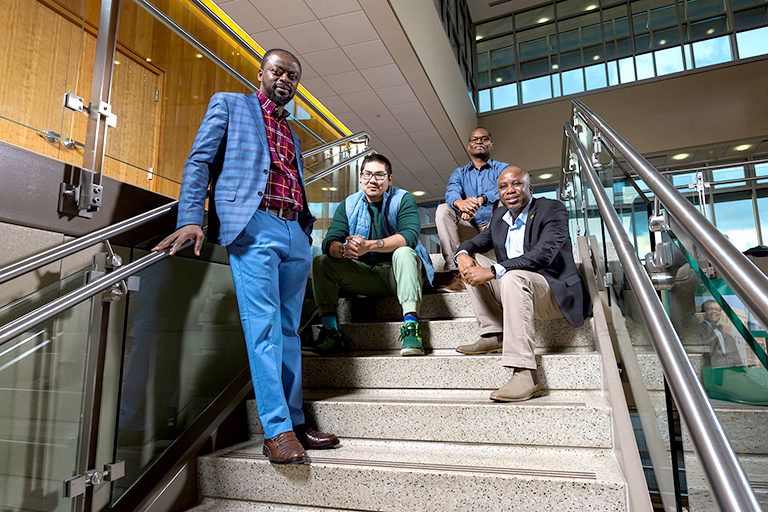
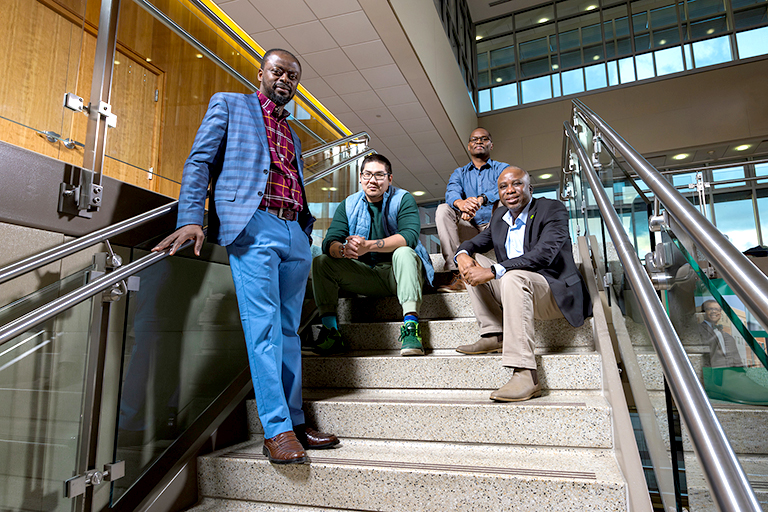
Peacebuilding and atrocity prevention. Liberation-centered community mental health. Global climate activism. Migration to rural centers.
Although these concepts may seem unrelated, CCPA students are working to connect them for common goals: helping people and changing the world.
“The doctorate program in Community Research and Action (CRA) has a democratizing effect; you don’t get the sense that you are being boxed into a specific corner,” student Frank Okyere Osei says. “There is room to decide which direction to go for your research and career. That enables you to think outside the box and to connect with different concepts, different ideas, different networks and different approaches.”
Many students who join the CRA program are dedicated to their interests and possess significant experience. The program enhances these opportunities by encouraging students to apply multiple levels of analysis and to emphasize collaboration within communities.
From business and finance to atrocity prevention
Osei, for example, began his career in business administration and worked in finance. A research associate at the Kofi Annan International Peacekeeping Training Centre in Accra, Ghana, he researched and helped implement the R2P (Responsibility to Protect) framework in Africa. He has 14 years of experience translating atrocity-prevention principles into policy and has been involved in risk-assessment modeling for African governments and institutions.
Osei arrived at Binghamton in 2019 to present at the Institute of Genocide and Mass Atrocity Prevention (I-GMAP) annual Frontiers of Prevention Convention. In 2022, he returned to I-GMAP as a Charles E. Scheidt resident practitioner and was so impressed by the work being done on campus that he decided to pursue a CRA doctorate.
I-GMAP has this incredible ability to bring people from different walks of life together to share ideas and provide the opportunity to ask questions and interact. You can directly test the theoretical ideas in the classroom with the practitioners who visit Binghamton. Bringing together high-level expertise from various parts of the world to engage and deliberate on critical issues is a huge strength.
Frank Okyere Osei
Osei’s work in peacebuilding and atrocity prevention is easily attached to what he identifies as “vulnerability and resilience studies.” He believes that the variety of projects within CRA — from disability studies to climate change to mental health and more — share this distinction; by making the work interdisciplinary, everyone benefits.
“There’s always a way to connect what you are doing with other students,” he says. “That is the strength of the CRA program. More than anything, I think what the world needs is the ability of different disciplines to speak to one another and the communities they serve.”.
Mental health practitioner finds value in community-based program
Adam Zhao (he/they), a third-year doctoral student, has an “eclectic” academic background. Before coming to Binghamton, he earned a dual degree in psychology and neurobiology from the University of Maryland, College Park, and a master’s in clinical mental health counseling from the University of Northern Colorado.
While contemplating different professional trajectories, Zhao heard about Binghamton and was attracted to the community-based nature of the CRA program.
There are ways that academia can create distance between the people you want to help. I love what this program does instead — you’re working from the bottom up. You’re engaging with people. You’re generating knowledge in ways that don’t feel hierarchical. The more I learn, the more I feel invigorated to do the work.
Adam Zhao
For Zhao, the CRA program feels like a “choose your own adventure” scenario. Driven by a desire to explore work in radical healing and liberation, he pursued electives with far-reaching topics such as Asian studies, witnessing and cultural production, and whiteness in higher education. While in the program, he also became a health educator at Pride and Joy Families, ran a queer community health scholars program, and worked in Binghamton’s Human Sexualities Lab.
“I’m very grateful for having the opportunity to branch out and explore critically and then find ways to integrate what I learned into my work,” Zhao says. “The more you branch out, the more you understand how many things are connected.”
Lawyer joins program to aid climate change activism
Other students are also actively involved in institutions, and many, like Jerome Nenger, travel internationally to make contributions to their fields.
“I’ve been exposed within a short time outside the classroom to the practical nature of what I am studying. I’ve interacted with people of like minds. It’s good exposure for me to see what other people are doing in different places and different countries,” Nenger says. “Seeing how various nonprofits are tackling environmental issues is igniting an even bigger passion in me!”
President of the CRA Graduate Student Organization and a third-year doctoral candidate, Nenger studied law in Nigeria and became an attorney in 2007. After practicing law for several years, he transitioned to academia and taught at various law schools in East Africa. Nenger later graduated from the University at Buffalo School of Law, earning a second master’s degree. When Nenger learned about the CRA program, he recognized that its analytical and multidisciplinary approach could help him achieve his long-term goal of contributing to climate change activism.
Nenger is now sponsored by the Kaschak Institute, where he serves as a climate ambassador for the 1MReady_BING initiative. He also participated in the development of Rwanda’s climate change Gender Action Plan, which aims to identify opportunities for intervention in key sectors affected by climate change. Next, a research award from the Institute, in partnership with the International Union for the Conservation of Nature, will allow him to work with more than 20 countries during the development of the Gender Equality and Climate Policy Scorecard, investigating how climate change impacts women.
“I hope to collaborate with local governments to educate communities, create awareness, implement strategies for climate change adaptation with a focus on supporting vulnerable communities, and advocate for more robust environmental policies prioritizing climate action and human rights. Engaging with the Kaschak Institute and Binghamton 2 Degrees has catalyzed my thinking toward the intersections of environmental justice and policy advocacy.”
Jerome Nenger
Political science lecturer boosts teaching credentials
Second-year student Paul Macharia has been a political science lecturer at SUNY Oneonta and worked in CCPA’s Community Schools offices. He earned a master’s degree in political science from Binghamton but believed that additional training in the CRA program would help him address the gaps in his studies and perform better as a teacher.
Originally from Kenya, Macharia completed his undergraduate studies at the University of Alabama, Birmingham, before relocating to New York. His work focuses on African migrants who settle in rural areas.
Macharia says data shows that African migrants are among the most highly educated immigrant groups in the United States and have more opportunities in gateway cities. So why do they often relocate to rural centers? He decided the CRA program might help him find out.
“With the multidisciplinary nature of the program, you can combine both quantitative and qualitative analysis and do mixed-method research to get more nuanced insights. The other strength is the methodological discipline and pluralism ingrained in the program.”
Paul Macharia
Osei, Zhao, Nenger, Macharia and the other CRA students come from different backgrounds but share goals and a deep appreciation for the relationships built within the program. As the students point out, it’s the people who truly matter.
“The research shows that the more diverse a team is, the more effective it becomes,” Macharia notes. “These experiences prepare CRA graduates to be excellent candidates for careers in the field, advocacy or academia as researchers or faculty members. However, none of us could achieve this without the support and mentorship provided by the program.”