Bringing her love for learning and social justice to the classroom
Human Development lecturer Maribel Tineo uses an interdisciplinary approach to prepare her students for success

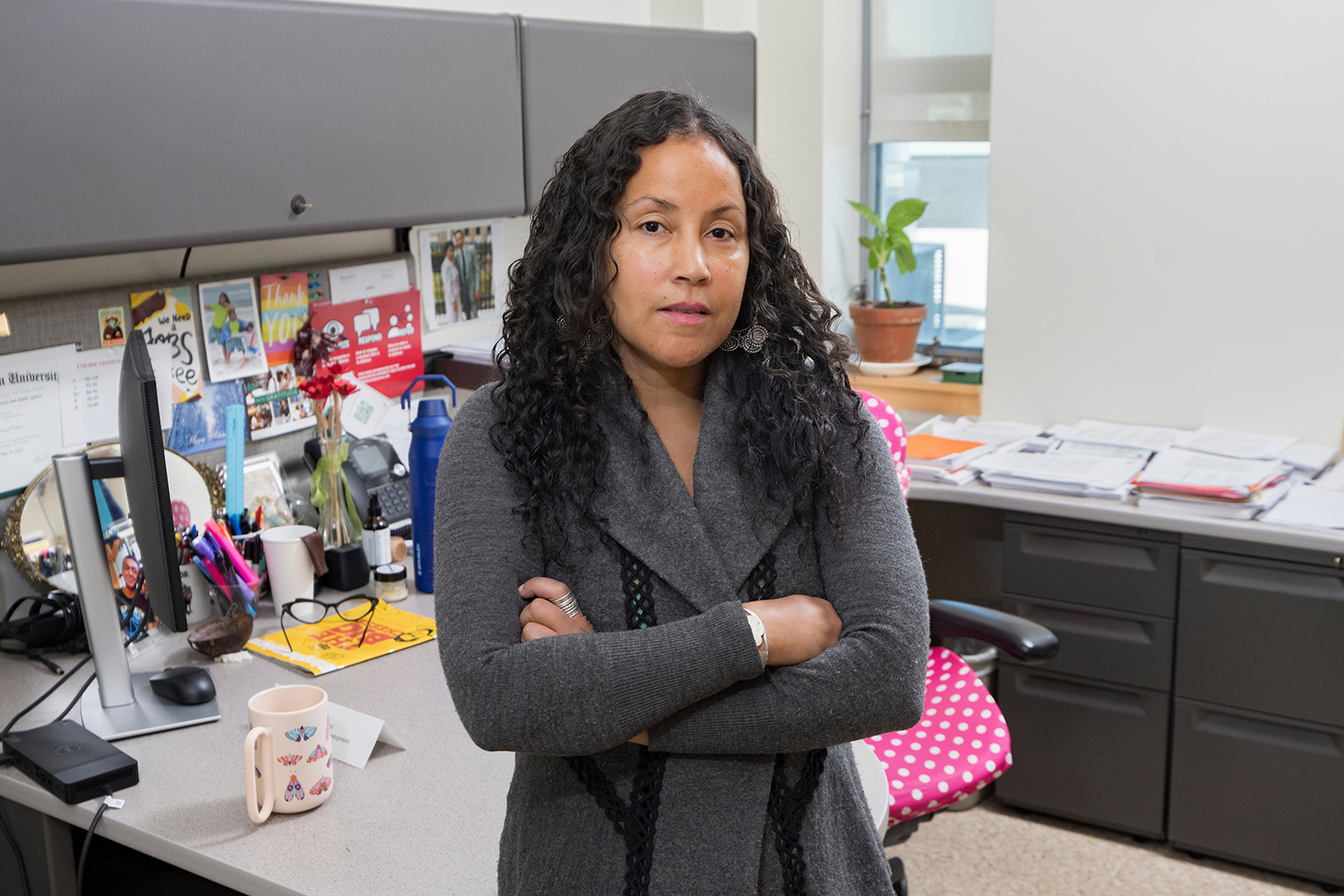
Human Development lecturer Maribel Tineo uses an interdisciplinary approach to prepare her students for success.
Maribel Tineo, a lecturer in the Human Development Department, was born in Harlem in the 1970s, a time when ideas about social justice and equality were gaining ground globally.
I feel like I am the daughter of a time when social movements were happening around the world, and that I benefited from the remnants of the Great Society era.”
Tineo was motivated to achieve academic excellence both at school and at home. Inspired by her teachers’ idealism and principles, she viewed the classroom as a safe haven.
“Many of my public school teachers arrived with a genuine desire to bring social justice and equity to education,” she recalls. “From an early age, I recognized a strong connection between the poverty I experienced and how education could serve as a means for personal growth and societal improvement.”.
Tineo grew up in an academically rich home environment. Her seven older siblings were high achievers and served as role models, demonstrating the many advantages of higher education. She benefited from their mentorship and, throughout her childhood, was surrounded by books and academic resources, exposing her to language and a diversity of ideas.
While Tineo’s siblings were educated in the city and state university system, benefiting from the financial support and low costs that public institutions historically excelled at, Tineo was encouraged by her school counselor to apply to one of the top Ivy League schools in the country, which is how the daughter of Dominican tobacco farmers ended up at Harvard University.
While she earned her academic credentials at Harvard, when it came time to apply her education, she returned to the New York City public school system. Over the next 25 years, she helped create systems and support as part of the “small school” reform movement of the 1980s and ’90s.
Tineo first served as a teacher at her alma mater in Harlem. She later worked as an assistant principal at the English Language Learners and International Support Preparatory Academy and Bronx Collaborative High School, and as a 12th-grade teacher and internship coordinator at Bronx International High School. Along the way, she supported high schools transitioning to performance-based oral assessments and developed strategies to reach a student population with few English language skills and other academic challenges.
In 2020, Tineo’s husband began working at Binghamton University, and she was hired temporarily as a visiting assistant professor to teach education-related courses in the Department of Human Development. Originally intended to be a one-year appointment, her position was extended for two additional years. Most recently, after a national search, the department appointed her as a full-time lecturer.
“I wasn’t sure if I would do well in higher education,” Tineo says. “I thought maybe I’m not erudite enough. However, I had a lot of field experience; I had been in the education field for 30 years, and that was something I was able to bring into my curriculum.”
Preparing students for success
Tineo takes an interdisciplinary approach to teaching, examining the micro and macro factors that shape human development. She maintains a connection with a Harvard graduate reading group, allowing her to integrate the latest research and innovations into her curriculum. In addition, she continually seeks creative ways to enhance her teaching, incorporating current events, films, videos, guest speakers and scenario-based learning to encourage students’ analytical skills and theory application.
“I want to keep my students engaged and ensure that they understand the relevance of what they are learning,” she says. “I encourage them to make connections among their internships, classroom experiences, current events and practical applications of their knowledge. I have received a lot of positive feedback from students majoring in human development who tell me they graduate feeling well-prepared for graduate school and various career fields.”
Outside the classroom, Tineo is always available to support her students’ extracurricular activities.
“It’s important to me to show up,” she says. “My students still need adult encouragement and support, and I enjoy celebrating and encouraging their passions. It’s also gratifying to see them in a different light and their talents in a different context.”
Tineo is also a member of the Lubna Chaudhry Human Rights Lecture Series committee, which has addressed topics such as workers’ strikes, immigration, and social and economic rights. She sees these as critical opportunities to engage in constructive debate and foment dialogue on timely issues in the classroom and across the University.
“I try to be honest and authentic in my work, providing my students with a solid foundation, interdisciplinary training and presenting broadly diverse perspectives,” Tineo says. “I feel fortunate to be here at Binghamton, a public university that does a really good job of educating a large number of diverse students and promoting equality in society, just like my teachers taught me in elementary school.”