Preserving voices, shaping futures: Binghamton graduate student documents EOP’s powerful legacy
Mariapaz Burbano ’24 contributes to oral history project spotlighting Educational Opportunity Program
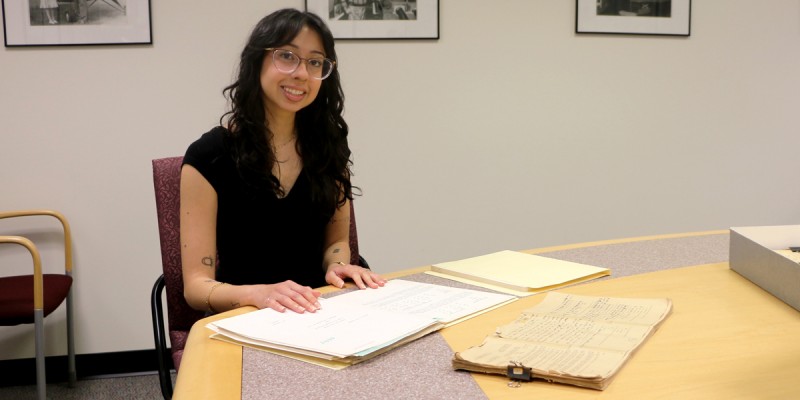
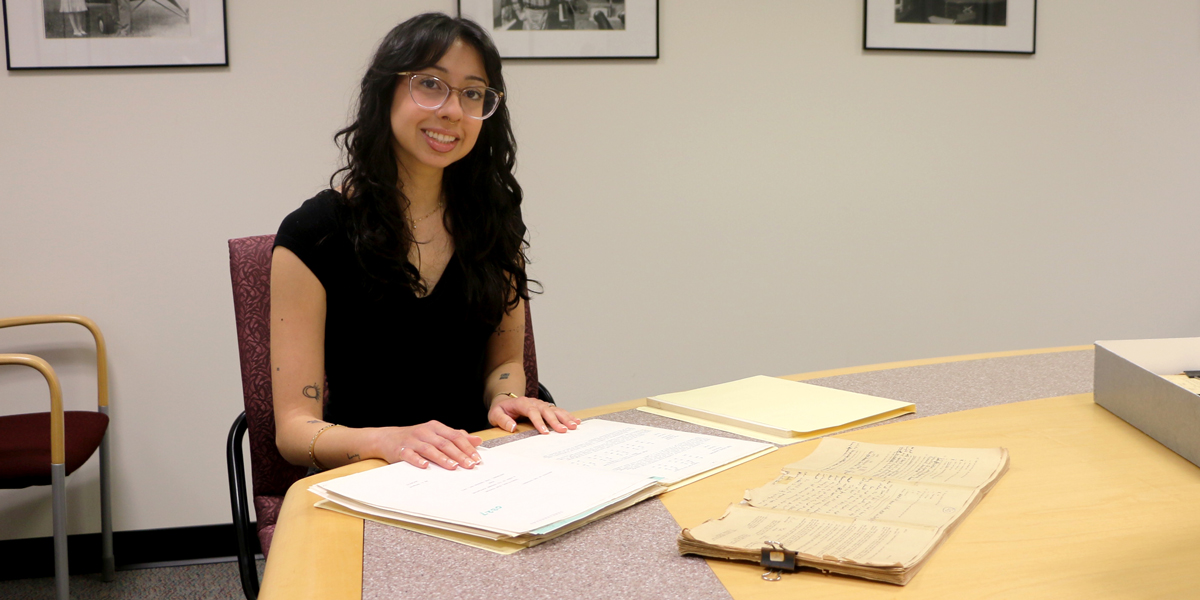
The Educational Opportunity Program (EOP) has played a vital role in shaping the lives of countless students at Binghamton University. For Mariapaz Burbano ‘24, who is pursuing a Master’s of Science in human rights through the Department of Human Development, researching EOP’s history has been a deeply personal and meaningful journey — one rooted in preservation, storytelling and advocacy.
Burbano graduated with a bachelor’s degree in political science and sociology. Her passion for social justice and equitable access was strengthened by her prior internship at Juan Neumann Center Redemptorist Immigration Services in Brooklyn.
Under the mentorship of the Rev. Ruskin Piedra, Burbano gained insight into the struggles faced by immigrant communities seeking education and opportunities. The daughter of immigrants herself, Burbano made the decision to pursue a master’s degree in human rights.
“Rev. Piedra’s unwavering commitment to social justice profoundly shaped my decision to pursue a master’s in human rights, and his passing last December only strengthened my resolve to carry forward the lessons he imparted,” Burbano said.
Originally from Brooklyn, Burbano did not participate in EOP during her undergraduate career at Binghamton, but as a first-generation student, she was drawn to the history of the program and how it has worked to enhance the college experience of other first-generation students.
She heard a lot about the program from friends who were involved, and she experienced EOP’s impact while tabling at the Binghamton Enrichment Program (BEP), EOP’s summer transition program for incoming students.
“I was involved in a lot of multicultural student organizations, including Corazoncitos, a philanthropic Latin American club,” Burbano said. “Every summer at BEP, I enjoyed talking to the EOP students and sharing experiences. I think that’s what sparked my interest in EOP.”
Burbano earned a position as graduate assistant with Bartle Library Special Collections, joining a team that was working to document the evolution of EOP at Binghamton through oral history interviews and archival research. The project was spearheaded by John Benson, the director of the Transitional Year Program, which predated EOP, before he passed away in April 2024. Through interviews with the individuals who lived that history, Burbano and her team have woven together a comprehensive narrative.
“The methodology of my research has been mostly the oral history interviews that we’ve been conducting,” Burbano said. “I love hearing directly from people who have experienced so much and seen Binghamton throughout the years.”
Beyond the methodology, Burbano has been driven by the power of memory and advocacy in the face of political and social challenges.
“In the midst of the pressures that academic institutions are facing, I think it’s definitely very important to hold on to these records and make sure to amplify these voices so that they’re not forgotten,” she said.
For Burbano, history isn’t just about the past—it’s about understanding the present. She has been struck by the ways that EOP alumni have drawn parallels between the struggles of the civil rights movement and today’s socio-political landscape.
“A lot of people think the ’60s and ’70s were a long time ago, and it really wasn’t,” she said. “Hearing that juxtaposition of experience and knowing that people from that generation are still reliving a form of oppression — it’s something that we need to highlight.”
As the project nears completion, Burbano hopes to make her findings accessible to future EOP students. “I think that students — EOP and first-generation students in particular — are definitely facing added obstacles. I would have appreciated seeing something like this when I was an incoming first-year, just to see that amidst all the chaos, there are people with similar backgrounds and similar experiences who have lived through very difficult times and succeeded at Binghamton.”
More than anything, Burbano carries a strong sense of responsibility to those whose stories she has had the privilege to record.
“I hope that I do right by the alumni, staff and faculty that we’ve been interviewing,” she said. “I just hope that by the end of it, it’s something we’re all very proud of — something that was worth doing,” she said. “I know a lot of the people we’ve interviewed really want, at the very least, to preserve their history, and I think we’ve done that.”
For alumni, Burbano’s work serves as both a tribute and a call to action — a reminder that their stories matter.
“It’s incredible to hear how hard they fought, how they were activists and how their efforts paved the road for current EOP students,” she said. “I’m honored to talk to them and hear how they shaped the very opportunities we have today.”
As she moves forward, Burbano hopes to continue amplifying these voices, ensuring that the legacy of EOP remains a beacon of resilience and empowerment.