Mummy tags: Inaugural Kadish lecture looks at funerary practices in Roman Egypt
An Egyptologist, Gerald Kadish left a legacy with a new lecture series featuring early career scholars
In Roman Egypt, embalming was big business — no longer reserved for pharaohs or their retinue, but simply the way that most people sent their beloved dead to the afterlife.
In some ways, this ancient business of death seems strikingly modern. Embalming houses dealt with multiple clients, tracking and certifying each step of the process with documentation. Then as now, increased demand led to mass production, cost-cutting measures and ultimately a decline in overall quality.
Mummies were the topic of the inaugural Gerald E. Kadish Lecture, hosted Sept. 17 by Binghamton University’s Middle Eastern and Ancient Mediterranean Studies (MEAMS) Department and the Center for Medieval and Renaissance Studies. Kadish, who died in December, left a bequest to establish a lecture series featuring early-career scholars.
A distinguished teaching professor of history, Kadish joined Harpur College in 1962 and spent 50 years at the University, where he taught courses in ancient Egypt, the Near East, Greece and Rome. From 1973 to 1983, he was editor of the Journal of the American Research Center in Egypt, an important journal in the field.
“When I joined the history department here, I discovered I could only reasonably manage to cover about half of the survey courses that Gerry routinely taught,” reflected History Department Chair Nathanael Andrade. “Taking his Western civilization course here became a tradition among undergraduates for many generations.”
The inaugural lecture featured archaeologist and papyrologist Leah Mascia of Freie Universität in Berlin, who discussed “Writing on sacred linen in Greek: Switching language in the funerary workshops of Roman Egypt.”
The practice of writing funerary spells on shrouds and mummy wrappings is attested as early as Egypt’s Second Intermediate Period from 1782 to 1550 BCE. The practice persisted after the Roman conquest of 30 BCE, although in changed form, Mascia explained.
“It marked not only the survival of ancient Egyptian religious beliefs, but it’s also a testimony of the existence of funerary workshops, which have ensured the performance of embalming practices and funeral rites for millennia,” she said. “Iconographically and textually, these inscribed artifacts are often very similar to specimens produced hundreds of years before, even in the Middle Kingdom. Others undoubtedly reflect the changing religious and social landscape of Roman Egypt.”
A mummy tracking system
Originally, funeral shrouds and mummy wrappings featured quotations from the Book of the Dead, prayers and invocations to deities in the native Egyptian tongue, intended to protect the deceased on their journey to the underworld. One shroud, for the daughter of a priest buried between 50 and 100 CE, featured three inscriptions in Demotic — an Egyptian script more widely used than hieroglyphics — by two different scribes. The inscriptions include a date, which may have functioned as a ticket confirming the mummy’s identity.
By the second century CE, mummy wrappings were increasingly written in Greek, the lingua franca of the day, preserving the body’s name, a patronymic and sometimes a phrase such as “farewell.” The linguistic shift reflected the changing nature of Egyptian society, which included not only native Egyptians, but citizens of Greek descent, Roman settlers and Near Eastern merchants.
“Beyond doubt, the traditional Egyptian funerary administration needed to find a way to adapt to the contemporary, multicultural, multilingual panorama and meet the needs and tastes of an extremely large clientele,” Mascia said. “It is indeed at this time that one can really speak of the democratization of the afterlife.”
The funerary process was intricate, from the transportation of the body to the embalming house, the many steps involved in creating mummies, and to the funeral rituals themselves.
Mascia also studies mummy labels, small tags of identifying information attached to the foot or neck of an embalmed individual. In short, these tags permitted embalming houses to track the bodies they prepared at each step in the process, through the delivery to the deceased’s family. Mummy wrappings — especially in later eras, when prayers and invocations were replaced simply by a hastily-written name — may have served the same practical role.
At the end, embalmers attached a clay seal, certifying the completion of the required funeral procedures. Documentation such as this certified that families received the embalming they paid for, and that they paid the shipping costs to transport the body there and back.
While everyone knew some Greek, Roman officials weren’t able to read Demotic — hence the need for bilingual labeling.
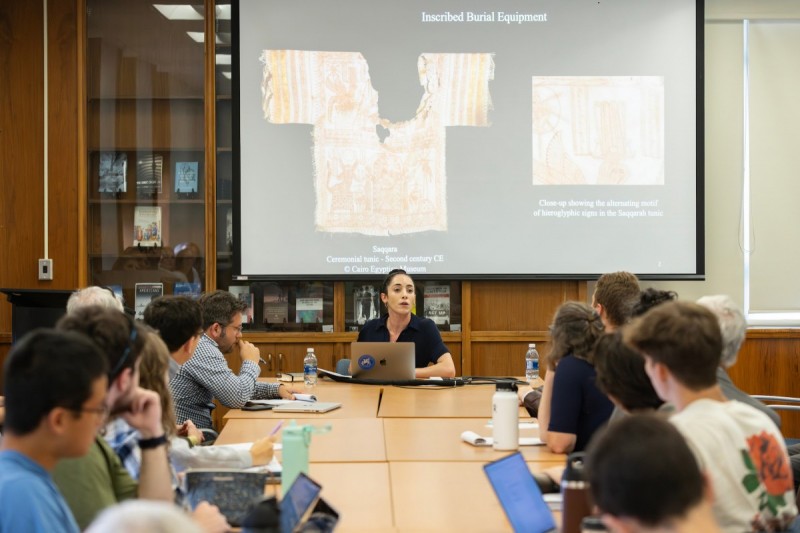
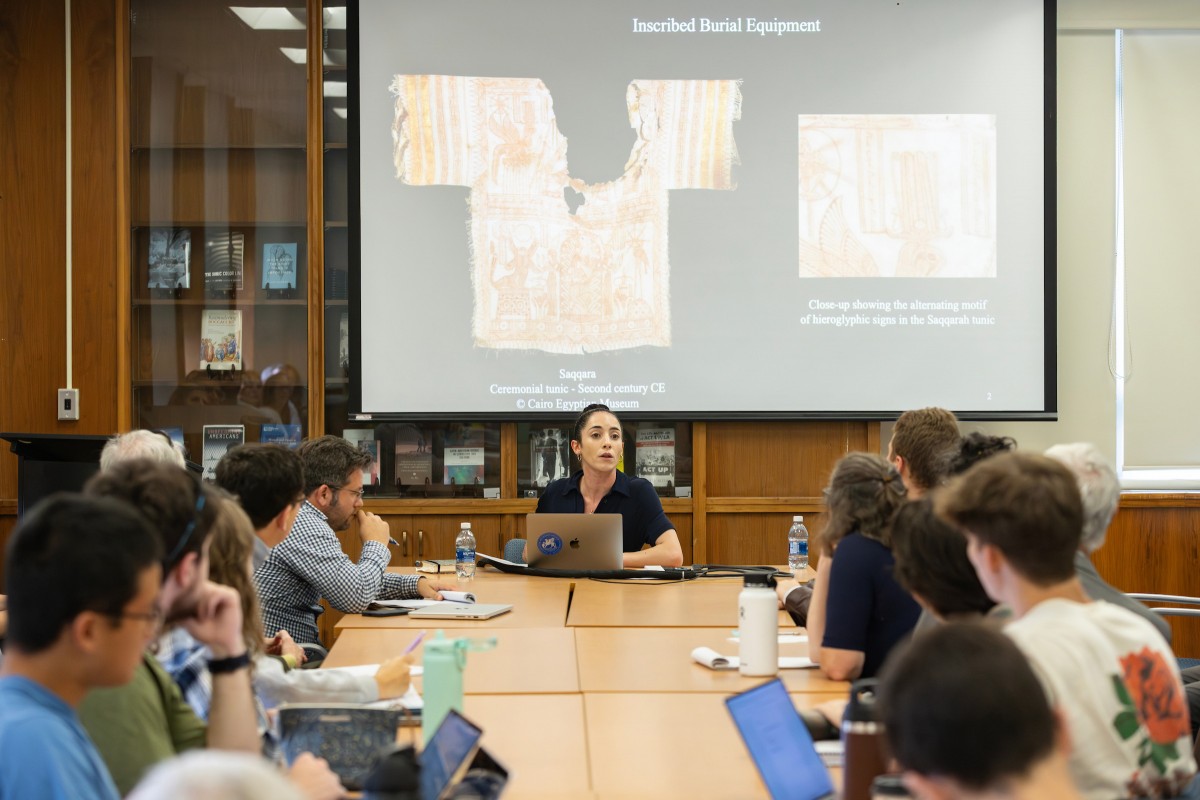
As a ceremonial script practiced by learned professionals, hieroglyphic writing wasn’t included in these later texts. In fact, a ceremonial tunic discovered in an early Roman tomb in Saqqara features faux hieroglyphics with only a symbolic or ritual value and no textual meaning — in other words, gibberish.
Other customs simply disappeared, such as the placement of more than 120 protective amulets on precise points of the deceased’s body during the wrapping process. During Roman times, mummies may have one or two winged scarabs or wadjet-eye amulets attached to the wrappings or worn around the neck.
By the third century CE, Egyptian funerary practices began to change dramatically, fueled by a funding crisis that led to the closure of many temples and the rise of Christianity. Standards were lower; embalmers no longer removed the deceased’s organs, and funerary garments were often reused from the individual’s lifetime.
However, those customs proved incredibly resilient, spanning more than a thousand years of continued — if shifting — practice.
“By examining the ritual practices documented by these inscribed objects, we can trace both the adaptation and resistance of the Egyptian funeral tradition during this transitional phase in a religious and cultural landscape in continuous transformation,” Mascia said.