Watson College alumnus strikes a chord in the piano industry
Michael Hindin ‘18, MS ‘19, brings his knowledge of industrial and systems engineering to Steinway & Sons
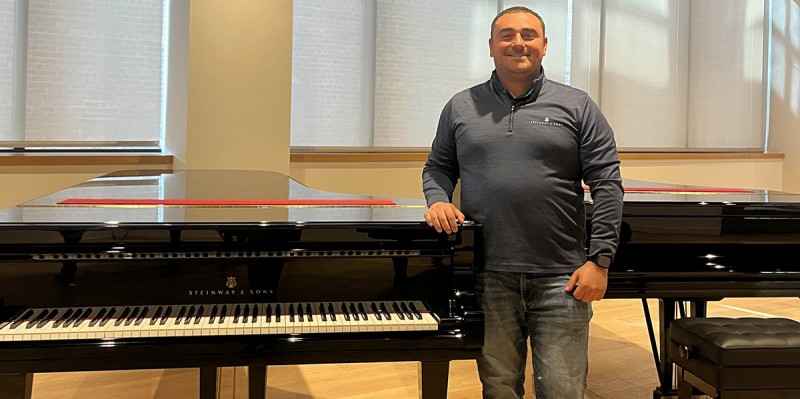
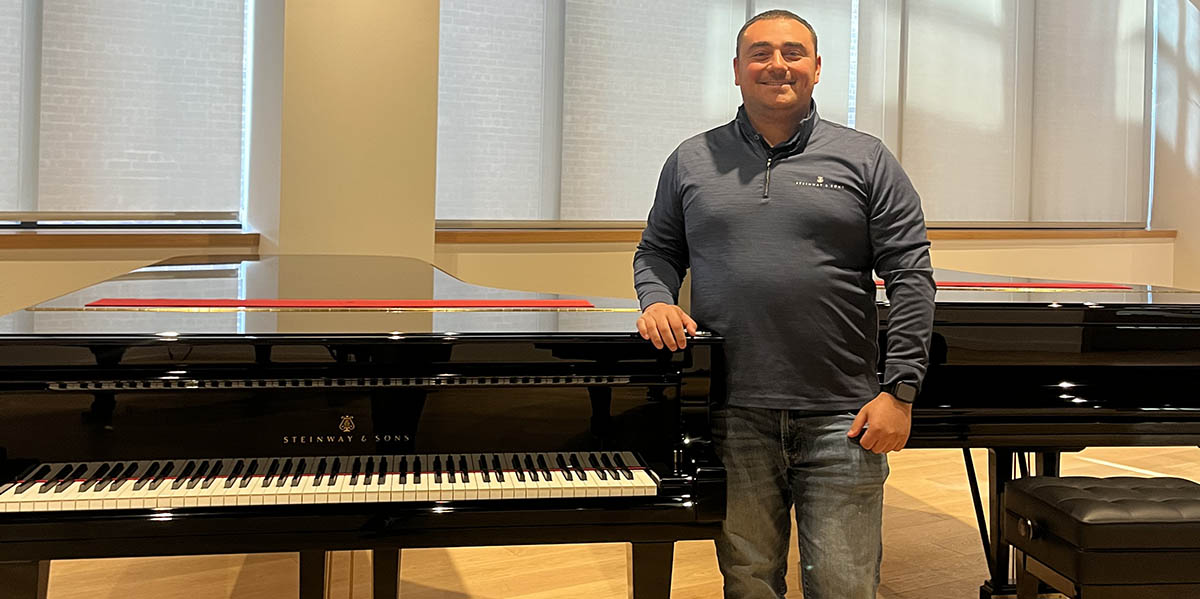
Binghamton University alumnus Michael Hindin ‘18, MS ‘19, always excelled in math and science, but he also wanted to use his communication skills to foster a successful career in industrial and systems engineering.
He graduated from the Thomas J. Watson College of Engineering and Applied Science’s School of Systems Science and Industrial Engineering, where he learned the skills required to improve manufacturing in the most efficient way.
Hindin now works for Steinway & Sons, which has built high-quality, world-class pianos since 1853. He puts in hard work behind the scenes to ensure that operators can assemble their pianos with ease.
What is industrial and systems engineering all about?
To me, industrial and systems engineering is all about taking what’s in front of you and trying to improve it to make it as simplistic as possible for whoever the operator may be. Or, if it’s a machine, simplifying it so that everything is as easy to operate to get the required result.
Could you tell me a little bit more about your background and what made you so interested in industrial and systems engineering?
When I was in high school, I was good at math and science. So going in, I was dead set on being a mechanical engineer. Then I started taking physics, and I didn’t like physics.
So then I got to first-year engineering and there was a seminar where all of the different departments came in. Some of the teachers came in and spoke — they pitched what they do, all the different classes, and we learned about their personalities and everything like that.
When the industrial engineering teachers came in, they sold it as something that I’m very interested in: analyzing processes using my math and science backgrounds, as well as being able to communicate with people and working in collaborative groups, unlike a lot of other disciplines.
That’s something that really appealed to me, because I’m a people person. I like talking to people, communicating and working in groups. So that’s what drew me toward that, because it allowed me to use all the skills that I developed, personal as well as educational, to further my career and actually do what I like.
You graduated from Watson College’s School of Systems Science and Industrial Engineering. Could you share more about your experience with that program?
My class was 93 students in industrial engineering, which is pretty large. And we all became very, very close. It was very collaborative. A lot of teamwork, pretty much all 93 people knew all 93 people. And we all stayed together from sophomore year, all the way through senior year. We did a lot of group projects, as well as individual learning through the various classes we took.
I was involved in IISE [Institute of Industrial and Systems Engineers], which is a club/professional group on campus that connects industrial engineers to people in the industry.
I also did a competition with two of my classmates in my year, Lauren Kelemen and Darren Silvanic, doing a simulation through arena. The simulation that we worked on involved a co-working facility trying to optimize the flow and meet the demands of the customers based on a given data set. We got selected to go to the finals in Orlando and then competed there against two other schools, one from Canada and the other from the University of Arkansas. We brought Binghamton’s name into the limelight of the IISE group. I know Binghamton continued to go back, and then won over the past couple of years.
Something else that was cool was my senior project. We worked with BAE Systems. I didn’t really push myself forward when I was in college to go get internships, go do summer programs or anything like that, so that was really my only experience working with an outside company or doing anything in terms of a real job.
And then through that and based on me doing that competition and doing so well in it, I was offered to go to grad school at Binghamton as well. So I ended up staying for an extra year doing grad school in SSIE (systems science and industrial engineering). I was a teaching assistant for undergraduate classes there, and then I completed my coursework over the summer and finished my graduate degree in a year.
Now you work for Steinway & Sons Pianos. What was the process of getting that job like, and what do you do there?
I had a job at a different company for three months, and then the world shut down because of COVID. Then during COVID, I was applying for jobs— applying, applying and applying. Obviously, I knew nothing was going to come of it because nobody was really hiring anybody. But just to get my name out there and get used to the grind of actually applying for jobs, I applied to 1,200 jobs over that time period.
To be honest, it was just by chance. [Steinway & Sons] had multiple positions open. I applied to a couple of them, and I got a call back to have an online interview with the head of HR.
He asked me one specific thing, which is the reason why I think I got the next interview, about what the most important thing industrial engineers should do in terms of focus — should it be quantity or quality? And since Steinway & Sons Pianos is a producer of high-quality goods at a low production rate, I answered it with quality.
I moved on to the next round; it was only a two-round process. I came in and interviewed with my former boss, my current boss and another industrial engineer. During that, I was given a tour of the factory, and they explained what goes on here and what I would be involved with.
And now I’ve worked here for four years in November. I started out as a continuous improvement engineer, which is a type of industrial engineer who is trying to constantly change little aspects to improve the building process. My perception is to constantly simplify, to make it as easy as possible for the operators.
I started out doing very basic standard operating procedures and time studies, just getting my feet wet and understanding how complex the piano actually is, learning all the different departments and operations that are involved.
As that progressed, we were doing larger-scale kaizen events where we would go into different departments, identify issues — whether in production reporting or not meeting production goals, anything like that — as well as preparation for any implementation of machinery or moves throughout the factory.
Then my boss left about a year and a half into me being here. I took over as the only industrial engineer. I started to take on all of the larger projects working cross-functionally with mechanical engineering, the quality team, automation, pretty much everybody in the factory. I was trying to support and drive all those projects as well as working on what I was doing previously in terms of reporting the day-to-day operations of the factory and standardizing everything we can. I’ve been in that same general role since that time.
The scale of the projects has increased more and more as we’ve expanded and developed our team. I am involved in a lot of implementation of machinery and preparations for that in terms of creating layouts for facility moves, actually physically going on the floor and picking up everything that we’re using to move it to the new location, and working with outside contractors to organize electrical setups. There’s also the smaller stuff in terms of tack time, cycle time, level loading, optimizing all the operators, keeping our efficiency as high as possible, and then I do reporting and other data analysis in conjunction with the co-ops that I have here.
What challenges have you faced throughout your time in the engineering field, both at Binghamton and at your current job?
At Binghamton, I’d say the challenges are understanding the applicability of some of the coursework that you do. Obviously, in college, you’re building a skill set. You’re learning for a reason, but you don’t see the end goal of it — you’re never going to know when you’re going to need it. But when it presents itself in front of you, you have it and you know exactly what to do.
Professionally, the biggest issues for my team are prioritization and optimizing people. We have a lot of projects across the entire factory, but we have a very limited staff to accomplish all of these. So our big issue is understanding prioritization from upper management and what they’re trying to see. It constantly changes. It’s all about being agile and being able to adjust what we’re doing to meet the needs of the company and meet the demands of our upper management board.
Do you have any advice for others currently working on pursuing a career in engineering?
My advice would be to take in all the tools that you’re learning in school. Every industry is different. I’m in manufacturing, but understanding all the basic tools that you’re learning throughout your sophomore, junior and senior years will help you in the long run. Whatever situation you’re in, all these different tools are applicable, and it’ll help you to problem-solve and have the correct mindset into how to go about analyzing and solving problems.
Is there anything else you learned from your time at Binghamton University that you apply to your career today?
One of the main classes that was actually very critical to what I’m doing now is Enterprise Systems. That was taught by Associate Professor Christopher Greene. It teaches you how to work with people on a team, whether they’re pulling their own weight or not. You just had to work with what you were given, working with that team to get to the end goal.
When you work in industry or wherever you work, you’re going to have people who don’t pull their weight, and you have to figure out how to get to the end goal and solve the problem regardless of their effect. That class teaches you how to deal with people and how to solve all the problems, regardless of the various situations that you may be put into.
Have you ever learned how to play the piano or do you just work on them?
That’s the question that everybody always asks. No, I don’t know how to play the piano. I kind of know how to fake my way through it. I know where all the different C notes are, so I know how to position myself. I kind of just play, and if I hear something that sounds right, I’ll try to do that by ear and mess around until I get it.