Biomedical Engineering Department celebrates 2025 accomplishments

The fall semester at Binghamton University is about a month away from wrapping up, and the Department of Biomedical Engineering at the Thomas J. Watson College of Engineering and Applied Science is excited to share its 2025 achievements in education and research.
Faculty news
Welcome to Assistant Professor Daniel Reynolds, our new faculty member for fall 2025!
Professor Sha Jin was placed in the top 0.5% of all scholars worldwide, according to the most recent 2024 ScholarGPS rankings. Jin was recognized for her strong publication record, the impact of her work and the notable quality of her scholarly contributions.
A Stanford University study that looks at the impact of scientists worldwide identified 29 Binghamton University faculty who were among the top 2% of all researchers in the world in their fields in 2024. Among them from BME was Associate Professor Yuan Wan.
Research news
Assistant Professor Qianbin Wang won a $600,000 National Science Foundation CAREER Award to advance his glaucoma research. Wang aims to investigate the mechanisms of and potential ways to detect and treat glaucoma early.
Associate Professor Guy German’s latest research into skin mechanics discovered why older skin is more prone to wrinkles. It’s because when your skin stretches in one direction and contracts in the other direction, it buckles – and this gets more pronounced as you age.
Inspired by a question from a child, German also proved that fingers wrinkle the same way every time they are immersed in water for long periods. The wrinkles are tied to blood vessels beneath the skin, which do not change much over time.
PhD student Tianzheng Liu collaborated with Professor Sha Jin and SUNY Distinguished Professor Kaiming Ye on research to turn food waste into biodegradable plastic. The published paper offers fundamental findings for any company interested in scaling up the process.
Assistant Professor Ying Wang teamed up with Assistant Professor Yingge Zhou from Binghamton’s School of Systems Science and Industrial Engineering for research into how to improve the vascular systems of engineered tissues. By integrating nanotubes into a composite hydrogel that formed part of the tissue-growing medium, they increased blood flow throughout the cells.
Assistant Professor Siyuan Rao is seeking better methods to monitor and recover from spinal cord injuries, which affect more than 15 million people worldwide. Earlier this year, she received more than $870,000 in grant funding to continue her study of neuroengineering technologies to treat those injuries.
In a story for the Binghamton University research magazine, Associate Professor Fake “Frank” Lu and Associate Professor Yuan Wan discuss their ongoing work on cancer detection. Lu hopes to use Raman scattering to improve cancer removal surgeries, and Wan is researching ways to better detect solitary pulmonary nodules (SPNs).
Student news
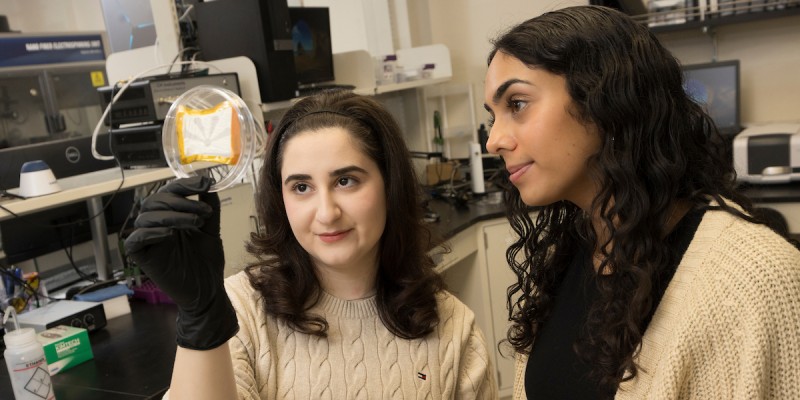
Working in Associate Professor Ahyeon Koh’s lab, Joab Dorsainvil, MS ’23, PhD ’25, led research on a new variation of polydimethylsiloxane (PDMS), a silicone-based and biologically inert material widely used for flexible and stretchable electronics.
Two of Koh and Dorsainvil’s collaborators, Dana Manashirov ’25 and Serena Patel ’25, were featured in this year’s Watson Review magazine as part of a story about undergraduate researchers.
Also in the Watson Review, Katherine Peters ’25 was featured in a story about how students are giving back to the Binghamton community. As part of the Watson College Scholars Program, she helped to organize a “period pantry” distributing free feminine hygiene products at the Broome County Public Library. Peters is currently pursuing her master’s degree at BME through the 4+1 program.
Peters also worked with Professor Gretchen Mahler and fellow students Sydney Nierstedt ’26 (BME) and Rachel Proper ’25 (Harpur College’s Department of Biochemistry and Chemical Biology) to investigate how bacteria can survive and thrive in the human bladder. The research could help millions of women worldwide suffering from recurrent urinary tract infections (RUTIs).
Alumni news
Flynn Anderson ’22 received an English teaching assistantship in Laos through the Fulbright Awards. His work on kidney-on-a-chip microfluidics and neural implants shaped his pathway through college and provided insight into disease treatment. He has been working in industry at a synthetic biology company post-graduation but has recently switched paths to write grants for virtual learning programs.