Student’s photo project shares experiences of transgender and genderqueer Ultimate Frisbee athletes
Billie Feigin ‘26 uses skills she learned as part of the Humans of Binghamton project on campus

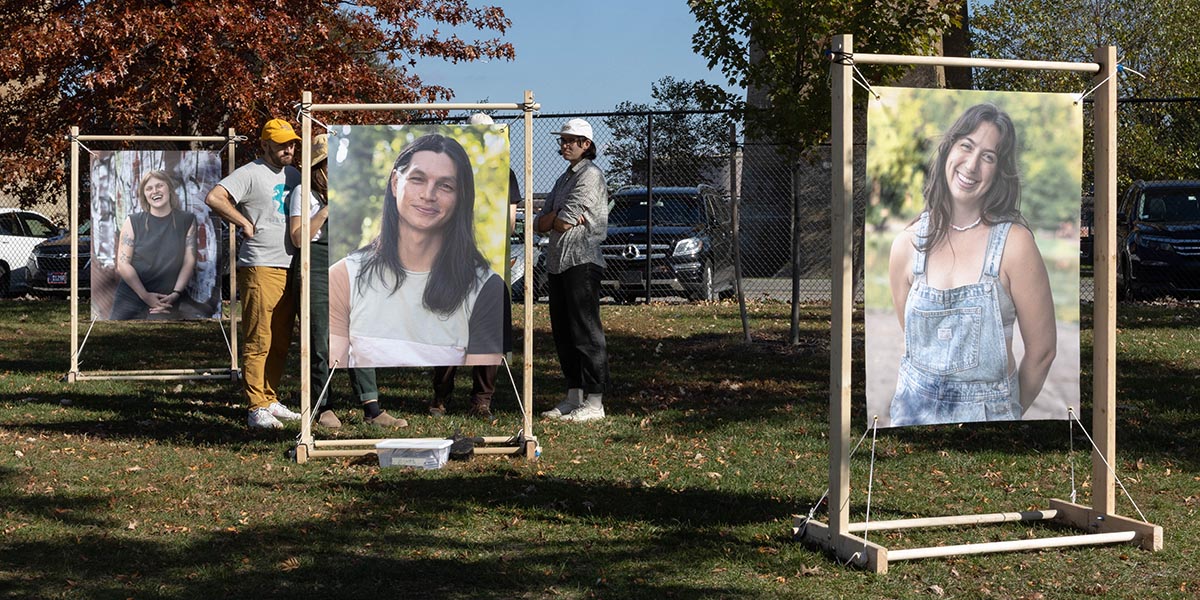
In response to discussions in the media surrounding genderqueer and transgender athletes in sports, Billie Feigin ‘26 decided to create an exhibit highlighting the stories of real people’s experiences in the Ultimate Frisbee community.
Feigin, a photography major, took pictures around campus as part of the Division of Communications and Marketing’s Humans of Binghamton, which inspired her to go on to create her latest project. Throughout her time with Humans of Binghamton, she was able to gain a skillset and knowledge in the arts that she still applies today.
On campus, Feigin is a member of the Ultimate Frisbee team, the Outdoors Club and the Student Association Programming Board. She has also been using School of the Arts facilities such as the Visual Media Center and Woodshop to build materials for her current project. Earlier this year, Feigin won Binghamton University’s Summer Scholars and Artists Program award, helping her create a series of portraits and interviews of transgender and genderqueer Ultimate players in New York City.
Feigin’s exhibit is online on her website, but she is aiming to bring it to Binghamton next semester.
Feigin shared more about what inspired her project, what she has learned from it, what she still applies to her work today from her experiences at Binghamton, and what she hopes for the future.
Tell us more about Humans of Binghamton. What does it entail and how were you involved?
In my first year, I met campus photographer Jonathan Cohen, who told me that the Division of Communications and Marketing was looking for an intern. I applied and soon after became part of a project called Humans of Binghamton.
Humans of Binghamton is inspired by Brandon Stanton’s Humans of New York — a series of portraits and interviews on the streets of New York City, highlighting different people from all over. We have our own version at Binghamton where we highlight different individuals from all corners of campus.
I would walk around campus with my camera and voice memos app, looking for students who were open to talk.
My questions varied depending on the time of year and what was happening on campus. I asked students about themselves, what they were involved in on campus, what they were excited about, and would then take their portrait. We would post a portrait and quote from that conversation on the official Binghamton University Instagram page.
Tell us about your current project and what inspired it.
After joining the Ultimate Frisbee team here at Binghamton, I went back home to New York City and discovered that there’s a pretty expansive Ultimate Frisbee community there. I started attending pickup games and joined a club team called Brooklyn Hive.
I grew up an athlete, so I’ve been in many different sports environments. I found Ultimate Frisbee to be unique in that it felt like there was a space for everybody there. It didn’t matter where you came from, what you looked like, what your gender identity was or your sexuality. It felt like you could be anybody and you had a place at Ultimate Frisbee.
This past winter, there was a lot in the news and national debate about transwomen’s participation in sports— whether they should be allowed to compete and if it was fair. I thought about my own community and how despite all of this discourse, there continued to be space for all people in Ultimate Frisbee. Written into our language and culture is inclusivity; the structure that we have offers space for gender diversity where people can self-select the gender matchup and division they play in.
I recognized this was only my perspective. I wanted to know if other people felt similarly, so I went directly to trans and genderqueer athletes themselves to ask about their experiences in our sport and community.
I was drawn to the combination of portrait and quote that defines Humans of Binghamton because it lets people connect deeper with the individual whose words they’re reading. I chose to carry that same format to this project.
You received a grant through Binghamton University’s Summer Scholars and Artists Program. What did that mean to you, and how has it helped you throughout your process of creating this exhibit?
I first heard about the Summer Scholars and Artists Program through Art and Design lecturer Kari Varner, who I have a great relationship with. She’s always letting me know about exciting opportunities, and she recommended that I apply.
Receiving the grant allowed me to pursue the most ambitious self directed project I’ve taken on. Having support from an advisor and funds to purchase equipment and cover other necessary expenses allowed me to fully realize this project in a way that wouldn’t have been possible without the Summer Scholars and Artists Program.
Most recently, I have been using what’s left of the grant money to purchase materials to build frames and create large 3-foot by 4-foot prints, taking advantage of the School of the Arts facilities. We have a really great woodshop and Visual Media Center here on campus.
I approached the Sculpture Studio technician, Austin Laughlin, with my ideas for the exhibition. He jumped in to help immediately, guiding me on how to choose the best 2x4s in Home Depot, use the equipment in the shop and develop my structures. I also worked with photography specialist Marcus Newton, who runs the Visual Media Center. He helped me with creating large prints and coming up with ways in which I could suspend them from my frames. Having faculty who outside of class are really engaged and willing to share their expertise was so helpful. It made taking on this ambitious project so much easier.
How did your time with Humans of Binghamton help prepare you for this project? What skills did you learn that you were able to apply to your work?
My time with Humans of Binghamton helped me gain the skill set; I had made portraits, conducted interviews and approached strangers before. I learned that the worst that someone could say is no, and if they say yes, you get to hear a new perspective and maybe learn something you didn’t previously know.
Making portraits in Binghamton taught me how to be adaptable, shoot outside of a studio and be present with the person I am photographing, which translated well to making portraits in the streets of New York. New York City is unpredictable; you never know who you’ll meet or what will unfold around you.
Another thing I learned with Humans of Binghamton was to approach each conversation I had with an open mind. I learned how to ask questions that allow people to have space to talk about what’s meaningful to them. That was especially important with more personal, intimate information that came up in these conversations over the summer. I knew not to go in with assumptions, but rather to ask broad questions and let the conversation flow from there. That really helped me listen and let people tell their own stories.
What has been the most exciting part about your current project, and what have you learned from it?
The other weekend, I went down to New York City and exhibited my work at a college Ultimate Frisbee tournament. I spent the whole start of this semester preparing for that. Seeing it all come together, seeing people interact with the work and learn about these athletes and these community members was really awesome. I had some really engaging conversations, and I got to see the impact that this project was having on other people.
Getting to hear the takeaways that people had after interacting with the work, what they learned or their assumptions that were challenged, was really rewarding. This summer, having these conversations taught me a lot about other people in my community, Ultimate Frisbee and its history, and myself.
I’ve learned that being trans is not a monolith. Not all non-binary people have the same reason for using the pronouns that they use. Every person is an individual with a completely different set of experiences, different gender identities and different things that they offer and need from the communities they’re a part of.
I learned that conversation is the most important thing. Being curious and asking questions is important. That’s the only way to create an inclusive space where people can feel safe, comfortable and able to be themselves.
Where do you hope this project will lead you in the future, and how will you continue to use the lessons you learned during your time at Binghamton?
This summer, I spoke with nine people. I know that there are more trans and genderqueer people out there in New York City who would be great additions, so I am hoping to include more people and expand on this project.
I also think that exhibiting this project in other settings would make it more accessible. I’ll definitely bring it to Binghamton next semester. Presenting my work at the Ultimate Frisbee tournament was amazing and fitting, but sharing it in a gallery space could allow more people to come interact with the work and hear these stories.
I hope this project will open up dialogue for people who resonate with these stories to share their own experiences. While my focus has been on gender, I hope it also encourages curiosity about all aspects of identity like race, class, sexuality and religion.
My main takeaway is that being curious about other people and engaging in conversation is important. I think that doesn’t just apply to gender and doesn’t just apply to this project. That’s a lesson I learned that I’ll take with me as I move through this world, speaking with people and entering new communities and new environments.