Pharmacy lab gives students invaluable, hands-on experience
Binghamton University students working under Assistant Professor John Fetse share how his lab is setting them up for success
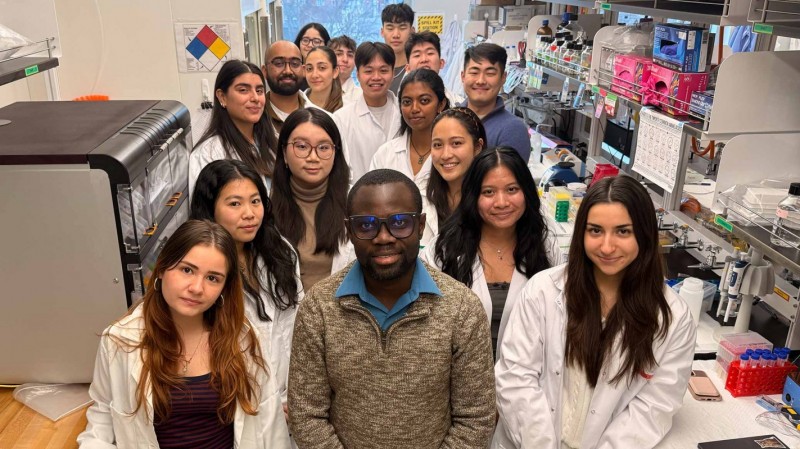
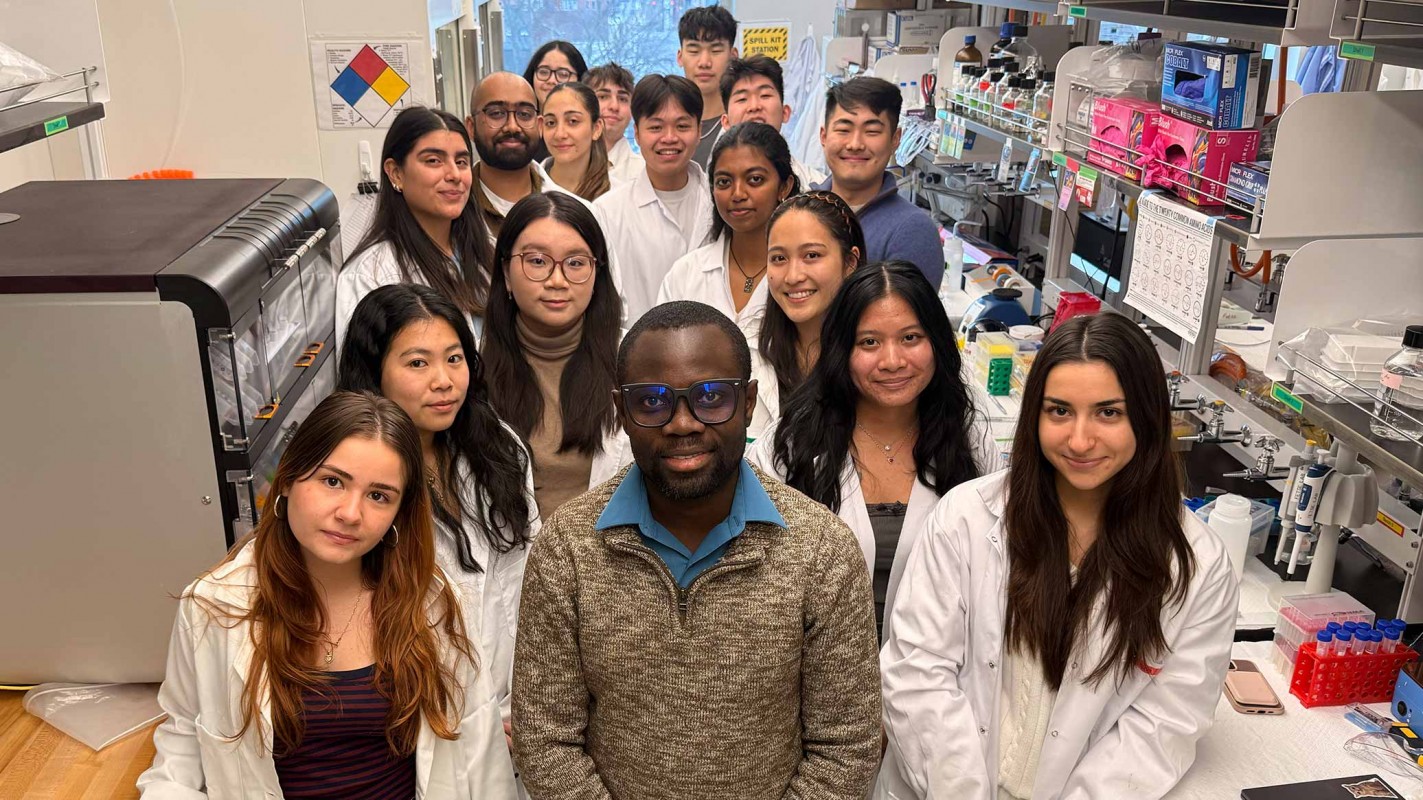
Experience is the best teacher. While textbooks and theories are great, firsthand learning through doing, making mistakes and facing challenges head-on can create a deeper understanding and respect for what you’re trying to accomplish.
Assistant Professor of Pharmaceutical Sciences John Fetse is giving his students that type of experience in his lab at the School of Pharmacy and Pharmaceutical Sciences. The Fetse Lab develops peptide therapeutics and biomaterials to overcome biological barriers in drug and gene delivery. Fetse and his students focus on peptide-based protein-protein interaction modulation, targeted drug delivery and minimally invasive therapeutics for cancer, brain disorders and inflammation.
“I’m incredibly proud of these students,” he said. “They are thoughtful, driven and deeply committed to their science. What stands out most is their willingness to ask hard questions, support one another and take ownership of their work.”
A personal connection
Sophia Kladias, an undergraduate chemistry major, is focused on developing a peptide drug for cancer immunotherapy.
“Before joining the lab, I didn’t have experience with this type of work, so learning the process has been interesting,” she said. “I’m especially interested in this research because I like knowing that what we’re doing could lead to therapeutics. This work could result in better outcomes than traditional treatments like chemotherapy.”
Kladias added that it has been enlightening to work in the Fetse Lab, and she enjoys the process of problem-solving.
“A lot of the work involves learning from failures,” she said. “Things don’t always work the way you think they will, and that’s part of the experience. I’ve found that those moments are actually when I learn the most.”
Kladias knows the experience she’s gaining now will help her down the line. She would like to work in the pharmaceutical industry and develop new drugs for treating diseases, something that is personal to her.
“My mom had cancer, and her treatment process was really hard on her,” she said. “Even though she’s now in remission, she still has ongoing issues and has to continue getting surgeries. The idea that our research could help future patients avoid some of what she went through is a huge motivation for me.”
Overcoming challenges
Maeko Plotena, an undergraduate researcher, also works in the Fetse Lab. She joined last semester and has been synthesizing a photoactivated polymer for drug delivery.
“The research has been exciting, especially seeing how the work translates from experiments in the lab to something that could eventually be used for patients in health care,” Plotena said. “A lot of the projects I’m working on are independent, so having guidance along the way has been important. Professor Fetse has been a great mentor. Our discussions about next steps or obstacles I’m running into have helped me better understand my work.”
Plotena added that those conversations with Fetse have given her insight into how to move forward. She also has had a lot of good surprises during this process.
“Through our conversations, my expertise in chemistry has expanded in ways I didn’t expect,” she said. “I’ve learned to think about reactions more carefully and to be aware of all the factors that can affect the outcome. There are so many things you have to keep track of to make sure you’re making the product you want. Those discussions have helped me become more intentional and aware of what I’m doing in the lab.”
The main goal of Plotena’s research is drug delivery and finding alternative ways to administer drugs beyond traditional methods like oral tablets or injections. They’re looking for approaches that could be more stable and accessible, and that wouldn’t always require someone to go to a hospital.
“That opens up a lot of opportunities for how medications are used and delivered,” she said. “I think there’s a lot of potential impact once this type of research moves forward. It’s exciting to think about how many different directions it could go.”
Like any ambitious research, there are challenges. Plotena says one of the biggest challenges has been working on something really novel.
“When you’re researching something new, there isn’t always a clear example to follow, even if you read a lot of papers,” she said. “A lot of the work involves troubleshooting and figuring things out on your own. Through this process, I’ve become much more independent and confident in my skills as a researcher.”
Creating confidence
Shotaro Odaka is a researcher associate in the Fetse Lab. He received his bachelor’s in biochemistry in 2023 from Binghamton and is hoping to work toward his doctorate within the next year. He says working with Fetse has allowed him to commit to projects he deeply cares about.
“Before this, I had worked in another lab, but I never had the chance to scale up the project the way I wanted to,” Odaka said. “Fetse’s lab had a very similar focus, so joining gave me the opportunity to see a project through more completely.”
Odaka works on ionizable lipids, which are a key component of lipid nanoparticles, like the ones used in COVID vaccines.
“Right now, I’m building an ionizable lipid library, which lets me create many different nanoparticle variations and test how well they work,” he said. “It’s been a rollercoaster of learning the details, managing a team and understanding the intricacies of the field. It’s definitely hard work, but it’s also been really fun.”
Fetse has helped him every step of the way, pushing him in the right direction on many occasions, whether that’s helping him solve problems or guiding how he thinks about his work.
“He’s encouraged me to think more like a scientist, not just someone following instructions,” Odaka said. “When I look back over the past six or seven months, the growth feels pretty dramatic. As an undergrad, I felt somewhat equipped to pursue graduate studies, but now I feel genuinely confident in my abilities. I feel more capable of taking ownership of my projects and trusting my judgment. His mentorship has made a huge difference in how I see myself as a scientist.”
While the students look up to Fetse, the feelings of admiration and respect are mutual.
“It’s a privilege to work alongside trainees who are not only technically strong but also curious, resilient and collaborative,” Fetse said about his students. “Watching them grow as scientists and professionals is one of the most rewarding parts of my role.”
For Odaka, his motivation comes from the idea of creating a platform that can be tailored to treat many different diseases.
“The thought that something you build could be adapted to address anything from a minor allergy to cancer is incredibly exciting,” he said. “Even something like treating cancer is fascinating to think about. I’m drawn to the idea of targeted therapies that are less invasive and less taxing on the body. Compared to treatments like chemotherapy, targeted approaches could reduce side effects and suffering. Knowing that this kind of impact might be possible is what pushes me forward every day. Even on tough days, that idea makes the work feel worthwhile.”
Odaka said the most important thing he’s learned so far is to never give up.
“Research is mostly trial and error, and not knowing things is actually a huge part of the process,” he said. “You try something, expect it might work, and if it doesn’t, you try again and learn something new. That cycle is repetitive, but it’s also what makes research interesting. What’s made a big difference is having a lab environment where making mistakes is accepted. Professor Fetse supports the idea that you can make a million mistakes as long as you learn from them. Being able to say ‘I made a mistake’ without being criticized is something I value a lot. That mindset has made me more confident and willing to take risks in my work.”